A year ago – while the virus was lurking in the bowels of some exotic animal or in some secret laboratory or in the office of some diabolical billionaire and while health coups were nothing but fleeting inspirations in the minds of well-meaning bureaucrats – an American government agency focused on artificial intelligence (AI) and how it can “respond to the national security and defense needs of the United States” thoroughly examined the “structural” changes that must be made to American society and economy in order to ensure technological superiority over China, according to a 120-page document that was released to the public under the U.S. Freedom of Information Act. According to the document, the U.S. is behind China, if not already far surpassed, in areas related to artificial intelligence technologies, particularly in the field of mass surveillance. This is an approach that complements the official American line that China’s state investments in technology and the export of advanced Chinese surveillance systems constitute a “major threat to the American way of life.”
It is significant that many of the proposals of the service for a “structural reorganization” in the USA, as presented in the document, are now being promoted and applied as part of the state response to the “pandemic.” It is hardly coincidental that many of the officials of this service have now assumed positions in the expert teams advising the American government and directing policy for “economic restart” and for the application of the most advanced technologies in the “war against the coronavirus.”
The study has been drafted by a relatively new and unknown agency called the National Security Commission on Artificial Intelligence (NSCAI). This agency was created in 2018 under the National Defense Authorization Act (the annual law that governs the Department of Defense), and its official purpose is “to analyze the methods and means required for the development of artificial intelligence technology, machine learning, and related technologies in order to fully meet the national security and defense needs of the United States.” The NSCAI plays a key role in state policy in the field of the fourth industrial revolution, which the agency describes as “a revolution characterized by disruptive technological development in areas such as artificial intelligence, big data, fifth-generation telecommunications networks (5G), nanotechnology, biotechnology, robotics, the Internet of Things, and quantum computers.”
According to the service’s charter, the main goal is to ensure that “the United States will maintain the technological advantage in artificial intelligence, machine learning and all related technologies concerning national security and defense.” The NSCAI Vice Chairman Robert Work – former military officer, former Deputy Secretary of Defense from 2014 to 2017 under Obama and Trump and senior fellow at the deep-state institute Center for a New American Security – had stated that the service’s role is “to determine how the American security establishment should approach artificial intelligence, with emphasis on how the government will be able to work with industry in order to compete with the Chinese model of merging the political and military sectors.”
The recently disclosed NSCAI document is a presentation dated May 2019 and titled “Overview of the Chinese Technology Landscape.” With this presentation, the NSCAI argues for the necessity of restructuring the American economy and society in order for the U.S. to achieve and maintain technological superiority over China. The underlying theme throughout the presentation is that the U.S. risks permanently falling behind China in the technological competition, and that the loss of technological superiority poses a direct threat to U.S. security.
The reason behind the U.S. decline, according to American agencies and institutional media, is China’s duplicity: the American technological advantage is being eroded due to extensive Chinese espionage and the unorthodox way the Chinese state collaborates with high-tech companies. Representative are the statements of Chris Darby (a member of the NSCAI and managing director of In-Q-Tel, a CIA front company tasked with funding technology firms), who claims that China is the main technological competitor of the U.S. and that privacy protection laws undermine the ability of the U.S. to compete with China:
“Data is the new oil and China is flooded with data. And they don’t have the same restrictions as we do regarding its collection and use, because the concept of privacy is completely different between the two countries. This condition, that is, that they possess the largest collection of processed data in the world, is their greatest power.”
Similar are the statements of Michael Dempsey, former director of intelligence services (a position in the American government that has overall supervision of all intelligence services):
“It is clear that China is determined to erase our technological superiority and is investing billions of dollars in this effort. More specifically, China is determined to become the global leader in fields such as artificial intelligence, high-performance computing, and synthetic biology. These are the industries that will shape life on the planet and the military balance of power for the next many decades.”
The U.S. military establishment has become so focused on not losing to China in the technological competition that the Pentagon recently decided to proceed with the unification of military services dealing with research with the corresponding departments of the intelligence services, aiming to “overtake China in the field of artificial intelligence.” This unification resulted in the creation of the Joint Artificial Intelligence Center (JAIC) with the goal of “jointly developing military efforts with those of the intelligence services, enabling combined action to provide a decisive boost to government initiatives for Artificial Intelligence.” The Joint Center will also coordinate the activities of other government agencies, industry, academic institutions, and U.S. allies. Robert Work, who is now vice president of the NSCAI, had stated at the time that the establishment of the Joint Center was “the necessary first step in response to Chinese, and secondarily Russian, plans for dominance in these technologies.”
Related concerns about losing technological advantages against China have also been expressed by NSCAI president Eric Schmidt, former chairman of Alphabet, the parent company of Google, who stated in February to the New York Times that Silicon Valley could soon lose the “technological war” against China if the American government does not take action promptly. Nevertheless, all three groups represented in the NSCAI – the intelligence services, the Pentagon, and Silicon Valley – view China’s technological development in Artificial Intelligence as the main threat to American security (and additionally for Silicon Valley, as a threat to profits and its share of the global market it holds).
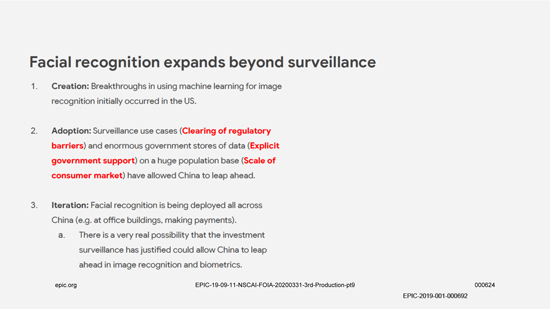
In its “overview of the Chinese technological landscape,” the NSCAI supports that while the US continues to lead in the “creation” stage of Artificial Intelligence and related technologies, it is being undermined by China in the “adoption” stage due to “structural factors.” According to the overview, “creation,” followed by “adoption” and “multiplication,” are the three phases of the “new technology lifecycle,” and failure to achieve dominance in the “adoption” stage will allow China to leapfrog the US and dominate Artificial Intelligence in the near future.
The overview also supports that in order to overcome competitors in emerging markets, what is needed is not “individual ingenuity” but, on the contrary, specific “structural factors that exist in certain markets,” citing several cases where China leaps ahead of the US due to the significant differences between them in these “structural factors.” Consequently, the US urgently needs to restructure these “structural factors” responsible for being undercut by China.
A key one among the “structural factors” causing problems, according to the review, is “legacy systems” (traditional or inherited systems; a repository of processes and regulations that have been shaped and strengthened historically), which are more extensive and powerful in the US than in China. According to the NSCAI, examples of such legacy systems include the financial system that still relies on cash and cards, individual vehicle ownership, and even receiving medical care from a human doctor. The argument is that while these legacy systems in the US are “good enough,” many “good enough” systems ultimately “hinder the adoption of new things,” especially AI-driven systems.
Another structural factor that NSCAI believes limits the ability of the US to maintain its technological advantage over China is the “scale consumer market,” supporting the equation “extreme urban density = adoption of on-demand services.” In other words, extreme urbanization forces consumers to extensively use online or mobile on-demand services, for example ride-sharing services or e-commerce. According to the overview, the electronic mass surveillance and control system of China’s “huge population base” is an example of how the advantage of the “scale consumer market” allows China to make leaps in related technologies, such as facial recognition.
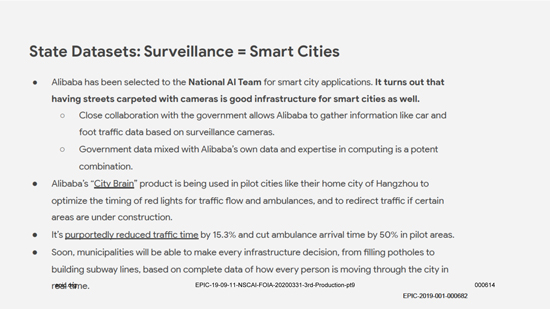
Beyond highlighting the shortcomings of American legacy systems and the absence of “extreme population density,” the NSCAI calls for “more and more specific government involvement in developments” as a way to accelerate the adoption of new technologies in the US. This involvement includes “borrowing” state databases with citizen data to research centers in order to “train” AI, specifically mentioning databases that can be used for facial recognition, and extends to urban redesign of cities centered around autonomous vehicles. Other areas of involvement mentioned are the investment of large capital in startups dealing with Artificial Intelligence and the engagement of tech giants in a national action team, with a public-private partnership and the application of smart-city technologies as its objective.
Specifically regarding the issue of state-company relations, the review notes that “the high level of cooperation between the private and public sectors” in China “is supported and demonstrated unreservedly” by all involved parties, which “stands in complete contrast to the disputes caused when Silicon Valley sells something to the government.” Such a “dispute,” for example, is the mobilization of Google employees aimed at canceling the military “Project Maven,” in which the Pentagon uses Google’s AI technology to analyze images taken by drones. Google ultimately chose not to renew the contract, due to the mobilizations, even though the company’s senior executives had considered the project a “golden opportunity” for closer collaboration with the military and intelligence services.
The overview identifies yet another area of direct and active government involvement: the removal of “regulatory obstacles.” This term is extensively used in the overview in relation to privacy laws in the US, despite the fact that in reality, American intelligence services, with the power and scope of action they possess, are not practically limited by any legal framework. Nevertheless, what the NSCAI essentially proposes is to change the relevant laws, the “regulatory obstacles,” so that what the services do covertly with personal data, they can do openly and more intensively, without restrictions. It is worth noting that another field where “regulatory constraints” should be lifted, according to the NSCAI, is that of autonomous vehicles, with the service insisting that the adoption of self-driving cars should be accelerated.
Another issue raised in the review is how China’s “adoption advantage” – how quickly and effectively new technologies are adopted – will allow it to “leap ahead of the US” in many emerging fields, such as “smart cities” and “AI medical diagnostics.” The NSCAI warns that “the future will be determined at the intersection of private enterprises and political leadership between China and the US,” and if “cooperation” is not achieved in regulating the global AI market, then “the US risks being left out of the negotiations that will define the rules governing AI for the rest of our lives.”
The overview also particularly emphasizes that “the main battleground [in technology] is not the domestic market in China and the US,” but the NBU markets (next billion users, practically the expansion of the global market caused by new technologies and new online commercial activities), where “Chinese players will aggressively challenge the position of Silicon Valley.” In order to address this challenge, the overview supports that “just as we examine the teenage market to identify new trends, we must also examine China.”
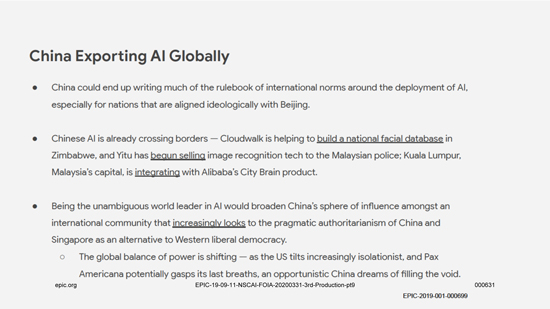
Another issue that concerns the NSCAI is the fact that China exports AI technologies more extensively and aggressively compared to the US. Examples it cites include that China “has already crossed borders” by supporting the construction of databases for facial identification in Zimbabwe and selling image recognition systems and “smart city” technologies to Malaysia. If allowed, according to the review, “to become the undisputed leader in AI, then China will end up writing the manual for international rules around AI development” and such a scenario “will extend China’s sphere of influence in a global community that increasingly turns to China’s and Singapore’s pragmatic authoritarianism as an alternative to Western liberal democracy.”
Given that the review makes it clear that America’s “legacy systems” undermine the U.S. ability to prevent China from making leaps in AI and thus dominate in the near future, it is important to see what the NSCAI proposes to replace these systems.
One of these “traditional” systems that is repeatedly mentioned in the review is the basic payment methods still used by most Americans, namely cash and credit/debit cards. The review supports that, in contrast to this legacy system, the better and more advanced way is the complete transition to digital wallets via smartphones.
As an example, India is mentioned, where the main digital wallet service provider, PayTM, is majority controlled by Chinese companies. Reference is made to an article, according to which “the big push came in 2016 when India invalidated 86% of banknotes in circulation, in an effort to tackle corruption and tax evasion, forcing citizens to transact without cash.” At that time, India’s attempt at a monetary restructuring towards a cashless economy had been viewed by most as a “conspiracy theory.” Nevertheless, the restructuring continued and a year ago a committee of the Indian central bank (headed by the chairman of an Indian company that has built India’s largest biometric database) concluded the formulation of the “Cashless India” program, which has been adopted by the government as official policy.
Examining India’s financial restructuring, the NSCAI concludes that “such a thing would have been unthinkable in the West. However, when 86% of banknotes were demonetized and since almost no one had a credit card, digital wallet online services in India skyrocketed, setting the framework for a much more advanced payment ecosystem in India compared to the US.” Nevertheless, what was “unthinkable” until recently has started to become increasingly realistic, due to the pandemic and its management. The restriction on the use of banknotes and coins has become a “health duty,” due to fears that the virus could be transmitted through money, while in the US the Federal Reserve has begun efforts to introduce the “digital dollar,” an online service equivalent to the digital wallet.
In the same context, the NSCAI supports that an end should be put to consumers’ on-site visits to stores and this practice to be replaced by purchases exclusively online. «American companies have a lot to gain by adopting the practices of Chinese companies», moving to sales exclusively through e-commerce. According to the overview, only online shopping provides an «unmatched experience» (sic), adding that «when online shopping is the only way to get what you want, then consumers will be forced to move to e-commerce».
Another “traditional” system that the NSCAI insists on overturning is individual car ownership, as what it advocates is autonomous vehicles and additionally supports that “fleet ownership of vehicles is better than individual ownership,” thus directly rejecting one of the fundamental elements of the Western way of life. The overview specifically focuses on the need for “a centrally designed network of shared mobility” which “is necessary to coordinate cars in order to achieve 100% utilization.” However, anticipating misinterpretations, the NSCAI warns that it would be wrong to promote sharing networks in which “the vehicle goes along with its human operator” (like Uber) and insists that “fleet ownership of vehicles” makes more sense than individual ownership. Additionally, it proposes that the cars in these fleets should not only be autonomous, but also electric, and refers to reports on China that “has the most aggressive goals in the world for electrification… and aims to dominate this emerging industry.”
The NSCAI supports that China is dominant today in the ride-sharing sector, although it was of American inspiration and first developed in the US. Apart from the legacy system of individual vehicle ownership, the absence of “intense population density” in the US allowed China to dominate this field. It also predicts that China “will achieve mass adoption of autonomous vehicles before the US” because “the limited individual car ownership in China allows consumers to be more receptive and adaptive to autonomous vehicles. Early mass adoption results in a vital cycle that allows Chinese autonomous vehicle technology to accelerate beyond the capabilities of Western competitors.”
Beyond the financial system and the autonomous vehicle system, the NSCAI also has similar advanced proposals for surveillance. The overview characterizes mass surveillance as “one of the first and best customers for AI technologies” and simultaneously an “excellent field for AI training,” while “paving the roads with cameras is a very good infrastructure.”
The overview notes that “a whole generation of innovative companies in the field of AI earned most of their revenue from government security contracts” and describes the use of AI in enhancing policing as excellent. Examples mentioned include that “police can now issue indictments based on phone calls monitored with voice recognition software” and that “police departments use AI technologies in facial recognition to support everything, from catching jaywalkers to solving murder cases.”
Specifically in the field of facial recognition technology, the NSCAI considers it a given that China has now surpassed the US, even though “the major breakthroughs in machine learning for facial recognition were initially achieved in the US.” It argues that China’s advantage in this case is due to the imposition of an official state system of mass surveillance and the enormous state databases that are seamlessly combined with corporate databases over a huge population base. Consequently, the NSCAI argues, China is able to outpace the US both in facial/image recognition technologies and in biometrics.
The next field that the review refers to is that of healthcare, proposing the implementation of a system that is becoming increasingly feasible today due to the pandemic. Examining the use of AI in healthcare services (almost a year before the health crisis erupted), it argues that “China has set the terms to lead in this sector” and that this “could allow it to massively export its technology and set international standards.” One reason this is happening is because “China has proportionally few doctors for its population,” therefore the shift to digital healthcare services is inevitable, while at the same time in the US the pursuit of having enough doctors to support the ability to visit a clinic is another legacy system that hinders innovation. A second reason is regulatory frameworks, such as “compliance with insurance and healthcare laws and approval from the drug agency,” which pose obstacles in the US, while something similar does not constrain Chinese authorities.
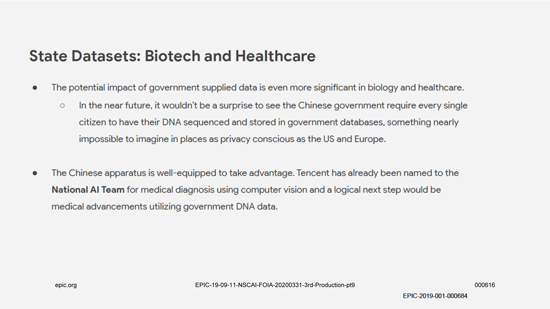
The concerning aspect, according to the NSCAI, is that “the potential contribution of the massive databases controlled by the state is even more decisive in the field of biology and healthcare provision,” and it considers it almost certain that “the Chinese government will impose the recording and storage of every citizen’s DNA in governmental databases, something that is almost inconceivable in regions highly sensitive to personal data such as the USA and Europe.” It concludes that “the Chinese establishment is already well-prepared to benefit” and despite all concerns, mass DNA databases are “the next logical step.”
Here is the alarming difference between China and its competitors, according to NSCAI: “In politics and the media in America and Europe, Artificial Intelligence is described as something frightening that violates privacy and steals jobs. In contrast, in China it is viewed both as a tool for solving macroeconomic challenges aimed at sustaining the Chinese economic miracle, and as an opportunity to seize technological hegemony at a planetary level.”
However, in an emergency situation, “fears” and constraints can easily be overcome, confirming the following (from a Forbes article, on 4/13): the extensive use of connected sensors makes it clear that the pandemic – whether intentional or not – is being used as a testing ground for new surveillance and control technologies that threaten privacy and individual freedoms. Thus, beyond being a global health crisis, the pandemic has effectively evolved into a large-scale experiment in monitoring and controlling people.
Harry Tuttle