
Social media is the place par excellence for “shocking” advertisements, let alone in the era of generalized quarantine where online consumers are ready to invest in any product that promises to reduce their anxiety of confinement and health fears. Small boxes that sterilize masks, keys and small items with ultraviolet radiation; Smart devices that spray surfaces with disinfectant before you touch them; Microscopic bluetooth greenhouses to grow organic broccoli in your kitchen while you’re locked up at home? Whatever “magic” you want, you’ll surely find it on Instagram or Facebook.
However, there is a device that seems to surpass every imagination and fulfill the dream of every behaviorist and hypochondriac: the Pavlok! The device’s advertisement shows a person wearing a bracelet like a Fitbit, with the caption “combat cravings!” A little further from the hand wearing the bracelet lies a tempting piece of cake. As the hand innocently reaches toward the culinary sin, the bracelet turns red and delivers an electric shock! You understand it’s an electric shock because the entire frame shakes as if pierced by electric current and small animated lightning bolts fly from the bracelet, like an old low-budget Batman movie. The only thing missing is a cloud that says “bam!”
This illustration could very well be a metaphor or exaggerated joke. It could refer to yet another wearable device among the many that record behavior and give “wellness instructions.” Or it could be an accessory for Fitbit that records eating habits and helps with weight loss.
But no! Pavlok is exactly what the ad describes: a wearable device, connected via bluetooth to an app, equipped with various sensors and electrical circuits, and shocks the user (or convict) with 450 volts when they do something “undesirable.” The device costs only $150 and is available through Amazon. The company that manufactures it claims that there are over 100,000 customers using Pavlok to quit procrastination, smoking, or to stop touching their face during the pandemic (with the occult there is no problem; continue freely until the relevant decision is issued).
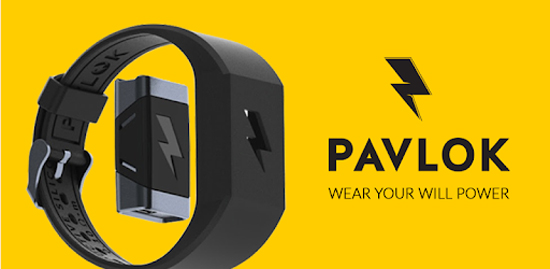
Pavlok was first launched in 2014 as a tool for people trying to quit “bad” habits such as smoking or nail biting. The device is based on a variation of the theory of conditioned reflexes – the one described by Pavlov, from whom it also took its name – called “aversive therapy”.
The idea is simple – connect a negative behavior with a negative stimulus, such as an electric shock, and the brain of the “patient” will begin to associate and identify them. After some time and several “negative stimuli,” even the thought of the “bad behavior” will trigger memories of painful shocks and the “patient” will abandon the habit under treatment. The designer of Pavlok says he got the idea when he was working at a company and paid a colleague to slap him every time he went on Facebook (he really is a person who needs many slaps…)
The “aversive therapy,” where it was applied, was a brutal misery and it suffices as proof just mentioning the tortures that people underwent to be “cured” of homosexuality or hysteria. Even the devotees abandoned it when it became obvious that the “negative stimuli” had effects only as long as there was a “therapist” with a whip over the head of the unfortunate “patient.” Outside the clinical environment, all “bad habits” returned without painful associations.
Pavlok works by overcoming exactly this “disadvantage” of therapy, putting a permanent, microscopic algorithmic “psychiatrist” in the user’s hand, who continuously applies the “therapy,” delivering electric shocks. In early versions, users had to manually activate the relevant function if they realized they were dangerously close to committing a “bad habit”—for instance, when they felt the urge to open the refrigerator and browse around. But today, thanks to advances in technology, Pavlok can autonomously detect when a transgression is imminent—for example, the company says it can detect from hand movements when you’re about to bite your nails—and acts on its own, without any user intervention. A small bracelet, worn on your hand!
Through a Chrome extension, it can also automatically punish behaviors, such as wasting time on Facebook, Twitter, or other time-wasting sites; it can even shock you if you open too many tabs or even if you fail to complete all the tasks on your to-do list. But where the techno-behavioral-psychologist-punisher-in-a-wearable-package fully unfolds its capabilities is amid today’s pandemic: every time you go to touch your face, it shocks you and collects your dry skin! The manufacturers are clear: 16 times an hour, we unconsciously touch our face—picking our nose, scratching our ear, brushing our teeth, rubbing our eye, touching our cheek—in short, our head touches our head. But this can’t continue; we spread the virus and we’ll all die! So, get an electric shock to learn to comply…
The Pavlok caught the “don’t touch!” vibe very early on, with a message it sent to users (whom it calls “shockers”) on March 4, 2020. “Even when you know something is bad for you, it’s easy to keep doing it automatically.” Not anymore, if you have a bracelet ready to hurt you into compliance—and it can do so up to 150 times a day with just one charge! There are certainly other devices that promise the same, such as Immutouch (immune-touch?), which has a similar function, but they don’t go as far as causing actual physical pain to enforce compliance. Amateurs… what can you say?
With the outbreak of the health panic, Pavlok entered good rhythms for covid-19. The company has thrown new advertisements on social media that play with fears and anxieties. “No one knows how long we’ll be stuck in quarantine… Most will end up sicker, fatter and in worse health, because they stopped following positive routines. If you had ordered the Pavlok a week earlier, by now you would have already managed to break bad habits” (150 shocks per day is what it takes).
Apart from fighting off sleepiness, the device also includes the ability, using its sensors, to detect when you are asleep. You can set the alarm to ring at a specific time and if you don’t get up promptly, the device first starts vibrating to wake you up. If that doesn’t work, then it starts with light electric shocks. If that doesn’t work either, then you know: pain!
Pavlok may seem like a techno-gadget, but it’s nothing more than the logical conclusion of the trend that wants technology capable of shaking and pushing the machine/brain into new ways of perception and thinking. You can lull your brain by sending it signals of joy with apps like Calm or Headspace, put it in order with Welltory or Muse, or train it with Luminosity or Elevate. If these apps are the little carrots of “wellness”, then Pavlok is the stick, whose purpose is to impose compliance on the brain, instead of “cajoling” it.
On the other hand, there are the issues of digital security of a device connected to the internet and designed to cause pain to the user. The bluetooth technology – on which Pavlok relies to communicate – is not particularly secure. A hacker could theoretically easily gain access to the device via its wireless connection; and could easily cause electric shocks to the user at will. Theoretically, such a hypothetical case would be nothing more than a nuisance – the user can always remove the bracelet. But in combination with location data, a digital intruder could activate the device during an activity that requires increased attention – for example driving – forcing the user to remove the bracelet that is shocking him with its maximum power while he tries to maintain his course.
In the early days of computer restructuring, wearing a “bracelet” was the symbol of extending the prison and an accessory of the convict who came out of the cell but constantly carried the guard with him. Later, bracelets became the fanciful proof of digital tyranny, technological symbols of faith in the “wellness” and good functioning of the body/machine. Pavlok is undoubtedly the epitome of both: an accessory for cheerful convicts who need punishment when they deviate from the dogma of “good health”…
Harry Tuttle