
… Historian David Channel sees the current phase of our culture as the merging of two distinct ideals of the Western world regarding the order of the organic world (“the great chain of being”) and mechanical rationalism (“the universe/clock”). He argues that today these two formerly distinct ideas are merging into one, into the idea of the living machine. Bruce Mazlish, of MIT’s history department, has a slightly different view, a hymn to human epic poetry against the historical illusions of our species. According to Mazlish, this epic poetry begins with the rejection of the belief that we are at the center of the world (thanks to the Copernican revolution), proceeds with the rejection of the belief that we fundamentally differ from animals (the theory of evolution), continues with the realization that we are not completely rational (thanks to Freud and the unconscious). Ultimately, the “fourth discontinuity,” as he calls it in a book with the same title, must be overcome. This “fourth discontinuity” is the technical distinction we created between the organic world and life on one hand and machines on the other…1
This excerpt is 20 years old: the “transcendence” of the distinction, the differentiation, between the living (including the human) and the mechanical; especially now in its digital/computational/biotechnological manifestations.
It should not be shocking. On the contrary, if there is something truly terrifying, it is that the tendency for this “transcendence” has been publicly presented and re-presented for decades with every fanfare; and has been ignored/rejected by the masses of the mainstream, including their “intellectual” and “political” echelons, as the offspring (scientific) fantasy. So that our documented attempt, for example, to explain what genetic technologies of cell modification/mutation are and what they aim to achieve becomes very difficult to understand; and not due to our own fault.
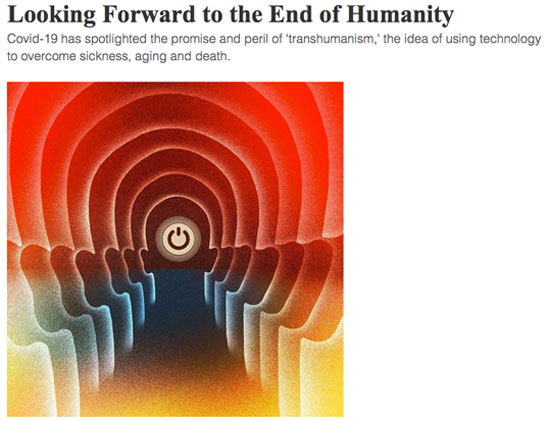
We may be laboring in vain, but we are not acting arbitrarily!!! The relationship between the sanitarian terror campaign and the legitimization of genetic engineering as “therapeutic” and “transhumanism” as a clear capitalist tendency and orientation, is organic. On June 20, 2020, in the establishment Wall Street Journal, under the byline of Adam Kirsch (recommended as a “poet” and book critic…), one could read under the title Looking Forward to the End of Humanity, among other things, this:
… Eternal life through advanced technology seems like a summer night’s dream for a society that, until recently, had trouble manufacturing enough masks to save the lives of doctors and nurses. However, Covid-19 could prove to be exactly the kind of crisis necessary to explosively accelerate efforts to achieve what proponents call the “transhuman” future. With our biological vulnerability clearer than ever, many people may be ready to adopt the message of the Transhumanist Declaration, an 8-point program first published in 1998: “We envision the possibility of expanding human capabilities by transcending aging, conscious problems, involuntary pain, and the limitations of planet Earth.”.
It is not merely artistic delirium! Nor is it, and never has been, “science fiction”! The inception of the intention (and design) for this “transcendence” is clearly and starkly presented in Wiener’s “Cybernetics and Society: The Human Use of Human Beings” – a book from 1950. And not only there, of course.
It is simply, purely, and starkly capitalism. This very tendency, the tendency of “binding” and alienating the human from the mechanical, was analyzed by Marx in the “Grundrisse – Critique of Political Economy,” in the famous “Fragment on Machines” – from 1858. In the middle of the 19th century, Marx possessed the intellectual/critical clarity not only to identify the capitalist dialectic of the relationship between humans and machines but also to analyze it in its generality; and everyone can understand what kind of machines he had before him: the iron complexes of gears and arms powered by steam engines… A hundred and fifty years later, at the end of the 20th century and the beginning of the 21st, with a galaxy of “new technologies” before them, whether those who characterize themselves as “Marxists” or all the rest are deeply at a loss; and whether they are “shocked” or repel the most advanced aspects of this reality.
If this is not intellectual decadence and degradation, then what is?
Animal Machines
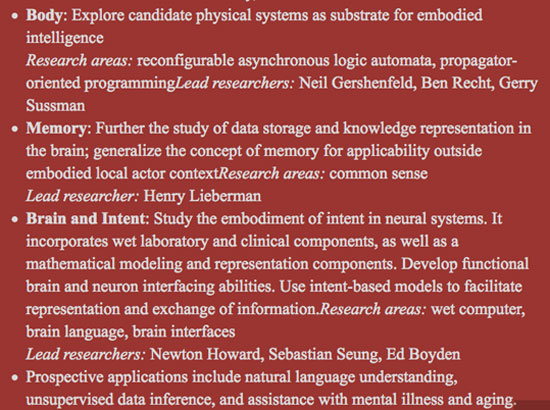
The MIT’s Mind Machine project dates back to 2009. According to the declarations on the project’s site, its purpose was/is
…The development of technologies for reading, recording (and virtual simulation) of millions of neurons simultaneously, so as to enhance interactive exploration of both individual brain circuits and overall brain function.
The Mind (thinking models), Memory (accumulation and utilization of experience), the Body (augmentable substrates that incorporate intelligence) and the Brain / Will (seeking upgraded applications of these technologies, such as “non-chemical” solutions for psychiatric therapies and brain prosthetics)…
The names of the techno-scientific branches that deal with all these things and even more sound futuristic to “ordinary” citizens: synthetic neurobiology, physics of consciousness, attention theory… and many others in the armed parade towards “artificial intelligence”. In the not too distant future lies (also) this: the path from constructing brain models to brain enhancement.
Enhancement! This is the buzzword that seems to have been chosen as the most appealing to captives. Enhancement of (human) intellectual capabilities… Enhancement of (human) physical capabilities… Enhancement of (human) sensory capabilities… Enhancement of reality… Anything that anyone can imagine as “enhancement,” as a plus, will be offered freely (so goes the propaganda) from the fusion of the human with the mechanical/digital, even at the cellular scale. With a preference for the neural, cerebral.
It is a new religion (technocratic, “scientific”… ) that is already constructing its faithful, the longing for “salvation” and “paradise.” There is such a one. Ray Kurzweil, one of the American gurus of “human plus,” describes it as technological singularity (technological singularity) that
…It will offer to every human being personalized abilities to fully control the universe…
You will become Gods!!!! This is promised by the technologists!!! And the spiritual degradation of a large part of the subordinates is so deep that they will believe the promise! They will “buy” it, they will admire it, they will worship it. In reality, they have already begun: they “believe” (only faith can achieve such intellectual contortions) that genetic engineering and mutations are … “safe” and “effective” for themselves.
Between public declarations and promises, and practical research and applications, there is no distance; the latter are advanced. But the declarations, more than technical papers and conference announcements, shape the ideological environment, the “aura of faith” and its halos.
Last November, a Canadian state think tank, Policy Horizons, published its paper on Biodigital Convergence. The director of Policy Horizons and author of Exploring Biodigital Convergence2 is Kristel Van der Elst, who should specialize in “futurism” since a few months earlier, in March 2020, she prophesied the future of covid-19… The interesting thing is that before transferring to Canada, she was head of the “strategic foresight” office of the World Economic Forum (which has generally taken over prophecies for capitalist restructuring), while she also passed through the USA and the EU with similar duties.
What does Ms. Van der Elst’s completely transparent and completely spherical statement say?
… In the years to come, biotechnologies will be integrated into our lives in the way that digital technologies have been integrated now. Biological and digital systems are converging, and they will change the way we work, live, and even the way we evolve as a species. More than a technological change, this bio-digital convergence will transform the way we perceive ourselves and will push us to redefine what we consider human or natural…
They are not “words.” They are existing trends. According to the Policy Horizons document (which can be considered state-sponsored), the convergence of “biological” and “digital” occurs in three ways.
- Through the complete physical integration of biological and digital entities:
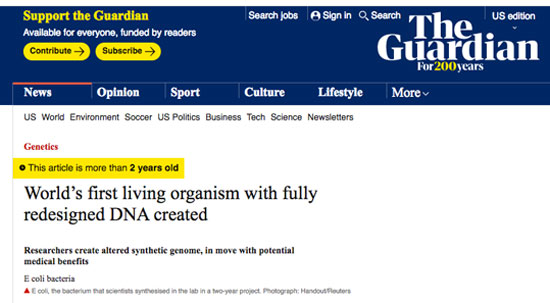
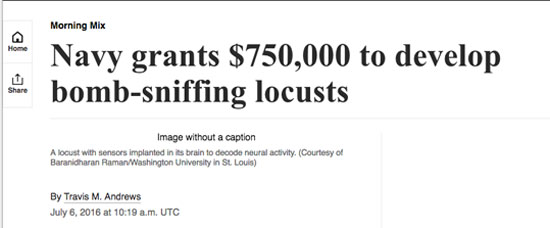
… Robots with biological brains and biological bodies with digital brains already exist, as well as the interaction between humans and computers and brains with machines. The medical use of digital devices in humans, as well as technologically manipulated insects such as “priest’s horses” drones3 and surveillance locusts, are examples of digital technology that has been combined with biological entities. Technology can be added to an organism through connection to its nervous system and manipulation of neurons, to change its functions and actions. New types of human bodies and new concepts of identity can emerge as convergence continues…
- Through the simultaneous and parallel development of biological and digital technologies:
… For example, bio-synthetic vanilla is created using a phenylpropanoid acid, eugenol and glucose as ingredients, and bacteria, fungi and yeasts as microbial producers. Although it does not originate from the vanilla plant according to the legislation of the US and the EU for food products, its production from “microbial transformations of natural raw materials” allows it to be labeled as “natural flavoring”…
- Through the conceptual convergence of biological and digital systems:
… As the understanding and control of the mechanisms that support biology improves, we can see a significant shift from vitalism, the idea that living and non-living organisms are fundamentally different because they are considered to be composed of different principles. Instead, the idea that biology has predictable and digitally controllable characteristics may become commonplace as a result of living in the bio-digital age. Every biology student today has grown up in a digital world and can consciously or unconsciously use this bioinformatics framework generally in biology…
The word “convergence” is deceptively charming. It implies two distinct states (life and digital and bio technologies) that touch upon each other. In practice, however, it is a process of mechanization, an even greater mechanization of the living. An extension of dead capital at the expense of life, to the extent that life as a whole (and not only human labor or animal “production”) can become an object / target of capitalist accumulation.
But mechanization does not resemble what has historically been considered as such, that is, the machines of the 1st and 2nd industrial revolutions. There are no pistons, cylinders, gears, lubrication, heavy thuds and smells of burnt oil. Those whose thinking is stuck on the equation machine = internal combustion, period, cannot understand anything. Only believe, admire or fear – all compatible with the metaphysics and mystification of techno-power and biopolitics in 21st century capitalism.
The ideal soldier / worker
For at least a century now, ever since chemistry, biology and psychiatry were definitively recognized as sciences with great developmental potential, all or almost all of their steps have been served “for the good of humanity”, as scientific efforts to cure this or that disease. This packaging is almost perfect and is still used: whoever doubts the motives and real purposes of one or another technology can only be characterized as “inhuman”, “perverted”, etc.
However, the field where major technological “cuts” are truly tested and applied is not health; but war. The same holds true now. Armies and wars are ideal for key components of the functioning of the capitalist machine conceived as a whole. Firstly, because armies tolerate no questioning, objections, or “grassroots organization.” Secondly, because military production, the production of destruction, increasingly embodies “capital intensification”; it corresponds (inversely) to ever-higher capitalist “productivity” (in this context: destructiveness); it must be precise, coordinated; it possesses (must possess) all the fundamental characteristics of the capitalist manual for any given historical period.
What, then, is the militaristic heart of this new religion that promises immortality and eternity (meaning exactly the opposite)? What does the mythical enhancement (through the unification of human and mechanical “equipment”) show when it wears boots?
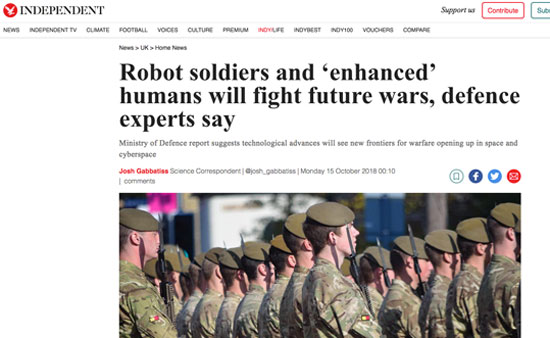
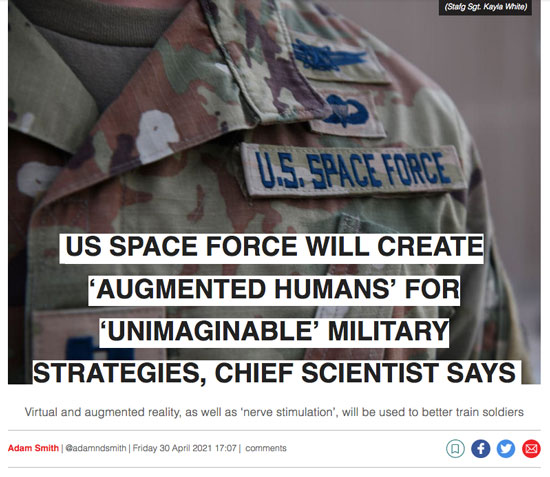
Under the title US Space Force will create “augmented humans” for “unimaginable” military strategies, chief scientist says, one could read in the Independent on April 30, 2021 (the emphasis is ours):
The chief scientist of the U.S. Space Force says that “human enhancement” is “imperative” in order to maintain military superiority.
“Over the past century, Western civilization has transformed from an industrial-based society to an information-based society, but today we stand at the threshold of a new era: the age of human enhancement,” said Dr. Joel Mozer during an event at the Air Force Research Laboratory.
“In our work in national defense, it is imperative that we embrace this new era, otherwise we will fall behind our strategic competitors.”
There will be “incredible” advantages in the coming decade in areas including artificial intelligence, which will allow the military to develop tactics that “humans cannot do.” Completely “autonomous” programs will advise unit commanders in real time, added Dr. Mozer.
Commanders and decision-makers will have multiple autonomous tools at their disposal, each capable of performing recognition, fire control, or attacks. Human enhancement, meanwhile, will ultimately be developed with technologies that will include augmented and virtual reality, as well as “neural simulation” to better simulate natural senses.
“You can place an individual in conditions of intense focus4, where learning can be enhanced and retention ability maximized,” said Dr. Mozer. “This individual can be shaped into someone with very high-performance dynamics.”
What is described (what the caravans dream of) is the most absolute “absorption” possible of anything human from the machine’s operation; so that, if possible, even the last breath of life depends on it. The militaristic ideal is mechanical death: precise, merciless, “clean.”
We must therefore insist as specifically as possible – in order to avoid any kind of myth-making. The machine and mechanization are introduced into production, as a birthday moment of capitalism, in order to substitute and subsume human labor. The utopian socialists of the 19th century observe and study this development; but its clearest analysis is found in Marx, in the Grundrisse, in the famous fragment on machines.
There Marx correctly and insightfully analyzes the relationship between living labor (the labor of every human being) and dead labor (which has been shaped into a machine within the workshop/factory). He describes (many decades before Taylorism, that is, the second industrial revolution) how living labor becomes a mere appendage, an “operator” of machines; so that production appears as an achievement of capital (that is, of its machines and the corresponding organization of labor) and not as a result of human labor:
… The accumulation of knowledge and skill, of the general productive powers of the human mind, confronts the worker in this way, absorbed into capital, and hence appears as a property of capital; more specifically, of fixed capital, insofar as it enters into the productive process as a means of production in itself. Thus, machinery appears as the most adequate form of fixed capital, and fixed capital—insofar as capital is examined in relation to itself—appears as the most adequate form of capital in general….
At this historical moment, let’s say at the beginning of the 1st industrial revolution, as well as in the subsequent developments (including the 2nd) and up until shortly before the last decades of the 20th century, capitalist machines in almost all their forms are distinct as forms, as “entities”, in relation to what was human: body, relationships, etc. While in the organization of labor (primarily industrial) the relationship between the living and the mechanical is “internal” (to capitalism), there is nevertheless a structural distance, “externality” of one to the other. The machine is external to the human, the human is external to the machine.
Marx observes this externality by comparing it to the period before, when the worker / craftsman had and used his tools:
… The worker no longer inserts the modified natural object [note: the partially processed wood, iron, etc.] as an intermediary term between the object and himself: on the contrary, he inserts the natural process – which he transforms into an industrial one – as a means between himself and inorganic nature, which he dominates…. In this transformation, as the great cornerstone of production and wealth, there does not appear the direct labor performed by the person himself, nor the time of this labor, but the appropriation of the general productive power of man, his own understanding of nature and the domination of it through the existence of man as a social body – in short, the development of the social individual…
It is the distance between the mechanical and the human where the prerequisite lies for the worker (living labor) to discover, as they lose personal control over their work due to “automatic machines,” within these “automatic machines” the general abilities and knowledge of society, which are appropriated on their behalf both by the individual capitalist and by all of them together as a class. In other words, the mechanical infrastructure of capitalism, both in the first and the second industrial revolution, insofar as it stands opposite to (and often in opposition to) living labor, constitutes an alienated expression of the complexity/sociality that labor/production as a whole has acquired.
This externality applied, with different characteristics, at the beginning of the 3rd industrial revolution (personal computers, networks…). But gradually the distance began to shrink, both spatially and temporally as well as conceptually. The most well-known manifestation of this (significant) “approach” is the so-called smartphones: while initially appearing as wireless telephones, they steadily evolved within less than a generation into remote controls (for much of) daily life; “inseparable accessories” of the body, the senses—and social relationships.
This proximity / direct contact between human and mechanical was thoroughly studied by the specialists of the bosses; they had neither predicted its intensity nor its potential at the outset of the 3rd industrial revolution. The word/concept interface, the “interface/connection of two different systems” (human and electromechanical), would have been excessively fictional under the conditions of the 1st or 2nd industrial revolution… Yet it was “physiologically” born during the 3rd, with two “mothers.” On the one hand from the reduction/minimization of the externality we wrote about earlier; and indeed from the users themselves, without external imposition. On the other hand due to the functions of the new machines, which seemed much more “mental” and harmless from a physical perspective compared to the steel gears of traditional machines.
The reduction/minimization of this externality/distance between human and machine during the 3rd industrial revolution would require a new politics and not a dry empiricist rehashing of the opposition between “variable capital” (life…) and “fixed capital” (machines). And indeed within a horizon that seemed to have less to do with production and more with circulation and reproduction of social relations. The narrow-minded (and often crude) “Marxists” fell asleep and simply didn’t care, having definitively checked out from History. There were no other notable ventures, especially from the ’90s onwards – only “marginal” ones.5 In the end, this approximation (and often “identification”) between human and machine acquired rather metaphysical dimensions. This is proven by the fact that whereas at the dawn of the 1st and 2nd industrial revolutions the paeans to the (capitalist) capabilities of machines came from philosophers (Ure) or engineers (Taylor) and artists (Marinetti/futurists6) of the bosses, the corresponding hymns to their capabilities during the 3rd (without these capabilities being characterized as capitalist!) came – from the ’90s onwards – not only from intellectuals of power but also “from below”! It wasn’t only feminist Donna Haraway who considered the absolute synthesis of human and machine in the “Cyborg Manifesto” as the path to liberation. There were countless others who considered cyberspace as a “new space of freedom”…
The reduction to disappearance of the sense of antagonism between the human/living and the mechanical/digital in its capitalist exploitation, was and is the “oil in the gears” of the orientations (of the bosses) of the 4th industrial revolution; and of the full spectrum attack they launched under the banner of covid 19. Because ultimately, the imposition of any (capitalist) Technological Paradigm is less a matter of pure technique and much more a matter of politics.
Consequently, when the Gospel now speaks of the “integration of biological and digital functions” (and in the human body, but not only in it), when it speaks of transhumanism or hyperhumanism, it draws the “logical” consequences (from the perspective of power) of a line spanning nearly 2 capitalist centuries; benefiting from whatever acceleration, social legitimization and acceptance of recent decades.
It is significant that exactly the same techniques of human engineering and “trans-humanism” are already being applied to other forms of life. It appears there has been a shift in interest among biotechnologists from higher mammals to insects, bacteria and viruses: genetic engineering platforms in viruses being pushed as “vaccines” have been tested for many years.
The cellular scale and the minimization of spatial (and temporal) distance/externality between the human and the mechanical as envisioned by specialists of the Bioinformatics Paradigm carries (beyond other things) a serious risk that could also be a goal (of the bosses): that human life falls to mere, “naked” physical process (cellular function for example) that will have been directly transformed into industrial. This will be the literal bio-mechanical form (of human) life!
Those who reach this point in the text may think we are talking about something futuristic or (even worse) science fiction… Wrong, tragically wrong: the “physicalization” of the invasion of the modern (genetic) capitalist machine at the cellular scale is already happening! With genetic modification platforms that are being pushed as vaccines.
In cyborg no 18 (summer 2020) under the title mRNA vaccines: nanoparticles in genetic missions, among other things we conveyed words from Isabelle Bekeredjian-Ding, head of the microbiology department at the German Paul-Ehrlich institute (it belongs to the federal institute for vaccines and biomedicine of Germany), from her interview in the official “research and innovation review in the EU” Horizon, on April 1, 2020:
…By making the human body itself produce the pathological proteins, mRNA vaccines bypass the industrial production process [note: referring to the proteins needed for traditional vaccines] and thus can be produced more easily and quickly than traditional ones. In this case, the main benefit is the ease of production and, also, it is likely easy to scale up production, which is certainly something very important if we consider developing a vaccine for all of Europe and the world…
We补充: To put it simply, mRNA technology forces the body to do part of the work that the pharmaceutical industry has been doing so far; and thus saves time and increases profits for the companies!
It is difficult for citizens to understand that their cells are being (bio)mechanized, that parts of “external” capitalist production are being internalized and incorporated with the full meaning of the words, that now “the machine is entering inside.” Why is it difficult for them to understand these things, even for those nominally called “Marxists”? Because they have naturalized this process…
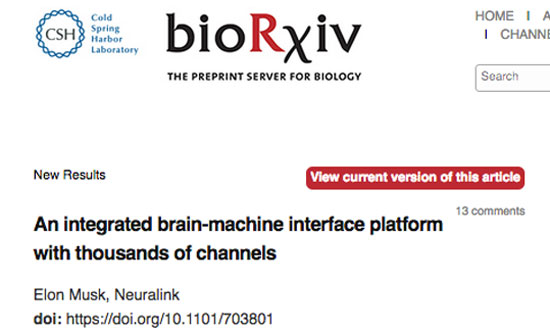
What Agaben has called “naked life” is not nudity, a surface phenomenon, how the body looks without clothes… It is a deep condition: the nerve / brain cells of each person, for example, will be used as “command keyboards” for direct action on digital machines. But also, the opposite will happen: digital machines will transfer commands directly to brain cells. Neuralink Corporation, a neurotechnology company (with the well-known Elon Musk as founder or frontman) is not just doing research on the subject; it can now demonstrate applications as well.

Monitoring the increase
Ms. Shoshana Zuboff, author of “The Age of Surveillance Capitalism,” in an article in the establishment New York Times on January 24, 2020, under the title “You Are Now Remotely Controlled” (Surveillance capitalists control the science and the scientists, the secrets and the truth), began thus:
The discussion on privacy and legislation at the Federal Trade Commission was unusually heated that day. Technology industry executives “argued that they were capable of regulating themselves, and that government involvement would be costly and counterproductive.” Representatives of civil liberties organizations warned that corporate data capabilities posed “an unprecedented threat to individual freedoms.” Someone observed, “We must decide what human beings will be in the electronic age. Will we simply become mere slaves to commerce?” A member of the commission asked, “Where should we draw the boundaries?” It was 1997.
The boundaries were never set, and the CEOs took their path. Twenty-three years later, we have the evidence. The fruit of this victory was a new economic logic that I call “surveillance capitalism.” Its success is based on campaigns conducted in such a way that we ignore them, within a fog of misdirection, euphemisms, and untruths. It took root and flourished in the new spaces of the internet, which surveillance capitalists celebrated as “the largest ungoverned space in the world.” But power fills the void, and these once lawless fields are no longer ungoverned. On the contrary, they are the property of private surveillance capital, companies that control and govern them with iron laws.
The rise of surveillance capitalism over the past two decades occurred without opposition. “Digital” was fast, we were told, and whoever put up obstacles would be left behind. It’s no surprise that so many of us rushed to follow the White Rabbit down the tunnel, hoping it would lead us to the digital Wonderland where, like Alice, we would become prey to illusions. In Wonderland, we celebrated, thinking that new digital services were free, but now we see that the surveillance capitalists behind these services considered us to be free merchandise. We thought we were searching through Google, but now we realize that Google was searching us. We believed we were using social media to connect, but we learned that connection is how social media uses us. Rarely did we wonder why our new TV or our new mattress had a “privacy policy,” but now we are beginning to understand that these “privacy” policies are essentially surveillance policies…
Organized and ubiquitous surveillance is an important part of the 4th industrial revolution, and perhaps that aspect which can be most easily understood by those still capable of comprehension. But the fact that it is not the surveillance – that – we knew, is directly connected to the fact that it does not concern the surveilled – that – we knew. It concerns far more.
The “enhancement” is an ideological Trojan horse. In reality, it is yet another wave of alienation, expropriation, and occupation by the “dead capital,” the mechanical infrastructure of evolving capitalism, at the expense not only of living labor but of life in all its breadth and depth. It is not a matter of “enhancement” but of diminishing the living; and reorganizing it in such a way as to “fit” and serve mechanical capabilities (as Marx had early on predicted). Practices that are, and will be, truly impressive; initially, they will take one’s breath away.
However, it is not about an “enhancement of the human,” except in the self-consumptive sense of an increased capacity for accumulating impressions. It is another wave of alienation of the living at the cellular scale: when, for example, the human immune system is undermined, devalued, erased, to be replaced as a dependent reflex面对 the microscopic genetic machinery, it is not a matter of “restoring health”; but of a deeper organization of pathology.
Now a series of new and unusual duties appear before us. First and foremost, to “buy time,” which means to delay the imposition of these “new realities” as much as possible. Secondly, we must make maximum use of whatever time we gain—to learn and understand the characteristics and methods by which the new Mechanical Paradigm, the Bioinformatic, transforms what is called life. At the same time, precisely because the externality between human and mechanical tends toward zero, we must be educated about this capitalist microclimate, the scale of the cell and the molecule—knowledge / consciousness here does not necessarily have to come through experience, but will certainly be the product of intellectual processing.
Finally, we must learn to confront the new contradictions that (this is inevitable!) capitalist development causes. Even if they present themselves as “illnesses”…
Ziggy Stardust
- Small excerpt from Chris Hables Gray’s “Cyborg Citizen,” 2001. Published in cyborg no. 1 in the winter of 2014, in a text titled The possibilities of post-humanism. ↩︎
- Available at https://archive.is/d3dOt ↩︎
- Related video at https://www.youtube.com/watch?v=Hrwn5sbNrp0 ↩︎
- The English term is “state of flow”. It refers to the state of heightened concentration on something, reduction of sensations and consciousness that are not related to this “something”, suspension of the sense of time, etc. ↩︎
- In the ’80s, within the bosom of the proto-cosmic ecological/alternative movement, notable criticisms developed mainly against biotechnologies. ↩︎
- Although initially an artistic movement, the Italian Futurists so fervently hymned an upcoming future made of steel and fire, that by the 1920s they had logically become supporters of fascism. In their Manifesto (1909), authored by Filippo Tommaso Marinetti, one could read among other things:
…We want to glorify war – the world’s only health – militarism, patriotism, the destructive gesture of libertarians, beautiful ideas for which we die, and contempt for women.
We want to destroy museums, libraries, academies of every kind, and to fight against morality, feminism, and against every cowardly opportunism, whether political or financial.
We shall sing of the masses stirred up by work, by pleasure or by riot, we shall sing of the multicolored and polyphonic flood of revolutions breaking out in the modern capitals, we shall sing of the vibrant nightly fever in the shipyards and foundries flaring under the violent electric moon; of factories hanging from the clouds by the twisted threads of their smoke; of bridges like giant gymnasts flinging their arches about, flashing in the sun with a gleam of knives; of the adventurous steamships sniffing at the horizon; of trains with broad breasts puffing along the tracks like enormous iron horses with bridles of piping; and of the swooping flight of airplanes whose螺旋 propellers cheer in the air like a banner and seem to applaud like an enthusiastic crowd… ↩︎