
One cannot say that we remained idle, that we were indifferent, that we looked at our navels (as is fashionable). In 2019, marginalized groups could read among other things1:
…One would not be wrong in arguing that the discovery and recognition of the extent and intensity of the “psychologized problems” of the Capitalist Self goes hand in hand with the overdevelopment of the corresponding professional sectors, as well as the “solutions” offered by the pharmaceutical industry. Professionals shape, without any cost, not only the “solutions” but, above all, the social beliefs regarding what the “problem” actually is. From this perspective, the “mentally disturbed” Capitalist Self remains 100% Capitalist Self! A Capitalist Self that has suffered some damage (which makes it “dysfunctional” and reduces its “performance”) that needs to be repaired—with the help of psycho-mechanics… The Machine Self, the Fixed Self, requires “maintenance,” both physical and “mental.” Service!
However, another approach is simultaneously evolving. One that doesn’t bluff. It understands Self-Capital as what it is, and evangelizes its “evolution” as what it is. It evangelizes the “improvement of its performance” through its further mechanization. Through the incorporation by Self-Capitals of the cutting edge of biotechnology.
The ideology / prescription of human plus (under whatever names it circulates in the market) is a fact that it does not deal with the “psychological problems” of the Capitalist Self. It does not appear to “offer solutions / therapies” for panic attacks or phobias; certainly not in the direct way that traditional “professionals of the soul” have undertaken this work. Except in the case where artificial intelligence and smart algorithms are proposed as capable of replacing these professionals (!!!) the mechanical “enhancement of the human” (that is, the systematic and organized mechanization of the Capitalist Self) argues in favor of its necessity in two fields…
The announcement is very recent (September 21, 2021) and celebratory. So much so that we are entitled to say “we have correctly understood reality and capitalist tendencies.” (Correctly but also in vain so far…) We copy translating from the WSJ:2
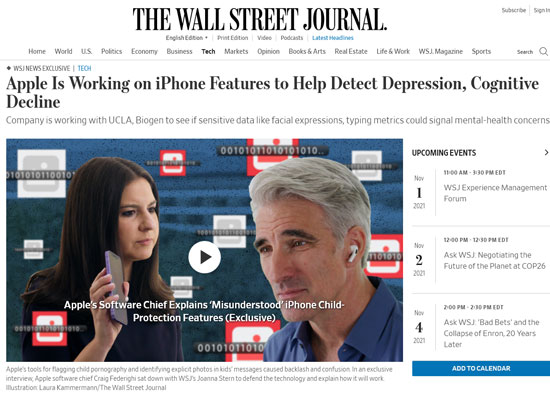
Apple is working on technology that would allow the diagnosis of depression and cognitive decline, seeking to create tools that will expand the range of its growing health portfolio, according to people close to these research efforts and documents in the possession of the Wall Street Journal.
Using a range of sensor data, including mobility, physical activities, what happens during sleep, behavioral patterns, and even more, researchers hope to find a way to process our digital signals related to our mental health so that the algorithms created can check the reality to which this data corresponds.
These efforts are based on research collaborations announced by Apple with the University of California in Los Angeles, which studies stress, anxiety and depression, and the pharmaceutical company Biogen Inc. which deals with mild cognitive impairments. The codename that Apple has given to the UCLA research is “Seabreeze” and to the Biogen research “Pi”.
Biogen started its studies last Monday… The pharmaceutical company received FDA approval last summer for a new drug to treat mild cognitive impairments in patients with early-stage Alzheimer’s disease. The drug, named Aduhelm, costs approximately $56,000 per year per patient.
A large part of Apple’s health research so far has focused on applications for the company’s smartwatch. Mental health and cognitive issues require more sensitive recordings from the iPhone, and show that Apple’s health unit is now researching suitable applications… University studies have some data that people with specific mental – cognitive problems use their digital devices in different ways from the rest, therefore it remains to be seen whether reliable algorithms can be constructed to detect the condition of these users.
… The hope for diagnostic tools in cases of people with serious neurological disorders or mood transitions is that this way timely intervention will be possible and potentially worse developments can be prevented,” said Faraz Hussain, head of BiAffect, a university research program at the University of Illinois in Chicago, which uses data from smartphones to predict mood. “The ability to look inside and see how the mind works instead of relying on what each person says is often objective, and this can be achieved by utilizing the digital ‘footprints’ of our daily lives that would otherwise go to waste.”
Although this research is still in its early stages, top executives at Apple are excited about the possibilities of success. Jeff Williams, the head of research who oversees Apple’s health division, spoke enthusiastically to employees about the company’s potential to detect high rates of depression and anxiety, as well as other brain injuries…
… Dozens of companies are chasing the opportunities offered by the broader digital behavioral-health sector, with related startups moving this year at a pace that doubles the record of their funding in 2020, which was $2.7 billion—according to data from Rock Health, a venture capital advisory firm.
The pandemic has caused an increase in mental health problems. The percentage of adults who reported symptoms of anxiety or depression last January reached 41% of the population according to the Kaiser Family Foundation, almost quadrupling the corresponding percentage from the beginning of 2019. Mild cognitive impairments, which can lead to dementia, affect approximately 5 million Americans over the age of 60, estimates the Alzheimer’s Association.
Apple has already developed health apps in collaboration with researchers. For example, a study by Stanford University showed that the company’s smartwatch can detect irregular heart rhythm called atrial fibrillation. Immediately afterwards, Apple added an app to its wearable to do this job.
UCLA says that its research studying anxiety, stress and depression signals began a pilot phase last fall, collecting data from the Apple Watch and iPhone of 150 people, and will continue its main phase by utilizing similar data from 3,000 people. UCLA researchers will gather data from the iPhone’s camera, keyboard and audio sensors, as well as watch data related to movement, physiological signals and sleep. The data may also include analysis of facial expressions of those participating in the experiment, the way they speak, the pace and frequency of their foot movements, sleep data, heart rate and breathing rate. They will also measure typing speed, frequency and content of what they write, and other signals. Each piece of data can provide researchers with information regarding users’ emotions, their level of concentration, their activity level, their mental state and even more…
First of all, the question or surprise “what does Apple have to do with mental health” is forbidden! Since Microsoft was accepted as a key “player” in (the industry of) health in general (one of the benefits of the sanitarian terror campaign…), every such question is outdated! We spoke from the beginning about the (hostile) bio-informatics-security complex, but… run around and see…
It is not forbidden, on the contrary, to have a brief acquaintance with Apple’s partner, the pharmaceutical company Biogen. It became world-famous last summer when the FDA approved its drug, the “first drug against Alzheimer’s,” but not for good reasons. Biogen pushes the monoclonal antibody aducanumab, and the FDA approved it “despite relative uncertainty” about its effectiveness, and even though there is a documented serious risk of brain hemorrhage. 56% of the test animals in the trials showed such side effects, along with immediate deterioration in their mental condition. Biogen’s extremely expensive gem should not be called a “drug” but “poison,” and this is how both doctors (many declare they do not prescribe it) and insurance companies (many say they will not cover it) treat it.
And then? How did this benevolent organization called the FDA, which has saved the world by approving genetic engineering platforms, give the green light to this lethal tool? The answer is simple: there are serious allegations that Biogen bribed members of the FDA committee in “secret meetings” with them; and the green light was given even though 10 out of the 11 members of the advisory committee of independent experts, whom the FDA is required to consult, voted against it, considering there is no evidence to allow such approval. Of course, the FDA committee denies it was caught, claiming their motives were philanthropic, and that it’s better to have some drug than none at all… At the end of the day, there’s also the 35% who didn’t get harmed… “The benefit is greater than the cost,” that’s a catchy motto… (It’s the same killers with the “vaccines,” right? The cost is all ours, the benefit goes into their coffers…).
This, then, is Biogen.
Tailorism 3.0
Those who will not applaud this “important step of science” as they have already learned to do with every capitalist crime, will notice that the analytical presentation of the above reportage accurately shows the method of “digital diagnosis of psychological disorders”. This is tailoring, the basic methodology/technique that became the heart of the 2nd industrial revolution (starting from machine shops and other specialized manual jobs), adapted of course to digital capabilities. That is, to datafication.
Taylorism 1.0 was the scholarly observation / analysis / timing of every separate movement, even the most insignificant, made by artisans or even simple workers doing a job. In this way, Taylor would start by having a “map” of the sequence of these successive movements (of the kind: raise his arm half a meter – move his arm to the right – lower his arm twenty points – etc.) and their duration. Then Taylor would discard the movements he considered “useless” (or suspicious of loafing…), keep the rest, and try to imagine them either as machine movements or as movements that can be done much faster (if the worker is pressured in one way or another, usually with some incentives). If the first (mechanization) was not feasible, the second (human movements adapted to the mechanical rhythm) became necessary.
Taylorism 2.0 concerns the internet, “search engines”, antisocial media, robots, so we will skip it to stay on topic. Taylorism 3.0, which is based on data, their processing by algorithms and the extraction of “representations” of the data sources, is much more ambitious. And therefore often (or even necessarily) more abstract. Because, for example, “mental disorder” cannot be analyzed before it is mechanized minute by minute as “behavior” and, secondly, its digital/mechanical equivalents are found (as Taylor did in his time for manual labor) the process is reversed: first all the “digital signals” (the data) that can be stolen from life through various devices and sensors (wearables, mobile phones…) are collected, assembled linearly, in series (a “digital assembly chain”), and thus the “representation” of life is created as a graph/curve. Subsequently, these “curves” are compared with each other to identify, always statistically, what is “normal” and what is “exception”. The “regularities” and “exceptions” in the statistical comparison of “behavioral curves” constitute the diagnosis.
From some perspectives, this methodology does not differ from that of “laboratory medicine” and “diagnostic tests.” There too, the basis of diagnosis is statistical, plus the interests of pharmaceutical companies and how they arbitrarily change the “measurement limits” and the distinction between “health” and “disease” in order to increase the number of “patients” and customers for their products.
However, there are also substantial differences – we are in the 4th industrial revolution! Control, the “signals”, the data arise not from bio-chemical but from electronic contracts. How, for example, is the heartbeat detected by a wearable? We assume some piezoelectric sensor that supposedly records the pressure of blood flow in the wrist. But how is “emotional disposition” recorded? From the recording of routine usage patterns of digital devices and comparison (in terms of time, space, duration, “content”, etc.) between daily electronic representations (created by algorithms at the “control center…”), the “behavioral curves” of each individual… And what information does typing provide? The difference between “order” and “disorder” (experts say) in daily, continuous device usage: many accumulated errors may indicate emotional disturbance or intellectual problems… By examining the content (of the keystrokes) we can conclude (experts say) which of the two or what combination applies…
Now add another set of data, say motion data as extracted via the built-in digital compass in wearables and mobile phones, and you’ll have a better “picture of the condition” of the monitored individual… And so on and so forth.
It is obvious that tailoring 3.0 is quite “compact” as well as wild, universally predatory. It continues the basic logic of tailoring 1.0 (cutting, timing, graphic representation, assembly on a new basis) but at a higher technical and political level. Such techniques as those dreamed of by Apple engineers will certainly anger traditional professionals of the “soul.” Because now, under the hegemony of the algorithmic Paradigm, the “soul” is not something dark and mysterious that psycho-locksmiths must investigate… It is rather an open behavioral phenomenon which, if monitored 24 hours a day and seven days a week and “recorded” as a set of digital signals (data), falls under the jurisdiction of statistics and programming. In the medium term, there will probably be a professional crisis for psycho-specialists, since they will be seriously threatened by companies such as Google, Apple, etc. That’s how capitalism is, though. “It brings some down and lifts others to the heavens,” as a saying from old Greek cinema goes…
What remains is the best part: what use will these inventions have? Many! First and foremost for the users of everyday telecontrol devices themselves. They will be able to monitor daily the impact of this digital control over their mental and intellectual state. In other words, they will add yet another obsession, another dependency to those they already have. If this technologically-driven “obsession” becomes counterproductive in the future, there may perhaps be applications for “moderation” of sorts, such as “self-monitoring limits.” In any case, the hypochondriac and the obsessive appear to be people from the near capitalist future.
The other interested parties are certainly those who sell “health insurance”, whether they are public funds or private companies. Well-being – not only of the soul and spirit, but of every aspect of human materiality – lies directly within their interests/profit motives: a “healthy” (according to standards) organism is one from which there are only revenues and no expenses… Who, then, would think to prohibit such philanthropists from having continuous knowledge of the type of clients they serve? Are they responsible? Or perhaps, are they lost bodies, mere fodder for the accounting office? Should they be put under house arrest or given a chance to correct themselves?
However, the best interested parties are employers—and public order! Perhaps amid the violence of recent days it hasn’t crossed your mind, but if it has become standard practice that in order to work you must, at the very least, have been tested (by an unreliable and false means for the unlikely event of a generally insignificant virus), how much more so (how much more we emphasize!!..) should your “mental and intellectual health” be under control! And not only at work. Everywhere. At school, at university, at the stadium, at the club, while traveling, at the mall… why not also on the street? Does anyone want “crazy,” “disturbed” people roaming here and there, with unknown intentions? (Ah, come on!!! We were missing this!!!)
This is how things stand therefore for the pioneering apple and every war-ready businessman or institution: the market is ready, the “need” exists (and can become even more existent with the proper propaganda), consequently: forward master!!!
(If you have objections, tell us, but carefully. First of all, keep your voice down… Many people are circulating who claim that all this is fine, since after all it is “scientific”… Many others are also circulating who sleep the sleep of the blissful victim…)
Ziggy Stardust
(thanks to S. and N. for suggesting the topic to us)
- Notebook for worker use no 4. ↩︎
- Available here. ↩︎