
He owes the Mafia the cost of a car. That’s a good reason for him to get serious.
It cuts straight across the Road, under the monorail line, heading toward a large, slow-moving black building. It’s exceptionally dark for the Road, like a package someone forgot to unwrap. It’s a low black pyramid with the top cut off. It has one and only door – since all this is fantasy, there are no regulations for the number of emergency exits. There are no guards, no signs, nothing to stop people from going in, yet thousands of avatars loiter around, peeking inside, looking for a quick glimpse of whatever is there. They can’t pass through the door because they don’t have an invitation.
Above the door there is a black matte hemisphere with a diameter of approximately one meter, mounted on the front wall of the building. It is the closest thing to decoration that this building has. Below it, carved into the black material of the wall, is the name of the place: Black Sun.
It is not exactly an architectural masterpiece. When Da5id, Hiro, and other hackers wrote Black Sun, they didn’t have enough money to hire architects and designers, so they limited themselves to simple geometric shapes. The avatars milling around the entrance don’t seem to mind this.If these avatars were real people on a real street, Hiro would not be able to reach the entrance. There is a large crowd. But the computer system that manages the Street has better things to do than to check each of the millions of people there and try to prevent them from stepping on each other. It doesn’t bother trying to solve this very difficult problem. On the Street, avatars simply move on through one another.
Έτσι όταν ο Hiro κόβει μέσα από το πλήθος για να φτάσει στην είσοδο, πραγματικά κόβει μέσα από το πλήθος. Όταν τα πράγματα μπερδεύονται έτσι, ο υπολογιστής τα απλοποιεί απεικονίζοντας όλα τα άβαταρ ημιδιαφανή σαν φαντάσματα, ώστε να βλέπεις που πηγαίνεις. Ο Hiro εμφανίζεται συμπαγής στον εαυτό του, αλλά όλοι οι υπόλοιποι είναι σαν φαντάσματα. Προχωράει μέσα από το πλήθος σαν να ήταν fogbank1, βλέποντας καθαρά τον Μαύρο Ήλιο μπροστά του.
He crosses the building’s threshold and stands at the door. At that moment, he becomes solid and visible to all the avatars roaming outside. Like a voice, they all begin to howl. Not that they have any idea who he is – Hiro is just a hungry freelance reporter for the CIC2 who lives in a U-Stor-It next to the airport. Yet throughout the entire world, there are only a few thousand people who can cross the line into the Black Sun.
He turns around and sees ten thousand crazy groupies behind him. Now that he’s alone at the entrance and not submerged in the flood of avatars, he can see everyone in the front row with perfect clarity. They’re all made with the craziest and most fantastical avatars, hoping that Da5id—the owner of Black Sun and lead hacker—will invite them in. They’re trembling and merging into a wall of hysteria. Unbelievably beautiful women, electronically retouched at seventy-two frames per second, like Playboy posters that became three-dimensional—these are aspiring actresses waiting to be discovered. Wild abstract whirls of rotating light—hackers hoping Da5id will notice their talent, invite them in, give them work. Scattered traces of black and white people—individuals entering the Metaverse from cheap public terminals and displayed with spastic pixelated black and white. Many of them are psychopathic fans, devoted to their fantasy of stabbing some actress to death; in Reality they can’t even get close, so they log into the Metaverse to seek their prey. There are ambitious rock stars, made with laser lights, as if they just came down from the stage, and Japanese businessman avatars exquisitely retouched by their expensive equipment, but completely restrained and boring in their costumes.
There’s one black and white who stands out because he’s taller than the others. The Road protocol doesn’t allow your avatar to be taller than you. This is to prevent anyone from wandering around as a mile-high giant. Besides, if this guy is using a pay terminal—which he is, judging from the image quality—he can’t modify his avatar. It simply presents him as he is, though not so well. Chatting with a black and white on the Road is like talking to someone who’s jammed their finger on a printer’s glass and, by continuously pressing the copy button, is watching the papers come out one by one from the output tray.She has long hair, parted down the middle like a curtain that reveals a tattoo she has on her forehead. With this lousy resolution, there’s no way to see the tattoo clearly, but it appears to consist of words. She also has a thin Fu Manchu mustache.
Hiro realizes that the guy has noticed him and is watching him, looking him up and down, paying particular attention to his scars.
A broad smile spreads across the face of the black and white figure. It is a smile of satisfaction. A smile of recognition. The smile of a guy who knows something that Hiro doesn’t. The black and white guy was sitting with his hands folded across his chest, like someone bored, waiting for something, and now his hands fall to the side, making a loose swing from his shoulders, like an athlete doing warm-up exercises. He walks as close as he can and leans forward; he is so tall that the only visible thing behind him is the empty black sky, fragmented by the bright trails of steam from passing three-dimensional advertisements.
“Hey, Hiro,” says the black-and-white guy, “want to try some Snow Crash?”
The above is one of the first scenes in Snow Crash, the science fiction novel written by Neal Stephenson in 1992, where the term “Metaverse” appears for the first time. The story takes place in a typical dystopian future world where large multinational corporations have monopolies on infrastructure and services, urban areas range from slums to fenced-off “good” neighborhoods, and an interconnected virtual reality is an organic part of daily life. The central element of the story, Snow Crash, is a computer virus that also attacks the user’s brain through audio stimuli.
The Metaverse of Snow Crash is a digital urban environment designed on a road 100 meters wide, called the Street, which runs across a black planet with a circumference of 65,536 kilometers, on which a monorail also moves with 256 stops, one every 256 kilometers. Connections to the Metaverse are made from terminals, the technical specifications of which determine the image quality of each user’s avatar, and access to various virtual spaces is not guaranteed; entry to the Black Sun, for example, requires an invitation or some kind of “pass.”
The fusion of the digital with the real permeates the book, not only through the various descriptions of interaction with the digital universe, but also through the language itself that the author uses. What does it mean for a building to be “slow-moving,” “like a package that someone forgot to unfold”? The static nature of a digital representation of a building may not be as fixed as it is in reality, since the flow and analysis of pixels can impart a sense of “slow” mobility to the walls. And the “package that someone forgot to unfold” carries the dual meaning of an object resembling a parcel that hasn’t been opened, and a software package that hasn’t been developed as much as it could have been.
Almost thirty years later, the term Metaverse is becoming widely known, with Facebook’s decision to declare that it will change its name to “Meta”, in order to proceed with the development of applications and services that will be – or will gradually become – part of the “next Internet”, the Metaverse. Even if you haven’t heard this term yet, it is very likely that you will come across it in the near future. And this is because the Metaverse is one of the “next big things” of the 4th industrial revolution. The upcoming revolutionary change in digital communications and the way we interact with (and through) new technologies. Or so it is said.
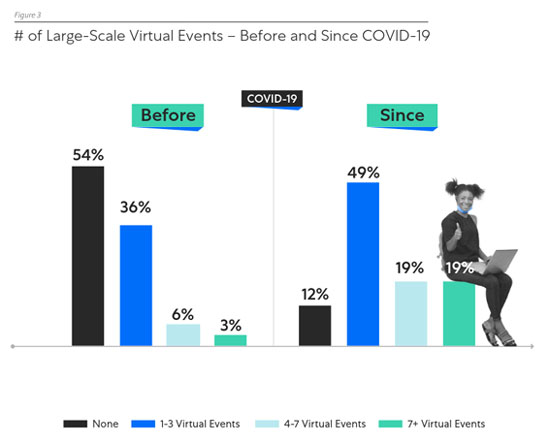
We have no reason to dispute it. The mass (though not universal, in the sense of exclusivity) acceptance of social networks and “smart” devices and applications as intermediaries of relationships (both with others and with ourselves/bodies), over the last two decades, clearly shows this trend of assimilation. And as several studies show, as well as everyday experience over the last two years, the numbers and rates regarding the integration/use of digital goods/services skyrocketed due to the fear campaign triggered by covid-19.
However, the Metaverse is not (intended to be) merely about participating in digital conversations or conferences via video calls, or using “smart” home devices to automatically order vegetables, for example, when the refrigerator’s sensor detects their absence. In essence, it is an “umbrella” term that aims to group/homogenize all the changes emerging across various technological sectors and present them as a unified package, in an ideologically cohesive “compact” form of the new paradigm. And we say “ideologically cohesive” because, just like the Internet or the Cloud as concepts conceal the material reality upon which they are built, presenting themselves as “ethereal” and intangible technologies that exist “somewhere” and “somehow” happen, so too does the concept of the Metaverse aim – or at least within the hype of current discourse “overlook” – to give an exotic form to the upgrading of existing technologies, the introduction of new ones, and the construction of an ecosystem among them.
Nevertheless, although in the course of events it appears that this is indeed what is happening – the upgrading of existing technologies, the introduction of new ones, and the construction of an ecosystem among them – the changes it will bring to behaviors and relationships will not be the corresponding ones of the previous paradigm “plus something more,” but radical restructurings of the social. And this change/restructuring requires a new name, and not something like “Internet 3.0.” In reality, this term (Internet 3.0 or Web 3.0) is used for the new Internet that is increasingly being built on “distributed” infrastructures such as blockchain. Although part of it, it is far from constituting the definition of the changes that (will) occur in the overall sphere of digital technologies. And thus came about Metaverse, that is, meta + universe: Meta-universe.
Just as the Metaverse is not the Internet 3.0, it will not be “a virtual world” of the Second Life type or a “virtual reality” of the three-dimensional city representation type. Nor a video game or a virtual Disneyland or a virtual store for digital products or even a facebook-type platform where users “upload” content. We can imagine these individually as pieces of it, but in no case do they correspond to the totality of its characteristics.
With a general description, the Metaverse (will) have the following characteristics:3
- It is continuous, that is, it does not “restart”, it does not “stop”, it does not “end”; it simply continues indefinitely.
- It is parallel and “live”, meaning a “live experience” that exists constantly for everyone in real time.
- It has no upper limit on simultaneously connected users and provides each one with an individual sense of “presence”, meaning everyone can be part of the Metaverse and participate in a specific event/activity together, at the same time.
- It is a fully functional economy, as individuals and businesses will be able to create, own, invest, sell, and be rewarded for an incredibly wide range of value-producing activities that are recognized by others.
- It is an experience that extends across both the digital and physical world, private and public networks, open and closed platforms.
- It offers unprecedented interoperability of data, digital assets, content, etc. That is, digital products and services purchased/acquired on one platform will be able to be transferred/used on another, within the Metaverse.
- It is developed with content and services/experiences that are created and managed by a wide range of participants, some of whom are independent individuals, while others may be informal organized groups or for-profit businesses.
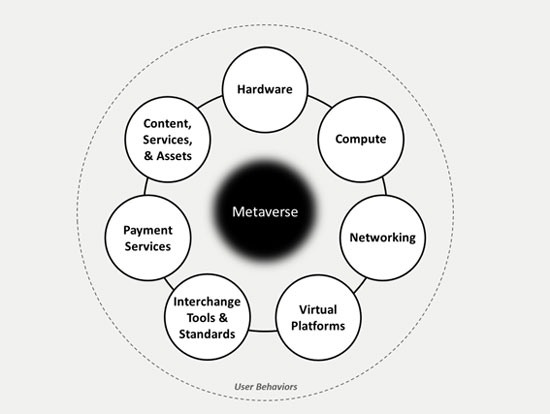
It is clear from the above descriptions that we are not talking about a technology, but about a set of relationships, behaviors and interactions with and through technology. With “continuous connectivity” with it, as the main component of its operation: that is, there will no longer be the concept of “connecting to the Internet” or “now I’m closing it”, but rather the “ubiquitous presence” of it in every activity. This function can be divided into basic categories that (will) constitute parts of it, so that we can better understand what we are talking about, something which we will do briefly below.
Hardware
By hardware we refer to the devices through which users access, interact with or develop the Metaverse, which range from “smart” mobiles, wearables and other “smart” devices, to virtual reality glasses and sensory simulation suits.
In all these devices, a common general goal is to reduce volume and weight, optimize batteries, create more practical designs, and achieve greater accuracy in whatever they “read,” photograph, measure, map, etc. For example, Apple’s new mobile models feature cameras that can detect 30,000 points on a face, making it possible to transform it in real time into video calls or other applications. The next step could be transferring the user’s face to their avatar in some virtual environment. Also, with another application called Object Capture, users can create three-dimensional representations of objects in the physical space simply by photographing them.
Ultra wideband circuits now present in mobiles and wearables can calculate distances from nearby corresponding devices, thus creating a map of the user’s surroundings. In this way, interaction with a “smart” door, for example, or with a digital representation of a house or a street becomes feasible using data collected in the physical space through this chip—possibly in combination with any cameras present in that space.
The representation of the digital, whether it is virtual or a projection of the real, is also an object for improvement through new and better devices. For example, Google’s Project Starline works on a construction equipped with dozens of sensors and cameras, a fabric multi-dimensional screen and Dolby surround speakers, which claims to present the speaker as if they were actually there. Also, virtual reality glasses (masks) are improving over time, with Oculus (a company that has been acquired by Meta – former Facebook) taking the lead in the market. Similarly, Microsoft’s HoloLens have the advantage in augmented reality glasses (masks), that is, the projection of virtual objects in the real space.
For the larger and more professional scale, there are photogrammetric cameras, such as some models of Leica, which have up to 360,000 “laser scanning points per second”, which have been designed to record entire commercial centers, buildings and houses with “greater clarity and detail than the average person would ever see firsthand.” Thus, companies can easily and cheaply construct digital worlds with originals from the real. Even more than a simple static representation, with these cameras it is feasible to “magnetize” the movement in a commercial center, as Amazon does for example in some of its stores by monitoring the movement of dozens of consumers simultaneously. Theoretically, this data will be able to be used for reproducing this movement in a virtual environment or for depicting “remote” workers in the physical space.
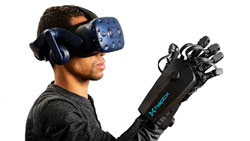
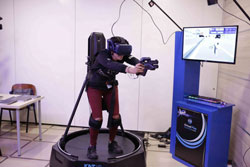
Another category of devices for interacting with the virtual world are those that allow users to feel it. Costumes and gloves that cause stimuli corresponding to virtual action give the illusion of contact, and static treadmills provide the illusion of movement within virtual spaces. Although the accuracy of stimuli, as well as the simulation of movement, is still at an initial level and for expensive portfolios, rapid improvement is expected as investments in such technologies increase.
Networks
Networking is the most important part of the technical infrastructure when we talk about live and parallel connections that interact, but at the same time it is also the most problematic in terms of implementation. We won’t go into technical details, but you can imagine a scenario similar to that of online videogames, where even the slightest delays make the experience problematic – if you get hit by a grenade and you realize it 50 milliseconds later, you’ve already been hit. No matter how powerful the computer’s processor is, no matter how accurate the facial recognition cameras and the “contact suits” are, if the information is not there at the right time, in real time, many of the experiences that the metaverse promises are lost.
The basic characteristics of networking: bandwidth, latency, and reliability, are the keys to this infrastructure and are influenced by distances, the equipment that providers and central nodes have, transmission media, user equipment, and other factors. Creating together a complex global “map” of networks and sub-networks that will need to be standardized and brought to the same standards and capabilities – if not globally, at least where we want the metaverse to be active.
“Bandwidth” is the volume of data that can travel through a medium (cable, optical fiber, frequency, etc.), “latency” is the time of this travel on a millisecond scale, and “reliability” is the guarantee that the two previous factors will be available at their maximum capacity and for the maximum time period. The first two are matters of infrastructure hardware (cables, antennas, satellites, etc.) and traffic techniques (devices, e.g., modem and router, as well as network algorithms acting as traffic regulators), while the third is more a matter of internet architecture that anticipates potential problems and designs backup nodes and techniques to be activated in case of failure or delay.
All of the above are in continuous development, with highlights being advances in satellite systems, fiber optics, and 5G mobile networks. Additionally, inter-capitalist disputes over leadership in network-related issues and the protocols that govern them are a central factor in the evolution of this story. However, the important point to retain for the purposes of this text is that without a network, all the other gadgets would simply be exhibits in a museum of the future.


Computational power
The demands for computational power, meaning powerful processors and graphics cards, not only for end users but also for the servers/data centers that will “run” the various platforms/applications, to support the metaverse, will be unprecedented. This support includes the computation of algorithmic laws of physics, graphics rendering, capturing and analyzing movements and images from the physical environment, data synchronization, applying artificial intelligence, and quite a bit more.
For example, the founder and CEO of Nvidia, Jensen Huang, sees the next step in simulations as something far greater than just realistic explosions or car races. On the contrary, it is the very application of “the laws of particle physics, gravity, electromagnetism, electromagnetic waves, including light waves and radio waves, pressure, and sound.” And as the virtual world expands, so will the real one. Every year, more sensors, cameras, and IoT devices will be integrated into the physical world around us, many of which will connect in real-time to a virtual simulator that can interact. Meanwhile, our personal devices will serve as both passports and partial enablers of many of these experiences. In short, much of the world around us will be continuously interconnected.
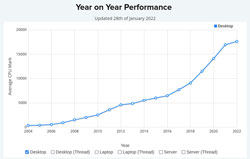
Different scenarios for solving the computational power problem vary in terms of whether this processing will be done on the server/datacenter side or on the user’s device side, or somewhat “in between.” The scenario that favors concentrating processing in data centers has the advantage that each user can be connected with relatively cheap and replaceable devices that do not have high performance or power demands, but it has the disadvantage of network limitation, as larger volumes of data would need to be sent within tighter timeframes to each user. Conversely, shifting the main processing load to users’ devices alleviates network overload but requires more demanding personal devices in terms of performance, energy, cost, etc. In this dichotomy, the scenario bringing more processing to the users seems to be gaining ground, as processors and graphics cards are evolving faster than network infrastructures.
The “intermediate” scenario involves combining a “deployment” of data centers across multiple geographic locations and sharing processing among them, as well as with users’ devices. The key terms here are Edge Computing and Distributed Processing, which essentially – and simply put – mean achieving processing power by combining different processors over a network, as if they were one processor. Such techniques already exist, in cases where someone wants to share their computer’s processor with a research center, for example: they install a program that monitors their processor and when they are not using it, it performs calculations for whatever research is being conducted there. A “metasyntactic scenario” could be the following: if a user needs greater computing power for a certain period of time, they could “borrow” it from nearby devices available on the network. Thus, in a neighborhood for example, “smart” mobile devices would circulate and share processing needs.
Platforms, content and services
The above (material, networks, computing power) are the three elements that lie at the heart of the Metaverse implementation – that is, those that constitute the “material skeleton” upon which various platforms, services, etc. will be able to be built. Which – being part of the Metaverse now and not just the Internet – will coexist in the virtual and real world.
“But this is already happening,” one would logically think. Since our interaction with the Internet and technology in general is not an “experience” that remains in the digital environment without affecting the real world, and vice versa. The answer to this is that the Metaverse – or at least what this umbrella term encompasses – will not be a replacement for what already exists, but rather, along with adding new elements, an upgrade and intensification of existing ones. Therefore, an approach that tries to determine what belongs and what doesn’t belong, with absolute dividing lines, to the definition of the Metaverse, is unhelpful. Whereas an approach that acknowledges the ongoing transition – through technological upgrades and changing behaviors – toward “new normalities” is perhaps more accurate. But we’ll return to this point below.
The definition of a “virtual platform” is as follows: “The development and operation of digital and often three-dimensional simulations, environments and worlds where users and businesses can explore, create, socialize, participate in a wide variety of experiences and economic activities. These enterprises differ from traditional online experiences and video games, due to the existence of a large ecosystem of developers and content creators who produce most of the content or/and account for the majority of revenues generated by the platform”.
It is no coincidence that the largest platforms today have emerged from video games, as these have the appropriate specifications for creating complex simulations that require significant computing power. Also, since they have been created for entertainment, they attract more users. In response to the question of whether he considers it ironic that a company rooted in entertainment now provides vital computing power for drug discovery, research and restructuring of production, the CEO of Nvidia comments characteristically:4
“It is extremely rare for a market to be both large and technologically demanding at the same time. Usually what happens is that markets that truly require powerful computers are very small in size, whether it’s climate simulation or molecular-dynamics drug discovery. These markets are so small that they cannot sustain large investments. That’s why you didn’t see companies being founded to research climate. Video games were one of the best strategic decisions we ever made.”
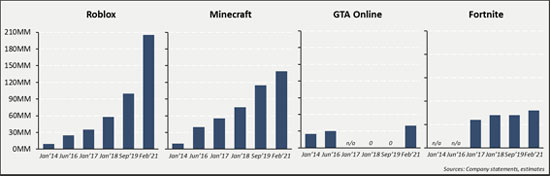
Beyond video games – and their upgrade to “metaverse platforms” – there are also other platforms being developed with different characteristics. Snap, the company with a video calling app, plans to become an augmented reality platform where users will create their own avatars, which they will be able to use across various social networks or games. Niantic, developer of the augmented reality video game Pokemon Go, has similar ambitions for a “global-scale augmented reality platform, for current and future generations of AR hardware.” Likewise, Facebook and Microsoft have aggressively entered the development of virtual and augmented environment platforms.
With Nvidia’s Omniverse, “an easily extensible, open platform built for virtual collaboration and real-time physical simulation, creators, designers, researchers and engineers can connect design tools, assets and projects to collaborate in a shared virtual space.” Similarly, with Unity, real-world environment simulations are possible. For example, Hong Kong International Airport was designed in Unity, a video game design engine, and not in any architectural design software, because it was feasible to simulate scenarios such as fires, floods, power outages, etc. Matterport creates digital replicas of buildings and plots for presentation to prospective real estate agents and buyers.
At the same time, there are several virtual platforms, similar to those of virtual worlds like Minecraft or Roblox, which however have been built decentrally via blockchain. Their most important advantage is the economic incentives given to users, as ownership certified through blockchain is a digital ownership that can be verified in digital worlds, but also in the real world. For example, those who spend hours playing games where they “collect armor, shields and plant vegetables”, if they do so on corresponding platforms that operate on blockchain, will be able to verify their ownership to a wider audience and outside the platform, to exchange them for cryptocurrencies, even to participate in decision-making for the specific platform, since there is also the right to vote according to the percentage of the virtual world that each person owns. Also, on social network platforms of the Instagram type, users will be able to be rewarded with cryptocurrencies according to the likes and followers they have; this is already happening on some video platforms of the Youtube type.
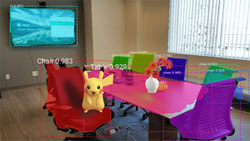
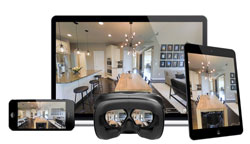


Summarizing and returning to the initial definition, the “virtual platforms” of the Metaverse are environments where users create the content and where virtuality – whether as a simulation of the real, or as the influence of the digital on the real – expands more and more, in parallel with a corresponding expansion of economic activities through cryptocurrencies and blockchain. In this respect, companies naturally play a central role as they gradually enter the game; as the CEO of Epic, a major video game company, comments on the matter: “Just as every company created a website a few decades ago and then at some point every company created a page on Facebook, I think we are approaching the point where every company will have a real-time, three-dimensional, live presence through collaborations with gaming companies or through games such as Fortnite, Minecraft, and Roblox. This is starting to happen now. And it will be much bigger than the previous changes.”
The entry of companies and users into the Metaverse ecosystem will accordingly influence both the content and services, most of which will be virtual, meaning they will be produced, shared, bought, and sold within virtual realities. This change will be mutual between companies and the way they conduct their business, as well as the content/services that will be offered. For example, just as the way we create, share, and listen to music has changed with the emergence of new media and technologies—from vinyl records to cassettes, CDs, mp3s, and Spotify—likewise, the new forms that (will) emerge in the Metaverse will change the content and services.
By the terms content and services, in the context of the Metasymbion, we mean “the design/creation, sale and resale, storage, security and economic management of digital assets, such as virtual goods and currencies, which will be linked to user data and identity. This includes all businesses and applications that are built upon and offer services to the Metasymbion and which will not be limited to a single virtual platform by the platform owner, as well as the content itself that has been specifically created for the Metasymbion will be independent of the virtual platforms.”
The products5 that are easier to imagine being offered in the Metasymbion are those of entertainment and social networks: upgrading social media with metasymbiotic features, such as avatars in virtual conversations, hologram projection in physical space, and linking activities with blockchain and NFTs (more on this later) so that they have reflection on other platforms as well. Video games that, beyond enhancing the virtual experience, will connect with personal social media accounts, to transfer the personal avatar to the video game for example, or to display the “awesome shield” earned in the game, on the user’s Facebook account, etc. Virtual concerts, cinematic experiences, three-dimensional tours, driving simulations, flights, fishing…
Other products that have a “metaverse future” are those belonging to the categories of health and “well-being,” from physical exercise to quizzes for “brain enhancement.” Also, the broader method of “acquiring knowledge and skills,” as well as the educational process itself, is expected to change radically – what we would call “educational products.” Tele-education through video calls and digital boards is simply the “primitive” introduction to metaverse educational methods, which among many others will include interaction with digital simulations, for an unprecedented interactive education: is it the same to read history or physics or even conduct some limited experiments in the school lab, as it is to be “inside” a virtual environment where you can interactively “play” with the law of gravity, electricity, wander through the universe and planets, and experience historical battles from “within” through simulations? It certainly isn’t the same – what it actually is, remains to be seen.
In any case, the examples of metaverse products that will emerge are many, from those that already exist to those being planned and are under implementation or still in the imaginations of creators. What is certain is that it still needs time to see the “final” forms these products will take, since the Metaverse is still in its early stages.

Standards, payments and blockchain
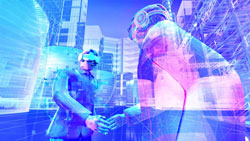
All this interoperability of products, platforms and infrastructure hardware (devices, networks, etc.) in the Metaverse ecosystem presupposes the establishment and design of common standards and tools. And this is the area where we would say that “the stakes are high”. Surely, in the other sectors as well, competition for pieces of the pie is fierce, but in this particular one, whoever defines the protocols by which all these little buttons will interoperate will also be the main “sovereign” of the game.
Facebook’s entry into the Metaverse space, with the name change to Meta, the acquisition of several companies that have products intended for the Metaverse, and significant funding in these areas, is said to be a move aimed at influencing the overall design of the Metaverse, setting the standards by which it will take its first steps. On the other hand, many believe that this is not feasible, since “closed and centralized standards” cannot cover the needs of such a large project, and in any case it would be the ultimate disaster.
From one perspective, this is logical and expected. In the past, when a video game company had closed standards for games and devices that were compatible only with its console, or when Apple designed its products to be compatible only with each other, there was a specific profit-driven logic in creating a “closed ecosystem.” At the same time, however, in several cases there was a need for interoperability, so common standards were designed, such as CDs/DVDs, USB ports, mp3s, and HTML that runs the basic Internet. Similarly and to a greater extent, the need for common standards in the Metaverse is manifold, corresponding to the breadth of activities it aims to bring into interoperability.
By the term standards we mean “the tools, protocols and formats that serve as actual or de facto interoperability standards and enable the creation, operation and continuous improvements in the Metaverse. These standards support activities such as graphics rendering, simulation of physical conditions and artificial intelligence, as well as asset formats and their import/export from one experience/platform to another”.
For example, virtual and augmented reality devices (masks, suits, projectors, etc.) from company X, on how many platforms and with how many products will they be compatible? Will wearables and smart devices (at home, in the car, etc.) from different companies communicate with each other, and if so, what data will they share? Will the performances, points and cryptocurrencies acquired on platform X be transferable to others and to which ones? Will avatars be different for each “experience” or will there be a single one that we take back and forth to different virtual worlds? Will graphics production engines (algorithms, software and devices) be able to support the creation of virtual environments on different platforms or will each have to develop its own? How will it be possible to connect from different devices (mobiles, laptops, web browsers, VR/AR masks, etc.) to the same platforms? What characteristics will the operating systems running on computers, mobiles, etc. have? And so on…
Amidst all this, one of the most important standards that will determine the course of the Metaverse is the one that will govern economic transactions and define ownership. And this feature is what makes the “qualitative” difference compared to what we have known so far as digital environments, virtual worlds and simulations: namely, that there is the possibility of buying, selling and consequently owning digital products. And if this, once again seems familiar – since “buying a piece of virtual space in some datacenter and creating a website” is buying-selling and ownership of a digital product – it is because, as we mentioned above, the Metaverse is the upgrade and intensification of what already exists, with the addition of new elements.
These new assets are essentially two: cryptocurrencies and NFTs. Both are based on blockchain technology6, where the former are digital means of exchange and the latter something like “titles of ownership”. For cryptocurrencies, perhaps we don’t need to say much; digital currencies that are traded in corresponding digital wallets, without the intermediation of any central entity such as a bank. They have value/counterpart in companies and communities that recognize them as such and can be redeemed for official money at various points and services.
Digital transactions, apart from cryptocurrencies, are now also taking place in some cases through NFTs, which are essentially unique digital ownership titles. Their uniqueness is also based on blockchain technology, which does not require an intermediary entity. With NFTs, someone can own a digital image, a video, a three-dimensional object on a platform, and generally any digital product that exists in the Metaverse. Ownership is defined and confirmed through the NFT, and what it essentially offers is the ability to resell—and in most cases, the vanity of displaying this ownership. An image owned by someone through an NFT, for example, can be copied by anyone (via screenshot or otherwise) and saved on their computer. However, in the digital economy, only the owner can put it up for resale—or be praised for possessing it.
Beyond the legal issues that arise regarding ownership in virtual worlds, a shift in the very concept of ownership is evident at first glance. The perception of the “old model,” which requires ownership to define a material uniqueness of the asset—regardless of whether there are identical car models or clothing items—is transformed into an “idea” of uniqueness, defined by algorithms. The mere “idea” that a specific digital house, for instance, within a virtual platform—where everything consists of bits and bytes on hard drives, flows through network cables, and is displayed in pixels—is “my property,” confirmed by the same digital means, appears to be sufficient—by metaverse standards—for the satisfaction that ownership provides. And this is not simply a shift in behavior toward something “more digital”; it is a qualitative leap in the perception of reality itself.
Behaviors and assimilation
While the material infrastructures are critical prerequisites for the construction of the Metaverse, and although the standards that will define its interoperability are of central importance, the most fundamental element of all and what will truly determine the future of the Metaverse is the degree and rate of its adoption – the changes in behaviors.
With “changes in behaviors”, the collection of texts on the Metaverse that we noted above, refers to “visible changes in the behaviors of consumers and businesses, including spending and investments, the time and attention devoted, decision-making and the opportunities that arise, which either directly relate to the Metaverse, or are carriers of its evolution or reflect its principles and philosophy. These behaviors appear almost always as ‘trends’ (or more dismissively, ‘fads’) when they initially emerge, but later acquire a lasting global social significance.”
The “lasting global social significance” of a “smart” phone today is self-evident; it started as a trend/fad about twenty years ago and has now become a necessary accessory. Similarly, the trend/fad of “smart” wearables that count steps and heartbeats and remind the user to drink water seems to be becoming a behavior that gradually acquires “social significance.” How much more so for social media platforms; they already have “social significance.” Also, the “social significance” of online shopping is increasing over time. That of digital entertainment (video games, movies/series, etc.) has been a given for many years; it’s just being enriched with more effects.
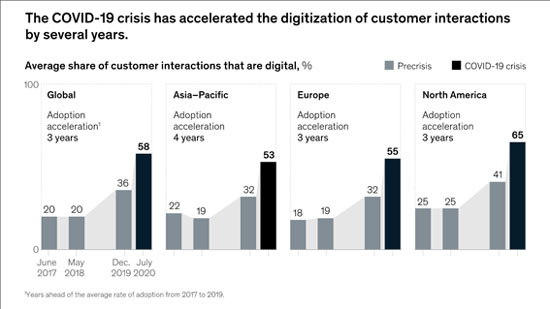
The changes in behaviors and the assimilation of “technological culture” over the past decades have, to a large extent, occurred voluntarily, within the atmosphere of an indefinite “ease” and the acceptance of an vague given that “technology evolves, what can we do?”. And these adapted behaviors became each time the groundwork for the next “new thing.” Our assessment is that the ground upon which the dominant narrative today stands, to so easily declare that “we will emerge from the coronavirus crisis into a new digital normality,” has been cultivated mostly in the preceding years, even though it was laid down in response to the pandemic, for a now abrupt transition. This, too, is a violent restructuring justified by “distancing” and “contagion,” but one that relies on already shaped behaviors to form the next ones.
We do not intend to enter into a discussion about the “good and bad use of technology.” What interests us is to identify the changes taking place, to trace their genealogy and underlying motives, in order to illuminate as clearly as possible the smaller or larger restructurings taking place in society: in relationships, in behaviors, in working conditions, in the self-disposition of the body… from the perspective of anti-power and anti-capitalism.
Within this framework, we raise questions and concerns such as: how do social networking platforms affect social relationships? How is data collected and used? What perception of the body and the self is created by the continuous monitoring of medical data? With what motives is technology evolving, and since automation increases productivity, why aren’t we working less? And many more…
It is within this framework that concerns about the upcoming “metacosmic restructurings” must also be placed. Here, we have attempted a general yet concise outline of these, and it is certain that there will be more references in the future, as the “new normality” spreads…
Wintermute

- STM: The fogbank is a code name given to a material used for the nuclear warheads of the USA, the composition of which is classified. ↩︎
- STM: The CIC is a profit-making organization that emerged from the merger of the CIA and the Library of Congress. ↩︎
- We have taken the basic information and descriptions from Matthew Ball’s “guide” to the Metaverse, which you can find at https://www.matthewball.vc/the-metaverse-primer ↩︎
- The full interview: https://time.com/5955412/artificial-intelligence-nvidia-jensen-huang/ ↩︎
- We will use this term to refer to the content and services. ↩︎
- Related texts have been written in Cyborg nos. 14 and 15. ↩︎