
If Bill Gates gets his way, food in the future will look very little like what exists on our plates today. Gates and his partners in the agricultural industry propose to transform our foods and the way we produce them.
For food technologists, hunger and climate change are problems that must be solved with data and engineering. The basic components of their revolutionary plan: genetic engineering—and patenting—of everything, from the seeds and animals destined for food, to the microbes in the soil and the processes we use to prepare food. Local food cultures and traditional diets could disappear, as food production moves indoors, to labs cultivating fake meat and highly processed foods.
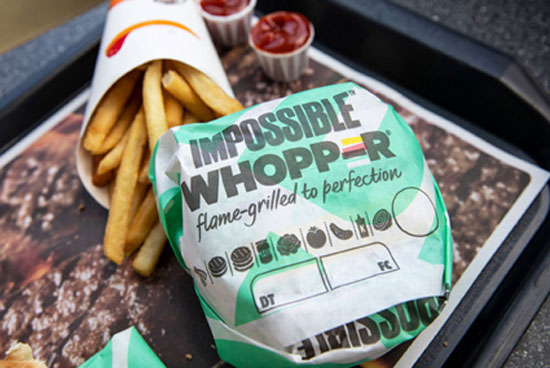
Gates says that wealthy countries should turn entirely to synthetic beef. And he has intellectual property rights for their sale. As a food that can contribute to climate restoration, Gates promotes the Impossible Burger, a plant-based patty made from genetically modified soy and produced with modified yeast. Its manufacturer, Impossible Foods, which is funded by Gates, holds two dozen patents and over 100 pending patents for artificially replicating cheese, beef, and chicken, as well as infusing these products with manufactured flavors, aromas, and textures.
Ginkgo Bioworks, a startup backed by Gates that builds “custom organisms,” just went public with a $17.5 billion deal. The company uses “cellular programming” technology to genetically modify flavors and fragrances in commercial strains of engineered yeast and bacteria to create “natural” ingredients, including vitamins, amino acids, enzymes, and flavors for ultra-processed foods.
According to its presentation to investors, Ginkgo plans to create up to 20,000 modified “cellular programs” (it currently has five) for food products and many other uses. Axios [American news portal] reports that the company plans to charge customers for using its “biological platform,” just as Amazon charges for its data center, and it will take rights similar to apps on the Apple Store. Ginkgo’s customers, the investor presentation clarifies, are not consumers or farmers, but the world’s largest chemical, food, and pharmaceutical companies.
If techno-food products are not high on the shopping lists of most consumers and need to rise, this is a goal that investors can support. The market for genetically modified products has the potential to reach $2-4 billion over the next 20 years. And Bill Gates is in a position to reap the benefits. Gates supports “a host of emerging agri-food technology companies,” according to AgFunder News, either through private investment vehicles or through the Gates Foundation Trust, which funds the foundation’s activities.
Gates and the emerging technology companies present their products as solutions to our most difficult environmental and social issues. But are they really?
Doubling of monocultures
Bill Gates’ “winning strategy for food and agriculture,” according to a recent article by Shawn Tully in Fortune magazine, “is to find ways for farmers to produce more corn and soybeans per acre… while significantly reducing carbon dioxide emissions.” Gates believes that “genetically modified seeds and chemical herbicides, in the right doses—and not intensive organic farming—are crucial for limiting carbon dioxide emissions.”
Since 2006, the Bill & Melinda Gates Foundation has spent over 5 billion dollars on efforts to transform African agriculture. Its flagship program, the Alliance for a Green Revolution in Africa, works to transition farmers to high-input industrial agriculture and develop markets for commercial seeds and agrochemicals. Gates says these methods can increase production and lift farmers out of poverty.
Many critics, including African religious leaders and hundreds of civil society groups around the world, say that the foundation’s agricultural development strategies are not keeping their promises and that multinational companies are benefiting more than small farmers and communities in Africa. The foundation did not respond to our requests for comment.
“Gates influenced the direction of agriculture for the benefit of companies,” stated Million Belay, coordinator of the Alliance for Food Sovereignty in Africa (AFSA), a coalition of 50 Africa-based groups. “His foundation has contributed enormously to undermining our regulations on seeds, biosafety and regulations related to agrochemicals… it will take years to reverse what they have done.”
Gates also influences the way governments and academic institutions think about the future of agriculture in Africa, said Belay. “The narrative now is that you must use agrochemicals, high-yield varieties, GMOs, and a host of other farm management techniques to feed yourselves,” he said. “It will also take years to convince our elites that the future is agroecology. As one of the richest and most powerful people on the planet, the doors of our governments are wide open (to Gates), while they are half-closed to African citizens. We need to call him and ask him to change direction.”
Leading experts in food security and nutrition are calling for a shift from industrial agriculture of the Green Revolution type toward agroecology, which promotes biodiversity instead of monocultures, integrates animals for soil restoration, and supports political and economic reforms to address inequalities and social divisions. Diversified agroecological systems are more resilient, they say, and have greater capacity to recover from disturbances, including extreme weather events, pests, and diseases.
Recent scientific studies show that industrial agriculture intensive in chemical substances is a key factor in climate change, soil erosion and the global decline of insects. Monocultures of corn and soy are particularly problematic – they exhaust the soil and rely on synthetic fertilizers that emit nitrous oxide, a greenhouse gas 300 times more powerful than carbon dioxide in raising atmospheric temperature. These are problems that Bill Gates hopes technology can fix.
A solution for the climate?
Fortune describes Gates’ plans to intensify corn and soybean production as a “critical campaign in the war against global warming.” How so? Syngenta, the world’s second-largest agrochemical company, “is developing big data, genetic processing, DNA analysis, and other cutting-edge technologies aimed at increasing yields and reducing CO2.” Bayer, the leading chemical and seed company, is making a similar effort and claims that its new sustainability technologies “will empower 100 million small farmers around the world.”
For 30 years, agrochemical companies have promised that GMOs could feed the poor and help small farmers, but nothing of the sort has been proven yet. Most genetically modified crops grown today are designed to survive chemicals that kill weeds or to kill insects. While these crops have offered short-term benefits to farmers, they have provided no benefit to consumers, nor have they kept their promises for increasing yields, but have increased the use of herbicides. The data now shows that crops are failing, as weeds and insects evolve faster than the technology.
As a solution to address the climate crisis and the possibility of “sustainable intensification” of industrial agriculture, the Gates Foundation and Bayer are demonstrating experimental projects for genetically modifying microorganisms in order to capture nitrogen in plants. “If these approaches succeed,” Gates writes in his book on climate, “they will dramatically reduce the need for fertilizer and all the emissions for which it is responsible.” In 2017, Ginkgo Bioworks collaborated with Bayer to launch JoynBio, a microbial company working to create self-fertilizing plants.
And this is a promise that Bayer has made in the past. As early as 1897, Bayer was promoting a product that could, according to reports, assimilate atmospheric nitrogen, according to Mark Finlay, a history professor at Armstrong Atlantic State University. Bayer claimed that its product could “make all agricultural soils permanently fertile,” Finlay wrote in a 2015 book about the history of agriculture. “Although the initial results were disappointing, many popular press writers welcomed the possibilities of this discovery.”
GTO 2.0: genome editing
Gates is an evangelist for genetically modified foods. He predicts that “GMOs will end hunger in Africa” and that GMOs can “end world hunger by 2030.” If the first generation of GMO crops failed to fulfill these hopes, Gates believes that new methods of genetic engineering will get us there.
With CRISPR-Cas9 and other “genome editing” techniques, scientists can now add or delete sections of DNA or activate or deactivate genes to produce specific traits in plants or animals – as if writing computer code. Examples include mushrooms that are “edited” to resist browning, “terminator” cattle that are bred to produce only male offspring, or harmless E. coli strains that are transformed into antioxidant factories.
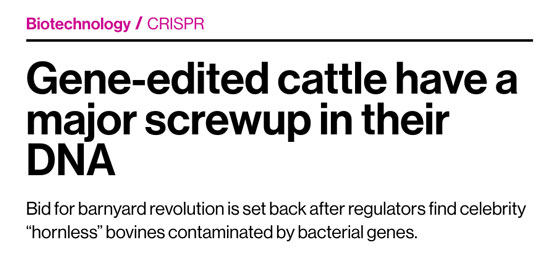
Gene editing techniques, and especially CRISPR, are effective but unpredictable. Studies show that the CRISPR process can create unexpected mutations, including DNA damage and other off-target effects. In 2019, a plan to release CRISPR-edited “hornless cattle” in Brazil was rejected after a U.S. government researcher discovered that the cattle had two antibiotic resistance genes that should not have been there. The Recombinetics cows were “poster animals for the gene editing revolution,” according to MIT Technology Review, until the “big DNA mess” in their genes came to light. The company’s researchers did not see the additional DNA in their own studies—they incorrectly reported that the animals were “free of off-target effects.”
Genetic engineering, including genome editing, “has unpredictable results,” says Michael Antoniou, a molecular geneticist at King’s College London. “You don’t know beforehand what the consequences of the process of converting genetically modified plants are… and because you don’t know, the only way to assess safety is general,” Antoniou stated. “Essentially, you have to conduct a long-term feeding trial on animals and see what will happen… and this simply doesn’t happen anywhere in the world for regulatory purposes, at all.”
Nevertheless, experiments continue on important crops and animals destined for food. The Gates Foundation has spent over 40 million dollars on genetic modification programs for dairy cows, hoping to create the “perfect” cow. Acceligen (a division of Recombinetics) is working with funding from the Gates Foundation to convert multiple characteristics in dairy cows, in order to maximize productivity and resilience in hot climates.
The foundation is also one of the main funders of gene drive experiments, which can impose a modified trait on a species. This month, in the Florida Keys, Oxitec, a company funded by the Gates Foundation, released 144,000 mosquitoes engineered to eliminate females of a disease-carrying species. Proposed agricultural uses of gene drives include reversing plant resistance to herbicides, suppressing weeds, and eliminating agricultural pests. What could go wrong?
Systemic risk
One of the leading experts on probability and uncertainty, Nassim Taleb, examined this question—What can go wrong with GMOs?—in a paper he wrote in 2014 with colleagues at the School of Engineering of New York University. The authors analyzed GMOs within the framework of what they called a “non-naive” interpretation of the precautionary principle. They concluded with the following statement: “GMOs represent a global public risk of damage” and should be subject to “strict limits.”
The precautionary principle states that if an action is suspected of posing a risk of causing serious harm to the public sector, the action should not be undertaken absent scientific near-certainty of its safety. The authors believe that “it should only be applied in extreme situations,” when the potential harm is systemic and the consequences extensive and irreversible – they said that GMOs “fall absolutely” within this criterion.
Among the systemic risks they cited are irreversible effects on the entire system and unknown negative consequences. The ecological impacts are not empirically tested—and therefore not understood—before the technologies are released. The researchers noted two factors that contribute to systemic risk: genetic engineering modifications and the monocultures in which they are developed.
“Instead of a long evolutionary selection story, these modifications are based not only on naive mechanical strategies that do not properly take risk into account in complex environments, but also on explicitly reductionist approaches that ignore unintended consequences,” the researchers stated. “Labeling the GMO approach as ‘scientific’ reveals a very poor – indeed distorted – understanding of potential outcomes and risk management.”
Taleb summarized their conclusions in an article in the New York Times in 2015: “The GMO experiment, conducted in real time with our entire food and ecological system as a laboratory, is perhaps the greatest case of human hubris ever. It creates yet another systemic, ‘too big to fail’ enterprise – but one that cannot be rescued when it fails.”
Monopoly bill
If Gates’ plans for the food system make no sense from the perspective of equality or ecology, they are logical from the perspective of an economic monopolist.
“As a former executive and major shareholder of Microsoft, you might think Bill Gates is a capitalist, but that’s not exactly the case,” stated Megan Tompkins-Stange, a researcher at the University of Michigan, to The Ink. “Gates’ version of capitalism could better be characterized as monopolistic. He consistently seeks to distort free markets in order to promote the accumulation of wealth, power, and dominance of his own company.”
These ideologies led to the recent controversy over Covid-19 vaccines, where Gates’s insistence on patents may have prevented the world’s poor from accessing vaccines. The incident raised concerns about the strong influence Gates wields on vital public health issues. As Timothy Schwab wrote in The Nation, “it is increasingly urgent to question whether Gates’s multiple roles in the pandemic—as a philanthropic foundation, business, investor, and lobbyist—concern charity and the provision of funds, or rather the assumption of control and the exercise of power—monopolistic power.”
The Gates Foundation plays the same roles in our food system. “Gates has placed his investment bets at many of the key points of this emerging corporate narrative about what the food system needs: genetic units, geomechanics, fake meat, digital agriculture, carbon capture,” says Jim Thomas from the ETC Group, which researches company concentration in the food industry. “It’s clear that he’s going to benefit from these changes, plus the funding from his Foundation supports all of this.”
Agricultural companies are developing digital applications on farms around the world to collect data on all aspects of agriculture: soil health, product inputs, weather, cultivation standards, and many other factors, including genetic information about the world’s most important seeds and livestock, as well as the knowledge that indigenous farmers have developed over thousands of years. All this data will be owned and controlled by corporations, processed through artificial intelligence algorithms, and sold back to farmers with “prescriptions” on how to farm and which corporate products to buy, with minimal transparency or explanation.
The hyper-concentrated food and agriculture system has already brought many negative consequences to farmers and consumers. A 2019 report from the International Panel of Experts on Sustainable Food Systems documents how corporate concentration has compressed farmers’ incomes, eroded their choices, limited innovation, and escalated risks to public health and the environment. The corporate effort to control big data, according to IPES, “is set to worsen existing power imbalances, dependencies, and entry barriers across the entire agrifood sector.”
Gates Ag One
Impatient with the slow progress of the agri-food revolution, the Gates Foundation launched last year a new tax-exempt non-profit organization that “seeks to accelerate the development of innovations supported by the foundation’s agricultural development team” in two of the world’s fastest-growing regions: sub-Saharan Africa and South Asia.
The new “agricultural technology start up” will “collaborate with partners from the public and private sectors for the commercial exploitation of resilient seeds and performance-enhancing traits.” It is based in St. Louis, Missouri, former headquarters of Monsanto and today’s hub of leading chemical and seed companies, and is directed by Joe Cornelius, former Managing Director of Agriculture, Food and Nutrition at Bayer Crop Sciences. As if wanting to emphasize that uniformity and central control are key goals of the effort, the new non-profit organization is named “Gates Ag One.”
Farm of the future
In 2019, Cargill (a partner of Ginkgo Bioworks) opened a $50 million factory in Lincoln, Nebraska. The factory produces EverSweet, a substance that has the taste of stevia sweetener. For its production, Cargill combines genetically modified yeast with sugar molecules to mimic the taste of stevia.
Consumers would not understand this by reading the website or looking at the packaging. The company describes the process artfully as a “centuries-old technique” that involves “fermentation.” EverSweet is marketed as “non-artificial.”
Cargill also advertises the product as “sustainably produced,” apparently because it removes stevia production from land cultivation, in places such as Paraguay, where small farmers have been growing stevia for generations. But the raw material for the processed foods produced at Cargill’s new factory must come from somewhere. Cargill did not tell us what it uses for raw material, but the factory’s location in Nebraska offers a clue: it is surrounded by monocultures of genetically modified corn and soybeans.
Published on the site usrtk.org on May 26, 2021.
Read the original here: https://usrtk.org/bill-gates-food-tracker/radical-menu
Translation: Harry Tuttle