
When a farmer buys a tractor from the agricultural machinery company John Deere, they receive a license to operate the vehicle. Nowadays, tractors are not like the old vehicles of past eras. They have built-in sensors that collect data and transmit it to cloud-based infrastructures (i.e., data centers). The farmer does not own the tractor or the embedded software, or even the data generated by it. It is the company, John Deere, that owns everything. Not only that, but apart from the cost of the tractor, the farmer must also pay for automated data services, or support services, that will provide them with technical advice on what, when, and how to plant in their own field. These tractors are primarily used in the global North such as in the USA, but are also increasingly being developed and promoted in large farms of the South.
What is this data produced by the tractor? How is data generally recorded in the context of agriculture? Who uses it? Why doesn’t the farmer own it?
I am Zahra Moloo. In this second episode of Who Will Control the Food System, I will speak with Kelly Bronson, a social scientist at the University of Ottawa in Canada. Bronson is the author of the book “The Immaculate Conception of Data: Farmers, Activists, and Their Common Policy for the Future.” Her book examines the hidden legal agreements around agricultural big data, primarily in the US and Canada, to identify how they are used and with what consequences.
Kelly Bronson, thank you for coming to speak with us today about who will control the food system. Allow me to start with an obvious question regarding the title of your book: The Immaculate Conception of Data. In immaculate conception, as we know from the Catholic Church, it is the idea that the Virgin Mary, the mother of Jesus, was free from the original sin of Adam. What exactly do you mean by the Immaculate Conception of Data?
Kelly: I thought about calling the book “Big Data, Big Power.” A large part of what I tried to do in the book is to peek behind the technologies and legal agreements and other kinds of social infrastructures, around these new digital tractors and other kinds of digitized agricultural equipment, to find out who did what with the data, and for what profit. But in the end, I called the book “The Immaculate Conception of Data,” borrowing from this religious story or metaphor, because the book is really empirically grounded in my own kind of data collection. I spent time with data scientists who worked in the private sector for companies like John Deere, but also Bayer Monsanto, Farmers Edge. I also spent time with scientists who work in public frameworks: for the Canadian government, for the US government, but also with activists, self-described farmer hacktivists, who were playing in the space of using data to promote food system reform. Initially, when I started writing the book, I somehow knew these communities, some scientists in the private sector, and I knew the farmer hacktivists and activists a bit more because, to be perfectly honest, that’s where my interest lies, regarding food politics.
I assumed that there was this model, we could call it “digital agriculture”, which was more on an industrial scale, like the John Deere model: selling tractors to farmers, mainly throughout North America, destined for export markets, that is, industrial agriculture. And then I thought that there could be another model for implementing a kind of data-based agriculture, which is more activist, looks at local food systems, promoting practices such as agro-ecology or regenerative agriculture.
At the beginning of the book, I could compare these two systems and the people working in these two spaces. But then I noticed, and this is where the title comes from, that even though there are real differences in how tools are used, what kinds of data are collected, by whom and for whose benefit, I noticed that there was a similarity. And that was that in every case, everyone talked about data in this really particular way, as if the data themselves were a thing that fell from the sky, as if they were “impeccable,” instead of being the product of powerful companies, for example.
And people were talking about data as if it were self-acting. I “borrow” this religious metaphor, because this narrative gives a lot of power to Mary and to God. Since if you can simply do something, if you can simply make it happen, that is quite powerful, and this kind of omnipotence is part of the religious story that I wanted to emphasize, using the title “the immaculate conception of data.” Because even activists who are really working (and I am with them) to transform the food system, were talking about data as if the data itself was going to lead us somewhere. I believe that this approach to data, using this framework, the “perfection of data,” is really problematic because it hides the truly powerful actors and interests. We must say it by name: they are the companies that have, for a long time, shaped the directions of the food system, at a technological but also social and environmental level.
Zahra: You also mention the term “data-driven,” and we hear this all the time—it’s truly “omnipresent”: “data-driven this, that, and the other.” I’m sure there are other terms you reference in your book that convey this idea of data as if it has its own “autonomous nature.” From your book and your research, did you find that this narrative, these terms, are used deliberately, or has it simply emerged as a way of thinking that spontaneously “came upon us”?
Kelly: Part of the research process is that someone carefully examines the data, using an approach so as to be able to derive some meaning from the field research, in a rather systematic way. And it wasn’t until I started doing this – it’s called coding – that I noticed this common way of speaking. I assumed these were just phrases that were everywhere present, “they fell upon us” as you put it. I found this interesting. This is the landscape now, or the vocabulary around digital systems, and it is actually part of a vocabulary that goes beyond agriculture. So, the “flawless conception of the data framework” is actually everywhere. You’ll probably start noticing it more, now that we’ve highlighted it.
But then I realized, at least in the context of the people I was spending time with, that the answer to your question is that “this is the tactic.” What do I mean by that? I realized that none of the scientists, none of the scientist activists or private sector scientists, none of the entrepreneurs – because I went to many agricultural technology and AI and data technology conferences – none of the participants would be able to be faithful to the positions behind the “immaculate conception of data.” No one would say: “Oh, yes, of course, data just emerges.”
In fact, it was these same people who worked continuously and showed me the very complicated and difficult work they did to bring the data into an understandable form, to “clean” the data, to manage the data infrastructures and to extract some meaning from the data.
And so I began to realize that it was part of a rhetorical strategy. Since, speaking about data in terms of “perfection” is a way to talk about data that have a functionality, and if someone brings them to this state of having an understandable form, then the person who is part of this system is considered omnipotent, or very powerful. And so I realized that it was part of a long-term cultural approach, in fact, long before data, big data or artificial intelligence.
We have, at least in the western world, an approach to technology where if someone can speak about a technological system as being free from politics, as “autonomous/flawless,” then this gives great power to the people who speak about this technology. It is a strategy of “winning,” and I refer to stories in the book, drawing speeches from the period of the colonization of America, where the so-called founding fathers, or the “civilizing politicians/technologists” in North America, had a very similar “flawless” way of conceptualizing how to speak about technologies such as the telegraph, for example, or the railway line—these powerful agents of change that were going to help in the “civilization” of America. And this is very problematic. It was a rhetorical method that directed people toward a specific direction.
Zahra: I would like to refer to more details about the data, how they are collected and how they are used. You mentioned the John Deere tractor. So, to take this example, the data obtained from this tractor and other data obtained from farms are now considered a very valuable resource by the agricultural world. What exactly is the content of this data? Why are they so valuable?
Kelly: I believe that an important thing we need to highlight is the broader framework within which people—both publicly and academically—perceive companies like Facebook, and what they do with their personal data. I started to notice in 2016 and 2017 that there wasn’t really a discussion around who collects data and for whose benefit, or even for what purposes, regarding what we might call environmental data—and I would include agricultural data in this. However, great attention, both widely and academically, is given to data collected about people and gathered through their participation in online environments such as social networks. I began to observe this at a time when there was a genuine mass public discussion around the profit from collecting and using—even misusing—this data. Let’s remember the Cambridge Analytica scandal, the tampering with the electoral system in the U.S. or the U.K., around the early Trump elections and the use of Facebook data to achieve this… Meanwhile, very few people were paying attention to environmental or agricultural data.
There are various ways of collecting data. One is what is called precision farming equipment. So, new tractors today are digital vehicles. They come with a license: they don’t belong to us, just like our mobile phones. Farmers who buy a new John Deere tractor must also sign a licensing agreement in order to use the data systems in that tractor. And the tractor collects data from the beginning. It’s like when you enter an online environment, data is collected about your behavior, even about the way you “scroll” through websites, and most of us know this.
Similarly, in a tractor, the moment the farm worker opens the tractor door, data is collected about the worker, where they are, the tractor’s movements. Data is also collected from the environment, the cultivation, the planting, the soil, the moisture, the pH, the chemicals… But more broadly, this data is combined with other environmental data in large systems designed to provide advice to farmers on how to manage their farm and specifically, when to plant, where to plant, how to manage chemicals etc.
Zahra: So an example of this precision agricultural equipment is tractors. What other such equipment collects data from the farm?
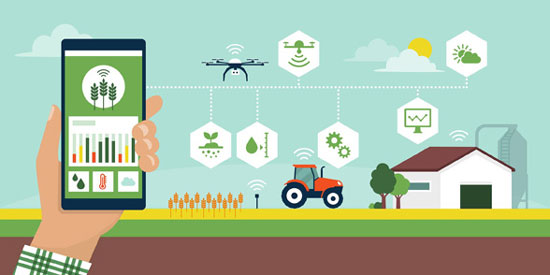
Kelly: Αν πάτε στην ιστοσελίδα “έξυπνης γεωργίας” της John Deere, μπορείτε να δείτε ότι παρουσιάζουν όλες τις διαφορετικές πηγές δεδομένων που η εταιρεία συγκεντρώνει για να δημιουργήσει τις λεγόμενες “συμβουλές που βασίζονται στα δεδομένα”, ή τις “συμβουλές που δημιουργούνται από τον συνδυασμό δεδομένων χρησιμοποιώντας μηχανική μάθηση ή συστήματα AI” για τους αγρότες. Εδώ έχουν λοιπόν και κάποιους άλλους εξοπλισμούς, τα drones, για παράδειγμα. Δεν χρησιμοποιούν όλα τα αγροκτήματα drones, αλλά πολλοί σε αυτά τα “έξυπνα αγροκτήματα” τα χρησιμοποιούν.
The sources of data for agricultural operations are systems – in many cases private systems – for collecting weather data or other environmental data. For example, the Canadian company Farmers Edge has its own private network of weather stations, where participating farms help collect data. Subsequently, this data is combined with satellite data. Again, in many cases, these companies collaborate with private satellite companies, such as Planet Labs, or purchase or simply use without even paying for publicly available environmental data, and combine it with other data from these private or licensed sources to produce what are called big data.
The uses are the provision of advice to farmers. A rights holder is the farmer who uses or, as you said at the beginning, pays—and this is a distinction between the use of agricultural data and the use of AI in relation to social media platforms—we don’t pay for our participation on Facebook. But farmers pay several times: they pay for the equipment that collects the data, they sign a licensing agreement, and then they must also pay for the so-called advice based on data. They will receive what is called “precision advice.” “Exactly where in my field should I focus regarding certain specific chemicals?”, for example.
Thus, farmers are the beneficiaries of this type of data. For example, Farmers Edge has “My Farm Manager,” which is an application for tablet or smartphone that helps create maps for specific fields and provide personalized advice specifically for certain usage methods or farming environments.
But there are other uses as well. First of all, there is a potential conflict of interest. So, for example, with a careful reading of the terms of use agreements and what these different AI systems advise farmers – what Monsanto or Bayer Monsanto call “prescription advice” – I found that in these so-called “prescribed advice” based on AI or data for farmers, the systems suggest chemical substances to farmers that are already products of the same company. Thus, there is an obvious legal interest, where the artificial intelligence system provides advice to farmers that they should use a specific chemical sold also by the company that produces the advice.
In the book, trying to do this work to understand how these systems operate, I discovered that I could not see the algorithms that produce the advice. It’s all closed. And I couldn’t even speak with the scientists who make them. In some cases, scientists spoke to me. In certain cases, I had to sign a non-disclosure agreement. However, the trade secret law also prevented full disclosure of the steps by which this advice is created. Thus, a kind of social and environmental issue arises: the fact that there is a potential legal interest in reproducing the specific use of chemical substances that make these companies very wealthy, which we already know have harmful social and environmental impacts on the food system.
But the other uses of this data go beyond the farm environment. It’s hard to find evidence for this. So I have to be very careful with the claims I make, because it’s very difficult to pinpoint exactly what happens with the data. But we know that data is traded between companies throughout the entire food system. We know that data has been transferred between John Deere and Monsanto Company. We can infer, based on what we know, for example, about the sale of data from social media companies to advertisers.
We therefore know that companies that collect data, such as equipment manufacturers, will make a lot of money by selling data packages to, for example, another type of company, such as a chemical company. And someone from within this industry told me that this is indeed happening, that we know these data packages are going to be very valuable to insurance companies, such as Lloyd’s of London or the Swiss Ag Swiss, which make a lot of money from “losses,” from the misfortune of farmers in the global dairy system, by being able to use modeling and AI to predict “losses.” Therefore, they literally invest in farmers’ “losses.”
Zahra: From your research, do you know what kind of relationships, what kind of legal and corporate frameworks would allow data sharing from different companies? For example, you write about how Bayer has the ability to access data from nearly half the farmers in North America. What kind of relationships would allow, let’s say, John Deere to share this data with Bayer Monsanto?
Kelly: There are two important things I need to point out here. There is a legal infrastructure that allows companies like John Deere to collect data and use it in particular ways, without giving back to farmers and without being transparent to farmers or other actors in the food system regarding the uses or potential misuses of the data. And these legal mechanisms are intellectual property mechanisms and specifically, terms of use or licensing agreements.
This is how farmers must sign these agreements if they want to use these systems, just as we must sign these agreements for our participation on the internet. An additional observation is that these agreements are really difficult to read, but these are the legal mechanisms that allow companies to do things with the data, which may not always be in the interest of the individual from whom the data is drawn, the farmer in this case.
With these terms of use, I discovered that there was some evidence, especially if I examined all the years, in the language changes in these legal agreements, where there was clearly room for data use, such as selling data to third parties, transferring data from an equipment manufacturer to a chemical products manufacturer, for example.
And so this is an important point to consider when thinking about controlling the food system. There is important work to be done by legal actors and activists to modify this legal infrastructure. And in fact, these seemingly brand new and disruptive data systems and AI systems in agriculture follow the history of other agricultural technologies, such as GMOs or genetically modified organisms. They are similar licensing agreements around seed systems that allow abuses of this system, on terms of environmental (in)justice.
Zahra: What is really shocking, as you mentioned before, is that when we use online platforms like Facebook, we don’t pay for it. But farmers provide the data and have to pay to use the platforms. So, is there some way that the public or farmers can have access to what is being done with their data?
Kelly: No, I don’t think so. And this is, again, a small difference between the social media space and the agricultural space. There are no ways for a farmer to have access to this data. There has been some recognition of the issue through the discussion around the “right to repair.” I haven’t found in these legal mechanisms surrounding these digital tools, any way in which farmers or others can easily have access to the data. But also, even I – as a critical researcher, from a scientific or technical perspective – it’s almost impossible to gain access to these AI systems. Legal scholar Frank Pasquale calls it a “black box,” or I think he says a “toxic black box” around the data and AI systems.
Zahra: You refer in your book to this digitized future envisioned by those involved in the industrial food system, and you present a picture of what this would look like. So what do we mean by “digital future”?
Kelly: In order to reach this future vision, what I would call the dominant vision, promotion is taking place throughout the entire food system by really powerful actors, whether they are agricultural companies like Bayer Monsanto or equipment manufacturers like John Deere, but also by academic groups and those working technically in this field. For example, there is an entire journal dedicated to digital agriculture called “Precision Agriculture.” Academics working in this space are promoting this vision, the dominant vision. There are also supranational organizations that we know are really powerful in setting directions in the global food system, such as the UN’s Food and Agriculture Organization or the World Bank, which also promote this vision.
In this vision, data are collected on farms and agricultural estates, either through the use of smartphones or through these precision tractors or other precision equipment, and combined with satellite data. All of these feed into a cloud-based infrastructure and AI systems, which are used to make sense of this data. This entire package of technologies and functions together is essentially considered to be this “smart farm.” Some academics describe it as Farm 4.0. It is the idea that agriculture and food production will be perfected in the future using these digital tools.
The vision is that these tools will indeed be used and that agriculture will become more precise. Digital tools, and AI in particular, is considered the pinnacle of human logic, of human cognitive ability. Specifically, people support that it will lead to an increase in productivity. Farmers will basically compete with each other because they will make more money through increased productivity.
But there is also another promise that is environmental. If you look carefully, the promise is that farmers will make more money and produce more food, but they will do so with fewer environmental impacts. And this is a really interesting message that I explore in the book. The head of so-called smart agriculture at Bayer Monsanto said that in the future they will not make profits from product sales, but from information. Which raises the question of how they are going to function as product supply companies. The message is that farmers are going to make more efficient use of resources, such as water, or harmful products, such as agricultural chemicals (e.g. Roundup), because they are going to make more precise decisions based on digital tools.
This is the vision then, that agriculture will continue its business operations, cultivating products for exports, but with modifications to the system. I would call this the dominant vision of the future of agriculture with digital tools such as data and artificial intelligence.
Zahra: This sounds like a very seductive vision when we consider both the idea of productivity and environmental sustainability. It seems that many people, farmers, activists, when they hear this rhetoric about digital agriculture, wonder if there is any truth to it. Can these digital technologies and data really be useful for productivity or for the environment? Is there truth in this seductive vision?
Kelly: I think there is some evidence that there is an increase in productivity and there are some data – but not many – that there is potential for regulation regarding the use of chemicals and the impact, for example, on groundwater. This is not due to a reduction in the use of chemical substances, but because as a scientist in the private sector told me: “We don’t mean that the substances will be less chemical, but that the use of chemical substances will be more precise.” I think it is a point where we may be seeing some evidence.
I would say that there isn’t enough evidence to support the genuinely widespread enthusiasm and funding behind these so-called digital agricultural systems. One thing I try to state explicitly, especially in the final chapter of the book, is that I believe we really need to be cautious: I am of the opinion—and this is my political stance regarding food—that we need something more than modifications to the global industrial model of food production. We need a broader and more radical change, a disruption to the dominant way food is produced. We need more small farmers, we need more support for farmers’ agriculture, we need greater biodiversity, and investments in historically tested and genuine techniques such as polyculture, cover cropping, and agroecological and regenerative farming.
And so there is reason to believe that in reality the promotion and use of these data and AI systems in agriculture will inevitably steer the food system towards a broader modification of the current dominant system, because they are already predisposed towards the global industrial model. Agriculture is just one example. Similarly, we know that Google search is predisposed towards certain bodies. If you search for the word “virility”, you will see the particular way that Google search selects results, due to bias regarding gender, or race that already exists in the data that feeds Google search. Likewise, if you look at a company like Bayer Monsanto, the data it collects is only for “agronomic crops” (note: In the original it is “agronomic crops”. From what we found, this term characterizes large agricultural areas)
Zahra: This brings me to a question, based on something you said in your book which was very interesting. You say that someone would imagine that activists in the US and Canada would have counter-ideas about industrial agriculture, but you say that activists also have a fantastic farm – a digital farm of the future. Can you describe this? What does a digitized future of food production look like to activists who one would imagine would be opposed to this idea of a digitized future and the industrial food system?
Kelly: I spent time with agro-activists who were already enthusiastic about data systems. This is a kind of bias in my research design. But in reality, at the beginning of the book, I was looking for people in the agricultural sector, activists or researchers who were critical of these systems and it was difficult to find them. There is no major criticism of these things. And so I ended up spending time with these activists who were enthusiastic about these systems. And yes, what is their vision for the future with these systems? Well, it is radically different from the dominant vision, regarding the kind of agricultural system they believe so-called digital agricultural data and artificial intelligence will support.
The activists I spent time with were from various groups, a group in Quebec called Autoconstruction and they are part of a broader agricultural cooperative called Capé, a group in the US called Farm Hack, and another related group called the Gathering for Open Agricultural Technologies or GOAT. These groups really envision that data can be used to disrupt the dominant industrial model of agriculture, supporting alternative agricultural systems such as regenerative agriculture and agroecology. In fact, there is an open-source platform called FarmOS, which is different from systems developed by companies like Bayer Monsanto.
This platform can use data and AI to help with advice for different micro-cultivations, not for “agronomic crops”. It collects data for fertilizers such as compost or manure. In this sense, the vision is different. In the kind of agricultural system that these activists envision, digital assistance is completely different. The model of using data, or the ethos, I would say, around the use of data and AI is completely different from the private sector. Activists are motivated by open data exchange, open access, without intellectual property rights. They work with farmers and incorporate a variety of feedback from farmers. And yet, as you pointed out, the subtitle of my book is: “Agricultural Companies, Activists and their Common Policies for the Future”. This is something that really surprised me, that activists share something with the agricultural industry. It is this common way in which they refer to data, as “the immaculate conception of data”, as if they fell from the sky. As if data are, regardless of all the people and strong interests behind them, going to lead us to the future.
I felt very conflicted about pointing this out in the book, because my politics are really with the Farm Hack types and activists. But I felt it was important to point it out, because I really believe that the words we use and the ways we perceive or imagine things, the way we talk about things matters. And I would say that, by seeing data as “something that fell from the sky”, activists are somehow moving against their own interests, because this way we don’t ask questions. And by “we”, I mean all of us, consumers, researchers, activists, we don’t ask questions about who collects this data? Where does the data go? How is it processed? Who profits from it?
Zahra: Another thing you mention in your book that I’m very interested to hear more about is that farmers in North America seem not to care what the agricultural industry does with their personal data. And you say that for years, being a successful farmer in North America has meant behaving like a corporation. Can you explain more about this, what do you mean by that?
Kelly: As you said at the beginning, the book focuses largely on a global North—and particularly within the North American context. And I would say there’s greater attention today in the Global South around data and data justice and data colonialism, as we might put it. Who uses data for what purposes and who benefits, both in the general framework and in that of agriculture?
But yes, I was impressed when I looked at North America’s farmers, especially those who had purchased these data systems. To a large extent in Canada and the US, these are farmers, for example in the midwestern states who operate on thousands of acres or hectares. They are the farmers who have really invested in this entire package of technologies, what some academics and industry call “the fully implemented smart farm” or “farm 4.0”. However, I would say that there is no similar widespread adoption of this “fully implemented smart farm” in Canada or anywhere else in the world. Canada, the US and Australia are perhaps ahead of this among certain farmers, but even in comparison, for example, with genetically modified organisms, the suite of digital tools has not found widespread application.
So I found something strange: I believed that farmers would be somehow negative about the uses of data collection, that they would be suspicious of companies that might collect the data and then use it without giving back to the farmer. But I didn’t find that. What I found is that farmers who had invested in these systems were actually quite comfortable with the company. They didn’t necessarily want to have access to the data because they have somehow bought into the logic of agriculture as a business. They consider themselves as busy operators or managers of the farm, as opposed to a farm worker. They were quite satisfied to simply transfer the management of their data to data scientists and AI of a company like Bayer Monsanto.
This was different from the activists. All these farmers who were using the full range of digital technologies didn’t seem particularly suspicious or concerned about corporate uses or potential misuses of their data, but they told me they were worried about government surveillance. One of them said: “I’m worried about Big Brother, that this data could end up in the hands of government agencies,” and he really didn’t want that. What they didn’t want was some kind of oversight from government bodies.
Zahra: Very interesting. It’s quite impressive to hear that farmers aren’t worried about large corporations taking their data, but I suppose this is very different for activists in the Global South or farmers in the Global South who are defending agroecology and such approaches.
Kelly: Absolutely. If you look globally, there is all kinds of activism around data abuses and data ownership, such as Via Campesina, and other farming organizations and groups from the Global South, in contrast to the lack of suspicion among farmers in the North, who have invested in these systems. And part of the answer lies in the very question of “who collects the data.” If we look at the history of industrial agriculture, companies such as John Deere, Bayer Monsanto, and Monsanto have developed trusted relationships with farmers. When I talk to farmers in North America, if you’re a “Deere guy,” you’re a “Deere guy.” It’s a cultural relationship that continues into the realm of data and artificial intelligence, and this is a particular advantage for these companies, because we know that whoever collects data faster gains an advantage in machine learning and artificial intelligence. If we think of systems such as Alexa or Siri, they have a market advantage because they improve the more data they are fed.
And to come to your question, regarding how this data is used, when I read the licensing agreements and terms of use, I noticed that these companies use the data to further promote those specific relationships with customers. So, for example, licensing agreements, such as those for genetically modified organisms, really prevent a farmer from changing companies. The tractor’s data system is not interoperable with any other from a different company. John Deere’s system, for instance, is not interoperable with other systems, and this locks them in there.
Zahra: Are there any developments regarding the regulation of data usage? With all this digital infrastructure in agriculture and all this data mining, what is there to address what is happening with big data?
Kelly: Not much. In Canada, for example, we have voluntary regulation systems, which means that companies regulate themselves, using their own internal policies, which you can read. And I read them on their websites, for the book. They are accessible to potential users, but still, the range of choices is minimal. Because if you are already a Deere user, you are in a way locked into that system. And in fact, if you buy a new tractor, it is necessarily a digital tractor. Data collection is mandatory. So you can’t even escape.
So the way companies voluntarily “regulate” themselves is through these terms of use or licensing agreements. And that’s why it’s important to read them. This is the regulatory system we have at the moment. There’s really nothing internationally that prevents these companies regarding potential data abuses. One could imagine, for example, that competition law could put some regulations. But they are already oligopolistic companies.
The sale of Monsanto to Bayer was almost rejected by U.S. courts. One might imagine that U.S. courts would take an anti-competitive stance and prohibit the acquisition, but they did not. It would have been a very significant move in the sale of Monsanto to Bayer in 2018, which is the largest acquisition in the company’s entire history.
Competition law could similarly be used to pressure these companies on issues such as interoperability, or the lack of data portability between companies for uses in terms of reinsurance. I feel that governments, not only regarding digital agriculture but more broadly on these issues, have been caught sitting with their arms crossed, unable to keep up with the pace of development of these technologies.
Since the emergence of chatGPT in November, for example, governments have been trying to develop legislation, particularly for big data and AI. In Canada right now, we have some proposed bills for AI and big data, but none of them mention anything specific about agriculture. And the situation is similar for all other issues. Perhaps there is slightly more regulation or legislation in Germany and other EU countries than in North America, but I would say that around the world, at this moment, there is no real regulation, and the only thing that exists is the “self-regulation” of the companies themselves. So, I would say that this is a point for activism, something that needs attention.
translation: Wintermute