
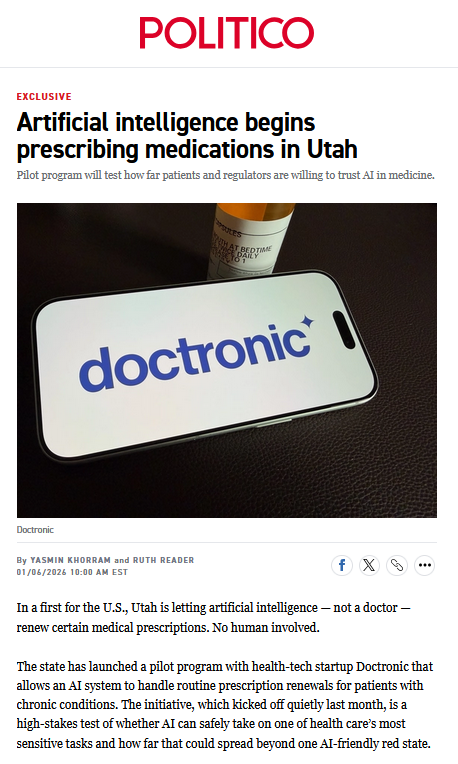
At the beginning of last January, the american state of Utah implemented a federal law that was passed in the spring of 2025, redefining who has the authority to prescribe pharmaceutical treatments. With just 21 – 22 words, legislators determined that professionals who possess a license from the law for issuing medications now include artificial intelligence and machine learning technology.
Is this a techno-scientific advancement that we should celebrate? Many say yes. And they explain: the human mind, at best, can simultaneously process up to 7 (seven) parameters for any given subject. In contrast, machines, with their neural algorithms and massive databases, can process all parameters. No matter how many there are.
Indeed. That’s why when these machines/algorithms make mistakes, they make monstrous errors: it’s due to the multiplicity of processing infinite data. And the truth is that “AI applications” make mistakes more frequently than those who sell them acknowledge.
Those who made no mistake were those who assigned to these machines the work that until recently we thought was doctors’ responsibility: they want to reduce healthcare costs for the public budget.
Will these “mechanical doctors” prescribe useless or even dangerous drugs for the benefit of pharmaceutical mafia? Oh come on now: algorithms are “objective”. And the engineers who create them have employers…