
On the 5th of last May, as part of the first world was gradually transitioning from the phase of ordered home confinement to a gradual “loosening of the straps,” the local high priest of the “6:00 prayer,” Mr. Sotiris Tsiorvas, spokesperson for the “holy health synod,” had something celebratory to say, without many clarifications:
… Started vaccine study in the United States based on messenger RNA technology, a pioneering vaccine manufacturing technique. With this vaccination technique, instructions are somehow given to the vaccinated person’s cells on how to construct proteins that resemble, but are not the virus. Thus, the vaccine leads to the production of something that looks like a piece of the virus, the virus’s spike, a pseudo-virus. And therefore you don’t get sick, but you produce antibodies that fight the real virus…
The enthusiastic priest was referring to the start of a clinical trial (vaccination of humans, that is) with a formulation whose laboratory name is BNT162, a joint product of the American pharmaceutical company Pfizer and the German biotechnology company BioNTech.1
The first reading of this paragraph should raise questions. According to this new technological approach, it is healthy human cells that are transformed (“in some way,” said the priest…) into “pseudo-diseased” ones… So that, subsequently, the human body will immunologically “react” against these very same cells of its own, which (“in some way”…) have been transformed into “pieces of the virus”…
The issue is interesting and particularly serious. It concerns an entirely new technology and perception of how the immune response of an organism is “triggered,” which has not been tested in humans to this day, neither regarding its effectiveness nor its potential side effects. Under the pressure (or/and provocation) of covid-19, this is now about to happen. Let us first see what this is about, with as understandable a description as possible.
Vaccines work in developing immunity in an organism through the introduction into it of parts of viruses or bacteria; or inactivated such pathogenic organisms; or through the introduction of the proteins produced by these microorganisms to “bind” to human cells.
This tactic has variations. The anti-tetanus serum, for example, introduces a specific immunoglobulin into the human body, which itself reacts immunologically against the two toxins of tetanus, until the organism produces its own antibodies. This is the direct action / intervention to limit infection and its consequences. The anti-tetanus vaccine, however, introduces inactivated versions of these toxins, allowing the organism to build defenses at its own pace.
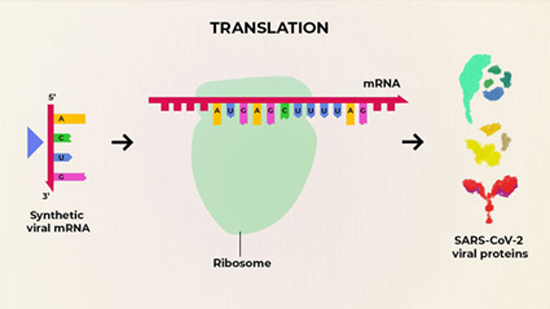
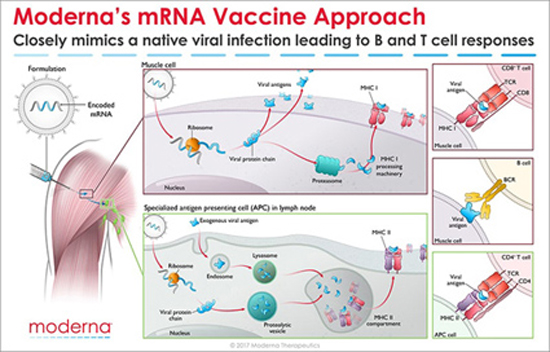
The mRNA technology, on the other hand, “tricks” the organism, forcing it to produce some of the proteins generated by the X virus itself. The initials mRNA stand for messenger RNA, and refer to an artificial molecule which modifies the genetic behavior of the cells into which it is introduced. This artificial molecule acts as a “template” for the pathogenic proteins that the modified cell is (supposedly) meant to produce, as it includes an artificially constructed genetic sequence of said proteins. It is supposed that this molecule (and its “instructions”) is a synthetic copy of the molecules of a virus that constructs its own proteins. When introduced into human cellular ribosomes, it is supposed that it “induces” the modification of cellular function so that instead of the usual production, this hostile protein begins to be produced. (Ribosomes normally perform protein synthesis on behalf of the cells in which they are located). This protein is “alone”, meaning it cannot become a normal virus. The immune system (always according to the rhetoric of this biotechnological injection) identifies the hostile proteins (which it itself has created) and begins to produce its immune defense.
One should note that there is a certain “diagonal” similarity between mRNA technology and traditional vaccines. Because even the latter can introduce the proteins of the pathogenic factor; that is, what mRNA technology forces some of the body’s cells to produce, by trapping them. So, since both methods rely on pathogenic proteins, why should mRNA technology be preferred? Isabelle Bekeredjian-Ding, head of the microbiology department at the German Paul-Ehrlich Institute, which belongs to the federal institute for vaccines and biomedicine of Germany, explains without circumlocution:2
… There are two parts to our immune system: the innate (the defense we have from birth) and the adaptive (that which develops as we come into contact with pathogens). Classical vaccines usually work through the adaptive immune system, and the innate is activated by another element, which we call the complement. It is interesting that mRNA can also trigger the reaction of the innate immune system, providing an additional level of defense, without the need to use something complementary…
… By making the human body produce the pathological proteins itself, mRNA vaccines bypass the industrial production process [note: meaning the proteins needed for classical vaccines] and thus can be produced more easily and quickly than traditional ones. In this case, the main benefit is the ease of production and, also, it is likely easy to scale up production, which is certainly something very important if we consider developing a vaccine for all of Europe and the world…
To put it simply: mRNA technology forces the body to do part of the work that the pharmaceutical industry has been doing so far; and thus saves time and increases profits for the companies!
Nano
Before we return to it, let us be allowed to describe the “dangerous genetic provocation” by which mRNA vaccines are supposedly facilitating an organism’s immune response; a clarification is needed. What is this “sort of” method of introducing the pathogenic “patron” into cells? They are nanoparticles and nanocrystals. Nano-materials are a rapidly developing field of new technologies, one of those that lead in many technical constructions but do not draw attention, because they are, if we can put it this way, infrastructure technologies.
It is, of course, completely different to make screens from nano-materials so flexible that they can fold, than to introduce such molecules into living organisms. The nanotoxicity is unknown (the “poisoning” of cells by such chemical or physical molecules of materials foreign to their composition), the biodistribution of nanoparticles, as well as the consequences of their accumulation inside cells. It is still unknown how long is the adequate study time of their bio-action in order to identify any side effects. Officially, seven years are considered the minimum time of basic research before preclinical trials of using nanoparticles as “drug carriers” in animals begin.
There is considered to be both positive and negative knowledge regarding this. mRNA technology, using nanoparticles, is employed for anticancer purposes. It is considered successful in mobilizing the body’s immune T cells against tumors. However, on the other hand, nanoparticles are also used in cosmetics, and there it has been proven that they are carcinogenic. More widely known is the case of talc powder from the chemical/pharmaceutical industry Johnson & Johnson.3
The nanoscale “delivery” of the protein “patron” to human cells adds an additional layer of uncertainty to how badly mRNA technology could end up. Especially since some biotech data used by pharmaceutical companies have been known for a long time, and although many attempts have been made to construct a vaccine against other coronaviruses using this method, all efforts failed already in animal trials.4
Experimental animals?
Isabelle Bekeredjian-Ding acknowledges at least that there is great ignorance about whether and how mRNA technology can work against covid-19. The immunization process against it has nothing to do with the analogous process against cancer cells. It is another part of the human “acquired” immune system that needs to be activated, the B cells. And “… there is very little experience with this,” she says. To complete:
… What is currently the real challenge is, I think, to understand whether such vaccines will actually be able to truly trigger an effective protective immune response in humans and also to understand what quantities of mRNA are needed for this to happen…
Other issues that are ignored are whether the selected “target proteins” are the correct ones; how targeted the body’s reaction to the virus will be; whether there will be side effects such as immune system overreaction, as occurred in some cases (without vaccination) in recent months, leading to pulmonary embolism and death; and/or to what extent cases might arise where, with the virus already present in the body, the mRNA vaccine could worsen the condition.
We would add something else. There is an increasingly expanded category of modern diseases called “autoimmune diseases”: the human body’s immune system turns against the body itself, considering it hostile! It is (scientifically…) unknown why such a thing happens, because among other things it is unknown how what in Western medicine is called the “immune system” works. In certain “autoimmune” conditions, technical management is applied that has been shaped by various “seeing and doing”. Nevertheless, ignorance is given and strong.
What does it mean, then, to force an organism (a part of it) to play the role of a “double agent”, that is, to produce by itself the pathogenic factor that will subsequently cause the immunosuppressive action of the same organism? What does it mean to artificially and biotechnologically transform certain points of a body into “enemy agents”? Why should something like this not lead to a generalization (on a population scale) of “autoimmune diseases”?
Within their ignorance, the technoscientists of capitalist 21st-century “health care” neither know the answers, nor are they willing to accept any challenge to the monopoly of “knowledge” they claim to possess. They have a serious motive: time and money must be funneled toward the pharmaceutical corporations, by turning human bodies into parts of these production chains…
In any case, this constitutes genetic modification of the human organism! Which is attempting to pass unnoticed, hidden within the fog of fear. Those in the West promoting mRNA technology in covid-19 vaccines know this. And they respond: … It doesn’t enter the DNA… Indeed, the genetic intervention/modification does not occur in the DNA but in the ribosomes of the cells.
What does this mean? That it is harmless?
(Will there ever come a time when “autoimmune diseases” will be explained politically/competitively as the resistance of the living against its transformation into capital equipment? Who knows?)
Ziggy Stardust
- A corresponding vaccine, named mRNA-1273, is being developed/promoted by the American biotechnology company Moderna, which began human trials first in March. ↩︎
- Five things you need to know about: mRNA vaccines, in the electronic magazine Horizon (the “magazine for research and innovation of the EU”), April 1, 2020. ↩︎
- Unstoppable machine, 15/12/2018, dust and debris. ↩︎
- Quantum dots (QDs), which are Bill Gates’ favorite scheme (which has also been adopted by the “World Health Organization”, to which the mafia that Gates represents is a major donor) for the digital tagging of everyone through vaccinations, are inorganic semiconductor nanocrystals, with various properties. This issue will require a separate analysis, soon. ↩︎