
Behold, according to a regulation from the end of the 17th century, the measures that should be taken in case plague breaks out in a city.
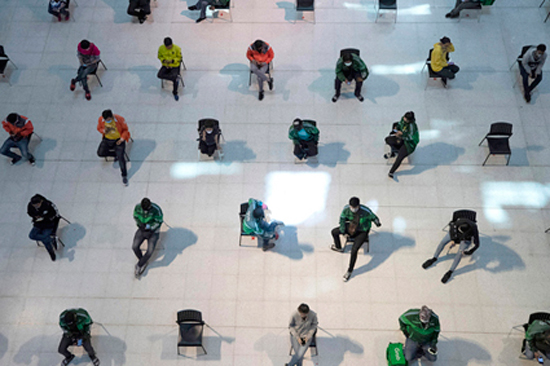
At first, a strict quarantine of the space: closure, certainly, of the city and the “territory”, prohibition of exit punishable by death penalty, killing of all stray animals; division of the city into neighborhoods, where a supervisor is appointed. Each street is placed under the authority of a syndic; he supervises it, and if he abandons it, he is punished with the death penalty. On a designated day, everyone is ordered to close themselves in their houses; whoever goes out is punished with the death penalty. The syndic locks the door of each house from the outside; he takes the key and delivers it to the supervisor of the neighborhood; he keeps it until the isolation ends. Each family must have made their provisions; but for wine and bread, wooden channels had been made in the streets and houses that allowed each person’s portion to be distributed without any communication between suppliers and residents; for meat, fish and vegetables, pulleys and baskets are used. If there is an absolute need for some people to leave their houses, they go out in rotation and without any meeting taking place. Only supervisors, syndics, guardsmen and also, among the infected houses, from one corpse to another, the “crows” will circulate, who do not care if they eventually die: they are “nothingness phantoms who carry patients, bury the dead, clean and offer various humble and menial services”. Space divided, motionless, frozen. Everyone is led to their position. And if they move, their life is endangered, due to contamination or punishment.
Supervision operates ceaselessly. The gaze is everywhere vigilant: there is “a significant constabulary force, directed by good officers and upright men,” there are guards at the gates of the city and at the town hall, and in all neighborhoods, so that the people’s obedience may be swifter and the authority of the municipal rulers more absolute, “but also to prevent all disturbances, thefts, and looting.” At the gates there are surveillance posts; at the end of every street there are guards. Daily, the overseer visits the neighborhood he has assumed responsibility for, finds out whether the syndics are performing their duties or whether the residents have complaints; “they monitor their actions.” Daily too, the syndic traverses the street under his charge, stops before every house, asks the residents to present themselves at the windows (whoever lives in a room that looks onto the courtyard has at his disposal a window that looks onto the street where he alone presents himself), calls each one by name, informs himself about the condition of all, successively – “if the residents do not tell the truth they are punished with the penalty of death.” If someone does not present himself at the window, the syndic asks to learn the reason: “He will then have no difficulty discovering whether they are hiding dead or sick people in the house.” Each one, locked in his cage, at his window, responds at the sound of his name and presents himself whenever asked: behold the great supervision of the living and the dead.
This surveillance is based on a system of continuous recording: reports from the syndics to the supervisors, and from the latter to the municipal officials or the mayor. During the first phase of the “tightening”, the roles of all residents present in the city are successively defined; “the name, age, gender, regardless of social status” are recorded: one copy for the supervisor of the neighborhood, a second for the town hall offices, a third so that the syndic can issue the daily summons. Anything observed during the visits—deaths, illnesses, complaints, irregularities—is noted and reported to the supervisors and municipal authorities. The latter have the upper hand in medical care, as they have appointed a responsible doctor; no other healer may intervene, no pharmacist may prepare medicines, and no confessor may visit a patient without having received a written note from him, “so that there is no concealment and so that he does not care for, in ignorance of the authorities, patients with contagious diseases.” The recording of the pathological must be steady and centralized. Each person’s relationship with their illness and with their death passes through the levels of power, through the recordings they make, through the decisions they take.
Five or six days after the start of the isolation, all houses are cleaned, one after the other. The residents go outside. In each room they remove or hang “the furniture and goods”. They pour an aromatic liquid and then burn it, after having first sealed the windows, doors, even the keyholes, which they have closed with wax. At the end they close the whole house for as long as the liquid burns. Research is conducted on the disinfectors upon their exit, as well as upon their entry, “in the presence of the house’s residents, to verify if they have anything they didn’t have when they came”. After four hours, the residents can return to their houses.
This enclosed and segmented space, which is monitored from end to end, where individuals are placed in a designated position, where even the slightest movements are controlled, where all events are recorded, where uninterrupted writing work connects the center with the periphery, where power is exercised undividedly, according to a continuous hierarchical form, where each individual is permanently located, examined and distributed among the living, the sick and the dead – all this constitutes a comprehensive pattern of the disciplinary mechanism. The plague cloak responds to order; it undertakes to unravel all confusions: the confusion of disease, which is transmitted when bodies are mixed together, the confusion of evil, which multiplies when fear and death eliminate prohibitions. Order determines for each person his position, his body, his illness and his death, his goods, as a consequence of a power that is everywhere and knows everything, which itself is subdivided in an orderly and uninterrupted manner, down to the final determination of the individual, that which characterizes him, that which belongs to him, that which happens to him. Opposed to the plague cloak, which is mixture, discipline puts forward its power, which takes the form of analysis. There was an entire literary mythmaking of the festival around the plague cloak: laws were abolished, prohibitions were lifted, time ran frenziedly, bodies mingled without respect, individuals were unmasked, abandoned their official identity and the form under which they were recognized, letting a completely different truth appear. But there was also a political dream of the plague cloak, which was exactly the opposite: not the collective festival but the strict separations; not the laws that were violated but the penetration of regulation to the utmost details of existence and through a complete hierarchy that ensures the hair-trigger functioning of power; not the personas that are worn and removed, but the attribution to each of his “true” name; of his “true” position, of his “true” body and of his “true” illness. The plague cloak as a form of disorder, simultaneously real and imaginary, has as its medical and political counterpart discipline. Behind the disciplinary mechanisms looms the obsession with “contaminations,” with the plague cloak, with uprisings, with crimes, with begging, with desertion, with people who appear and disappear, who live and die in conditions of disorder.
This is how the chapter “Panopticism” begins in Foucault’s “Discipline and Punish”. The measures that should have been taken in the event of a plague in a 17th century city have little in common with the measures taken in 2020. If someone finds similarities, these have to do with the power’s attempt to discipline individuals, constructing them as such through recording, surveillance and punishment. However, the processes are different. Disinfection is not carried out by state inspectors with aromatics and fires, but with antiseptics and sprayers. Food distribution does not take place with pulleys and baskets, but by workers with motorcycles. Breaking quarantine is not punished by death (ok, Philippines excepted), but by a fine. The transporters of patients and the dead are not considered wretched creatures but war heroes. The exit permit is not issued by the competent doctor, but by the general secretary of civil protection. The counting and checking of health does not take place with cadets under the windows, but with tests in diagnostic centers and “smart” applications. And this matters.
The reduction of every dystopian present to the junta and concentration camps of the past is useless for the preservation of memory and historical continuity, if at the same time the identification and highlighting of the changes that occur each time is not carried out, so that criticism can be competitive in the now. Otherwise, the risk of falling into ideology is a vain ambition far away.
Foucault identifies such a (structural) change between the way leprosy and the plague were dealt with, continuing:
If it is true that leprosy inspired the ritualistic exclusions which, to some extent, provided the model and general form of the Great Confinement, then the plague inspired disciplinary schemes on the contrary. Instead of a massive and binary division of us versus them, it demands multiple divisions, individualized distributions, an organization deepening supervision and controls, an intensification and branching of power. The leper is integrated into a practice of exclusion, of exile-enclosure; he is left there to be lost like a part of a mass that one is little interested in differentiating; those suffering from plague are integrated into a scholastic tactical quadrillage, where individual differentiations are the compulsory results of a power that multiplies, articulates, and subdivides. On one hand, the Great Confinement; on the other, the correct gymnastics. On one hand, leprosy and its separation; on the other, plague and its circumcisions. The first is stigmatized, the second analyzed and distributed. The exile of the leper and the restriction of the plague are not accompanied by the same political dream. On one hand, the dream of a pure community; on the other, the dream of a disciplined society. Two ways of exercising power over people, of controlling their relationships, of dissolving their dangerous mixtures. The pestilent city expresses the utopia of the perfectly governed city: it is a city traversed entirely by hierarchy, supervision, gaze, writing; a city which becomes immobilized during the functioning of an expansive power exercised discretely over all individual bodies. The plague (that at least which has not yet manifested) is the trial during which the exercise of disciplinary power can be ideally defined. To set rights and laws into operation according to pure theory, jurists placed themselves imaginatively in the state of nature; to see perfect disciplines function, rulers dreamed of the plague condition. At the heart of disciplinary schemes, the image of the plague equates with all disorders, with all confusions; just as exactly the image of leprosy, of the contact that must be interrupted, lies at the heart of exclusion schemes.
The infectiousness of leprosy, as something distinct and unidirectionally “communicable,” is incorporated and upgraded in the version of the plague; it now becomes invisible and indefinitely diffuse. As such, it requires not the prohibition of contact through targeted enclosures, but a universal disciplinary enclosure of the social body of the city. The prison-building is upgraded to a panopticon; the art of power (and) as specialization, becomes alienated from its own evolution; it is fragmented, classified, de-specialized and extended so that it can be exercised even by the hitherto unspecialized.
For Bentham, this power must be “…visible and unverifiable. Visible: the prisoner will constantly have before his eyes the imposing figure of the central tower from which he is spied upon. Unverifiable: the prisoner must never know whether he is actually being watched; but he must be sure that he can be watched at any moment.” The cells in Bentham’s prison are symbolic; they no longer have any utility. The chains and bars as the violence of power give way to the windows of houses and the inspectors of the city. The issue is “to replace a power that manifests itself through the brilliance of those who exercise it with a power that subtly objectifies those to whom it is applied; to form a knowledge of them rather than to unfold the pompous distinctive features of the supreme authority. In short, the disciplines are the ensemble of microscopic technical inventions that allowed the useful size of multiplicities to be increased, reducing the difficulties of power, which, in order to make them useful, must precisely direct them.”
These technical inventions, says Foucault, that panopticism creates as a “technology of individuals” are constructions similar to those created by the other sciences, through the dual process of accumulating knowledge from power (in the form of institutions: university, hospital, laboratory, etc.) and the consequent development of power, which in turn opens the way to new possible knowledge. The connecting link of each such (scientific) dual process, which connects the previous with the next, is the disciplines which “constitute nothing more than a sub-law. They appear to extend to the infinitely small level of individual existences the general forms defined by law,” categorizing, classifying, and specializing. In the case of panopticism, the “technology of individuals” activates and allows the increase of “immediate and material power that people exercise, some over others.”
The substantial changes are two. The internalization: “He who is subjected to a field of visibility, and who knows it, accepts the constraints of power; he puts them spontaneously into operation upon himself; he inscribes within himself the power relation in which he simultaneously plays both roles; he becomes the constitutive principle of his own subjection. This allows external power to relieve itself of the material burdens of its operations, tending toward the immaterial element; and the closer it approaches this limit, the more stable are its effects, the more profound, acquired once and for all and extended indefinitely: a definitive victory that avoids any physical confrontation and which has always been decided in advance.” And the universality: “The panoptic schema is intended to spread throughout the social body, without losing any of its properties; its destiny is to become a generalized function within the framework of the social body.”
The incorporation of the fear of power by the plebeians, as well as the power’s attempt to impose itself universally, one could say that it always held true1. However, the evolution of these processes, the upgrading of methods, and the gradual shift of responsibility for discipline from the guard to the prisoner, shape new paradigms within the same reality. With the “new normality” being the most popular expression for what is coming, and within the ongoing 4th industrial revolution, we will make reference to certain points on which the realization of the panopticon’s political dream is based: “the penetration of regulation to the finest details of existence and a complete hierarchy ensuring the capillary function of power.”

The omniscience of work
For the restructuring of work in terms of “people’s technology,” Taylor offers it to us wholeheartedly:2
There is another type of scientific research mentioned at various points in this report that deserves special attention, namely the precise study of the motives that influence each worker. Initially, it would seem that this is a matter of individual observation and judgment, and that it is not a proper subject for exact scientific experimentation. It is true that the laws derived from experiments of this category, due to the fact that their subject is a highly complex organism—the human being—include a large number of exceptions, greater than the laws governing material things. But it is beyond dispute that laws also exist here, which can be applied to the great majority of workers, and which, if clearly determined, are of great value as guidelines for the relationships between management and workers. For the development of these laws, accurate, well-designed, and well-executed experiments can be conducted over a period of several years, similar in general outline to the experiments on various other elements to which I have referred in this report.
Perhaps the most significant law belonging to this category, in terms of its relation to scientific management, is the consequences that the idea of duty has on the effectiveness of the worker. This has proven to be such an important element of the mechanism of scientific management that it is known by a large number of people as “management through duties.”
There is nothing new in the idea of duty. Each of us remembers from his own case that this idea was applied with good results in his school days. No effective teacher would think of giving a class of students an indefinite lesson to learn. Every day a definite, with a beginning and an end duty, is given by the teacher to each student, saying that he must learn exactly these things about the subject; and it is only through this way that the correct, systematic progress of the students can be achieved.
[…]
I have described in other reports a series of experiments conducted with workers, which ultimately demonstrated the fact that it is impossible, for any period of time, to persuade workers to work harder than the average worker around them, unless they have secured a substantial and permanent increase in their wages. […]
It is therefore absolutely necessary that when workers are given a daily task that requires high speed on their part, they should also be assured of higher pay if they manage to accomplish it. This requires not only the stabilization of each worker’s daily task, but also their payment with large bonuses, every time they manage to complete the task within the given time.
[…]
These two elements, duty and bonus (which, as I have shown in previous reports, can be given in various ways), constitute the most important elements of the scientific management mechanism. They are particularly important because they represent the culmination, which presupposes that all the other elements of the mechanism have been used earlier; such as the planning department, precise timekeeping, standardization of methods and tools, a system for the development of operations, training of operational supervisors (or instructors), and in many cases instruction cards, slide rules, etc.
The detachment of work experience from the “foundation” of scientific management, through recording, timing, and eliminating unnecessary movements, seems insufficient if not accompanied by the creation of incentives. The regulation of work intensity, when left to individual discretion, is influenced by personal motivations (covering one’s needs) and by the regulation imposed by the “labor market” (consciously or not), defending its collective interests. The assumption, therefore, of individual duties functions as this slight shift of responsibility for discipline from management to the worker; the purpose of the enterprise, the increase in productivity, is fragmented and distributed to individuals in the form of personal duty. Along with the incorporation of responsibility for increasing productivity comes the corresponding supervision. When the purpose of the enterprise has now become part of personal motivation, no guard is needed to monitor performance, but only a manager, who (re)organizes duties, offering bonuses to those who fulfill them. In the panopticism of labor, duty functions as supervision and the bonus as (exemption from) punishment.
Within more than a century, from its earliest applications, scientific management has advanced significantly. Technological restructuring imposes new methods of production which in turn require an upgraded organization of work. The evolution of production and the emergence of the tertiary sector, the toyotist organization of production chains in a customer relationship, state regulation of labor, the rise of self-employed individuals, are the key points that map out this upgrade. The detailed development of these points, regarding how they contribute to the completion of the “political dream of the panopticon”, although useful, we believe can emerge from the sketching so far of the methods of this dream. And perhaps here, it ends up being nonsense.
What needs to be noted here is that the scientific organization of work has long since escaped the narrow confines of the factory, as a result of the socialization of work itself. The above mapping points confirm this. The cycle of capitalist production—and the surveillance that corresponds to it—is no longer limited to the formal structure of the factory/company, but is diffused throughout the social (factory); along with the circulation of commodities. At the same time, the detachment of duty (and of punishments/bonuses) from the narrow space of work and its expansion into the rest of the space and time of everyday life gradually upgrades and discretely introduces the incorporation of discipline into every resource of the (social) body.
The “technology of individuals”, in its attempt to re-construct new normalities, assigns to each person their “true” name; their “true” position, their “true” body and their “true” illness; thus shaping new subjectivities. We have referred to these, in the recent past.
The panopticism of the self as capital
To distinguish the form of the new subjectivity, we can use the method of duty assignment of scientific management. If in the case of the factory, where everyone has accepted the obligation to complete a part of the production, the incorporation of duty—along with the corresponding supervision—shapes the worker who identifies with the enterprise, in the case of the social factory, this identification occurs with the entire set of disciplines governing the relations of production and the circulation of commodities.
The inevitable tendency of capitalism to expand, when space was exhausted, forced it to extend into time. The alienation of “time outside of work,” through mass consumption and the commodification of everything, occurs on terms of organizing labor; (and) therefore we can speak of a social factory. More accurately, it occurs on terms of circulation of commodities, including labor power as a commodity, where in combination with the expansion of the productive process beyond the limits of the classical factory, it determines the entirety of social life in terms of supply and demand; hence on terms of organizing labor.
The “truth” that fulfilled this pancake’s political dream for everyone is the notion of the self as capital; which is consumed with praise. We copy from the relevant report:3
It essentially involves constructing a self-perception not as a “producer of wealth,” no, therefore not as a worker, but as “capital.” As a set, that is, of individual characteristics that can and should be utilized by each person with entrepreneurial logic and the purpose of “profit.” To be utilized not only “economically” (although that is the ultimate goal) but also “sexually,” “relationally,” etc. It is thus a self-perception built upon “investments” in the Self, and the anticipation of the future “return on these investments.”
[…]In the Human Capital chapter, the fixed dimensions are the already acquired (and certified) knowledge, the already gained experience, the existing social relationships, “skills”, the state of health and anything else from life that can be “capitalized”.
Another form of (regular) capital is the commodity. If the fixed form has something static, it is a form already realized in its basic characteristics, the commodity form is dynamic: it is displayed, and must be constantly displayed; and it must evolve/adapt (or, more precisely, appear to evolve/adapt) to the “demands of the market” (of commodities). Being “showy” was once considered inappropriate and unseemly. Now the opposite, for example discretion or “secrecy,” is a scandal and a disadvantage (for the capitalist exploitation of the Self). The display of the Self, and permanently playing a theater of “evolution/adaptation” is, on the contrary, fundamentally positive. Capital-Self is not only capitalistically exploited when “it amortizes investments in the Self and surplus and profits arise,” but also when it is consumed. Even when it self-consumes.
This process of self-consumption and consumption of the Others is now called sociality. And it corresponds absolutely to the “socialization” of (normal) capital and its rules!!!
Just as the market for capital goods doubles and transforms the labor market into a rejection of working-class consciousness and working-class negativity, so too has the commodity market become the general model of social relations, transforming the use values of these relations into exchange values. Explicitly or implicitly, social relations become commodified. Not simply mediated by commodities; but, even more deeply, constituted upon a “commodity morality and aesthetics” – if we may put it that way. And just as in the first case, so too in the second, it is not separate Selves that shape the rules. It is the general and impersonal capitalist development.
… the greatest success of this development lies […] in the reconstruction of (social) subjectivities, in two times, in two steps so far. First in the reinforcement of you are what you buy. And then, complementarily to the previous, with the reinforcement of you are what you sell (from your Self) as image, as appearance, as surface, as inscription, as components/”interests”. It is about two faces of “identity” and the politics of identities.
[…]The Self Capital, whether as “fixed” or as “commodity”, is obliged to be in maximum overdrive of “utilization”. In the end, thanks to this intellectual / ideological unification of the “sphere of production” and the “sphere of consumption” regarding the constructions of “identities”, there are no class contradictions in post-industrial capitalist societies! More accurately: there should be no such contradictions; they are “useless”… There is no mass “surplus value extraction” – we must swallow this!! What happens is merely a variety in how much and what each person can produce and consume…
Within this universal discipline of daily life in the (Foucauldian) sub-juridical domain of the market, the (Taylorist) duty corresponding to each individual can only be universal. The Capital Self not only identifies with production, nor solely with consumption; being “obliged to be in maximum over-tension of ‘exploitation,'” essentially accepts as personal incentive the obligation to fulfill part of the overall purpose of capitalism, incorporating universal surveillance; with punishment being bankruptcy and bonus being paradise.
The raw material of the new normality
“The information age” is one of the expressions that characterize the importance that information holds today. An introduction to the evolution of technology and the centrality of information in daily life is rather unnecessary; we consider it somewhat self-evident. But what does it mean for information to function as raw material?
Regarding the surveillance capitalism,4 Shoshana Zuboff states that the raw material is the individual; specifically, the information (data) about the individual. In short, she means all this collection of data and the even more significant meta-data5 from companies, organizations, states, from which surplus value is extracted; either in economic terms, or in terms of power. The issue concerns big data and their utilization (and) in shaping behaviors.6
We also do not know whether Foucault in 1977, when he wrote “Discipline and Punish,” foresaw this development that information technology has taken in recent years, but in his description of Bentham’s prison, he identifies in the prisoner’s condition the element of “disconnected” information: Each one, in his position, is well locked in a cell from which the guard sees him face-to-face; but the side walls do not allow him to have visual contact with his companions. They see him but he does not see them; he is an object of information, but never a subject within the framework of communication.
Is information the raw material of the new normality, simply and solely because there is this rapid evolution of information technology? No—because people and their relationships do not “emit” information. Reality is far richer than encoded, abstract, and decontextualized representations. The conception of social experience as information is the product of the “timing” of the corresponding scientific organization of sociality! And the rapid development of technology is essentially a result of this process—not the reverse. The bio-techno-security complex, as a new “institution,” extracts social knowledge and experience, fragments it, categorizes it, and calculates it, by transforming it into—and utilizing it as—information.
The Self-Capital is the appropriate subjectivity; measurable, classifiable, exploitable as a commodity-information. Its body is expressed in repetitions of movements and pulse measurements, in calories, in ratios, in milligrams of substances and cholesterol limits. Its knowledge/memory in algorithmic calculations, in stored data for retrieval-on-demand and specialization. Its communication in image exchange and contact networks. It also drags along the embedded surveillance that its (social) capital needs; it continuously monitors the progress of its shares.
As a continuous extraction process, “individual technology” finds the new oil: information; which now exists in abundance and is ready to feed the new normality.
Discipline in the new society
The accumulation of information has as a result the evolution and accumulation of technology. The production of new technologies is now so great that it cannot be consumed; artificial intelligence and robotics, computer science and networks, smart applications and platforms, biotechnology, energy and equipment technologies have been upgraded so much and so quickly that they do not manage to find practical application in their entirety in everyday life. If all these have been constructed solely for social media and video games to exist, then the market is heading towards bankruptcy/crisis, and the delay in restructuring social relations and (socialized) labor, so that they can consume this accumulated commodity, is an obstacle.
Restructuring means destruction of capital and restructuring of social relations means destruction of the self-capital. Not entirely but, as with normal capital, a part of it in order to accommodate in turn the new. If until now the self-capital had been shaped by the terms of the free capitalist market, floating carefree in the freedom of choices without orientation, conflicting with the remaining commodities, the new normality imposes new restrictions and disciplines. A re-organization of the casualties left behind by “individual freedom” is necessary for a cohesive acceleration on the terms of the 4th industrial revolution. Acceleration in order to exploit the accumulated merchandise, but also due to intra-capitalist competitions.
We recently experienced the first glimpses of this acceleration, and perhaps we can discern the forms it is beginning to take. For example, reliability may no longer be information stored in a computer, but the terrorism of death was based on its numerical representation. The conception of knowledge as information automatically activated discipline through mediated trust in experts, a trust that will find its way into machine therapy. The fear of devaluing self-capital in terms of health created “responsible citizens.” Masks and gloves, physical distancing, and eyes on the street increased the intensity of self-monitoring and mutual monitoring.
It is still the beginning of this change and we do not know what the future holds for us, but it would be good if the new subjectivities would start making room in their capitals’ pluralism to accommodate the disciplines of the responsible citizen and trust in the arrangements of the experts. Mutual supervision will be the bonus of undertaking these duties.
Of course, reality is not that universal. The defiance towards experts is one example, and the world circulating outside, after quarantine, yet another. However, it was never the complete universality of power that imposed discipline/punishment; but rather the legitimization of an already cultivated (not necessarily majority) social behavior, which separates the legitimate from the illegitimate, the healthy from the sick, assigning to each their own reality.
Wintermute
- The concern about whether there are records of authoritarian instincts in DNA is useless. If it is true, then the existing order uses and sharpens them. If it is not true, then the existing order creates them, uses them and sharpens them. “Therefore, once created, these records remain and are passed from generation to generation” would be a reasonable conclusion; but this is not the place and time for an “environment or gene” type dialogue and a critique of genetic ideology. Those interested can search related topics in previous (and subsequent) issues. ↩︎
- The scientific organization of work – Frederic W. Taylor, anti-school editions. ↩︎
- Presentation of the event “wage or income” (the denial of wage labor by the right), by the working group 7ψχ (7yx.gr) – Written version in “Notebooks for Working Use no.4”. ↩︎
- You can view the relevant video in the videoc section ↩︎
- We would say that they are the information around and behind the central information. For example, in a photograph the central information is the faces and the meta-information is the place and time the photograph was taken, the medium used, the body poses and facial expressions, the space and lighting, etc., etc… ↩︎
- More at “big data: surveillance and shaping behaviors in the 4th industrial revolution” | Cyborg #16 ↩︎