
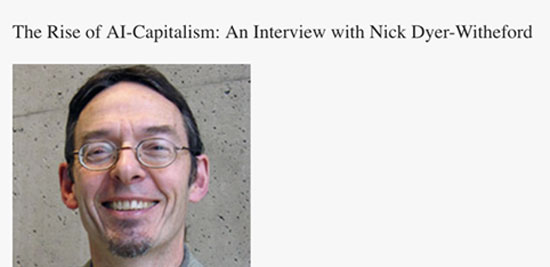
Interview with Nick Dyer-Witheford by Brian Justie
published on March 11, 2020 in Los Angeles / Review of Books
Question: Inhuman Power1 is characterized by you simultaneously as “a Marxist critique of artificial intelligence” and as “a critique of Marxism influenced by artificial intelligence.” What is it that makes this particular historical moment suitable for such a dual framework?
Answer: The moment is appropriate due to the explosive entrepreneurial interest in artificial intelligence and the applications of machine learning and other branches of artificial intelligence research. Major computer companies have reached the point where they consider human consciousness and biological limits as an obstacle to accumulation, and they foresee the potential to overcome this obstacle through machine learning, advanced robotics, and other technologies of the “4th industrial revolution.” Artificial intelligence today is in an initial stage, limited to specialized applications, far from human equivalence or general human intelligence—that level which is the stuff of science fiction—although such is indeed the goal of some serious research programs. Nevertheless, even this limited version of artificial intelligence has entered daily life, in the global North/West, in China, and to some extent globally: its algorithms organize the operation of social media, economic activities, virtual games, workplace control, social welfare systems, and police surveillance.
We are therefore in what, together with Atle Mikkola Kjosen and James Steinhoff (co-authors of the book), we call “artificial intelligence’s actually existing capitalism.” Its technologies will continue to colonize what we considered exclusively human abilities, and will be applied to an ever-expanding range of activities. As James Steinhoff argues, artificial intelligence could ultimately become what Marx called the “general condition of production,” a basic infrastructure for every commercial activity, just as steam engines and trains were in the 19th century, or electricity and mass transportation in the 20th.
This process unfolds almost exclusively under the guidance of giant oligopolistic corporations – Google, Microsoft, IBM, Amazon, Facebook, Alibaba, Tencent, Baidu – with the help of governments thirsting for artificial intelligence applications in national security. Marx would have understood this development very well. Therefore, we need a Marxist critique of artificial intelligence as arguably the primary contemporary example of profit-driven and revolutionary/oppressive techno-scientific knowledge appropriation. However, this same process challenges the humanistic assumptions present in the Marxist conception of labor: therefore, we also need a critique of Marxism from the perspective of artificial intelligence.
Question: Marx’s latent humanism is one of your main targets in the second half of the book. Can you say a few things about this?
Answer: For Marx, the pinnacle of capitalist mechanical equipment was naturally the factory based on steam engines, which existed in his time—a technological regime that employed and exploited workers on a mass scale. Therefore, he could continue to regard the machine as a complement and derivative of human labor—as “dead labor” that originates from and must be activated by “living labor.” He had one or two prophetic glimpses regarding the marginalization of workers that extreme automation could cause, moments within his work that remain contested within the Marxist tradition. But Marx never encountered even an early mechanical computer, nor did he anticipate artificial intelligence. What artificial intelligence research brings into view, however, is the possibility that mechanical “supplementation” to labor becomes the main game. And that the boundary Marx perceived between living and dead labor collapses.
Question: The stark distinction between the “living” and the “dead,” between the human and the non-human, occupies a central place in your book. But the perspective of destabilization can be read as a harbinger of a dystopian threat or as the realization of a specific utopian promise. Therefore, what do you think about the ever-expanding circle of significant players in Silicon Valley who rally around the nebulous idea of “human technology”? Humanism, as others have shown, is once again in vogue!
Answer: The push towards creating digital technologies that would always support humanity has always been significant. For example, it was present at the inception of the internet, in the hackers’ raids on the network of networks that were under the control of the Pentagon. And this kind of liberating hope keeps recurring steadily. But the inhuman force that hinders this hope is the market. This is what Marx was referring to when he wrote a phrase from which we took the title of the book: “In the end, an inhuman force controls everything.” What we emphasize is the way capital directs and designs technologies as an extension of the market’s power, as means not for human development but for the accumulation of profits. With the emergence of artificial intelligence, these means seem to be acquiring life themselves, making capital largely independent of the human element.
In the 1990s, in the early days of the internet’s socialization, when I first began writing about digital technologies—before the business world found a way to absorb them—there was an intellectual and political ferment, a tension surrounding the potential of creative commons, open-source software, and decentralized collective global communications: dot.com ambitions and dot.communist visions spread side by side. But in the mid-2000s, after the collapse of the dot.coms, capital truly landed, managing to integrate digital technology by developing the model that Nick Srnicek calls “platform capitalism,” which relies on the accumulation of big data, precision advertising, and the commodification of user-generated content, all managed by algorithmic processes that are now being intensified by machine learning, essentially still limited forms of artificial intelligence.
Where are we now? We are in a system that, in order to accelerate the promotion and sales of goods, combines mass surveillance with targeted distribution of attention-addictive content, regardless of the toxic social and ecological consequences; a system dominated by giant corporations, with the peripheral losses being thrown onto the temporary, low-wage, and precarious workers—the click workers. It is the oligopolies that created this regime—Google, Facebook, Amazon, Microsoft, and their Chinese counterparts Baidu, Alibaba, Tencent—which, with state support that they reciprocate by enhancing public order and national security, essentially direct the development of machine learning and other artificial intelligence technologies, taking care to embed their commercial priorities into the design, as well as those of their military and para-military partners. Today, renewed hopes for liberating digitization are largely futile, unless we want to think about dismantling and dispossessing the current artificial intelligence–industry complex.
Consequently, for such hopes to be expressed by the “power players” of Silicon Valley, and moreover embedded within this complex, is, at best, hypocritical.
Question: I would like to focus on this reference to the “current AI-industry complex” or what you said “surveillance capitalism of artificial intelligence”, a central issue in the book. The consequence of such an approach is that this type of AI capitalism must definitely be considered as something different from its predecessors, with a difference of kind and not just degree. This brings to mind Shoshana Zuboff’s recent book The Age of Surveillance Capitalism. Some who reviewed her book argued, I think correctly, that surveillance and capitalism are old partners, and that consequently the strong claim that it is a new model is excessive and potentially misleading. Does AI capitalism constitute a new model?
Answer: I will respond at two levels. The first is simple: it is generally accepted that while capitalism has a stable logic—the commodification of everything—it periodically changes the way this logic is implemented, altering the composition of dominant technologies, the organization of labor, consumption practices, and so on. Thus, for example, Fordism of the mid-20th century, organized around the assembly line, mass labor, and mass consumption, evolved at the beginning of the next century into post-Fordism, into a system of digital technology, flexible (as they call it) labor, and targeted advertising. In Inhuman Power, what we argue is that artificial intelligence will be a significant element in yet another transformation—or, as David Harvey puts it, in the “sea of changes” in the ways capital operates. Therefore, our position here is an extension and synthesis of previous capitalist periods.
However – and this is the second level – by predicting an “artificial intelligence capitalism” what we are referring to is a transformation that could cause some very serious problems, perhaps even in capital itself; and if not, certainly in human subjects. And, furthermore, as a minor side effect, in Marxist theory. This last point, of course, has to do with the condition of labor in the age of mechanical intelligence.
A few years ago, an extensive alarm emerged regarding the “robot revelation,” a sudden crisis of technological unemployment. These fears of a sudden “end of work” are now countered by the significant rise in employment levels in the post-recession era; albeit with uncertainty regarding wages and working conditions. But in the longer-term, there are real prospects that the adoption of artificial intelligence could, in gradual and indirect ways, weaken and make shallow the relationship between labor and wages. We perceive this as a slow tsunami. Waves of technological unemployment across various sectors, reinforced by their synchronicity with business cycles and economic crises: these may be pieces of the slow tsunami. Likewise, various intermediate phases of job transformation, where for example truck drivers become simple escorts/accompaniers of automated trucks, or people laid off from telephone centers that now operate with artificial intelligence find themselves covering the needs of algorithmic banking services.
But the issue does not end there. As Jason Smith says, under capitalist conditions people must sell their labor power in order to avoid complete marginalization, so even if automation advances, they will seek employment and find exploitation, or seek self-employment and find self-exploitation, in increasingly baroque forms of service provision. But work under AI capitalism will likely be periodic, precarious, de-skilled, and disposable, controlled by opaque programs which, at some level and above, will be incomprehensible even to their own creators. Under such conditions, the human element will be largely peripheral both to production and to profitability.
The issue will most likely not be so much unemployment but rather incapacity; a workforce without power, as capital gradually becomes independent of the human. From this perspective, AI capitalism could prove to be a period not so much akin to Fordism or post-Fordism, but rather closer to the process of primitive accumulation, during which capital pushed populations away from their land and into industrial labor; except that now the movement will be in reverse. It could be the starting point of a futuristic accumulation period, in which capital, instead of accumulating proletarian labor power, will gradually, over the centuries, marginalize and discard it.
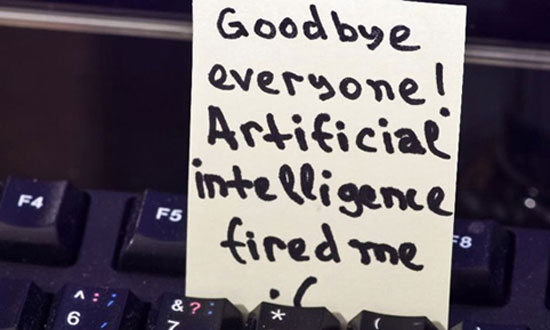
Question: Other authors in the Marxist tradition see autonomism and accelerationism2 as a viable response to artificial intelligence capitalism. Why, in your opinion, are these not effective?
Answer: The leftist accelerationist view regards the development of artificial intelligence as a promising tool for socialism, which will liberate people from wage labor and enhance the possibilities of economic planning. And specific branches of autonomist Marxism express a similar enthusiasm, based on the belief that the development of artificial intelligence will support and strengthen distributed techno-scientific knowledge about the human condition – even if it is cyborg – of the general intellect. These positions are permeated by a particularly modernist confidence in the essentially progressive direction of capitalist technological development, a conviction that is part of Marxism. I do not exclude the possibility of emancipatory uses of artificial intelligence. But what is being accelerated now, in the current development of artificial intelligence, is capitalist command over (and the ability to dispense with) workers. And what is expanding is not the autonomy of labor from capital but capitalist independence from the human.
This is not a matter of abstract futurology. Leaving aside the question of a long-term crisis of labor, what we see today is that the dominant applications of artificial intelligence are intensifying processes that have been underway since capital began its governmental assault on the organized working class, decades ago. These include the increasing temporariness of work in the gig economy, which has a direct relationship to the creation of artificial intelligence itself, as well as the development of machine learning by companies such as Uber or Amazon; the polarization of the workforce between a techno-managerial elite that has taken up the automation of many jobs, and a service sector where mainly women and migrants work, whose labor is largely cheap enough that it is not profitable to automate it; shifting the cost of education and skills improvement onto individuals themselves, in the hope that they will withstand the consequences of the fourth industrial revolution; the intensification of control over work spaces/times; the linking of this surveillance with propagandistic campaigns of algorithmic precision executed by bots, funded by wealthy reactionaries; and the integration of artificial intelligence with the actuarial regime of big data for the disciplining of the poor, from the screening of welfare benefits to predictive policing. This mixture of temporariness, polarization, surveillance, propaganda and policing constitutes – to use a phrase from David Noble, that great radical historian of digital technology – the “current intensive” politics of the capitalist artificial intelligence project.
Question: Do you see any perspective?
Answer: The political response is not acceleration but denial. And this has indeed begun to manifest in a range of social resistances. These include strikes by gig economy workers, protests by Silicon Valley tech workers, anti-surveillance movements, urban protests against the smart city, disengagement from social media sites, and backlash (“techlash”) against the oligopolistic concentration of digital forces. This is the new composition of the order against capitalism of artificial intelligence. Such denials will always be labeled as Luddism, but in our view, such characterizations are simply irrelevant. The issue now is not the containment of an emerging techno-capitalism, but the avoidance of its potentially catastrophic termination. This moment of denial is necessary to keep the future open under conditions of capitalist artificial intelligence, to gain space and time for the truly collective control of artificial intelligence.
Inhuman Power was published last year, but since then we have seen significant developments that confirm its approaches: renewed warnings from prominent artificial intelligence scientist Stuart Russell about existential threats from AI; law professor Frank Pasquale’s proposal that the “accountability” of new digital systems must include the ability to ban them or impose restrictions on their licensing; and the inspired Manifest-No of feminist data scientists who called for withdrawal from the disciplinary, prejudiced, and intrusive development of machine learning. These calls come from positions different from our own but share the recognition that new developments in machine learning require a response that ensures a future where, even if the nature of the human undergoes significant changes, these transformations will not be imposed by the commercial monoculture of artificial intelligence capitalism.
If we want an image of what such an answer entails, we need look no further than the images coming from the streets of Hong Kong and Santiago, where protesters against poverty and inequality use lasers to block facial recognition technologies and police drones.
This is how the struggle against inhuman power is waged today.
Translation / rendering Z.S.
- Inhuman Power, Artificial Intelligence and the Future of Capitalism is the title of a book published in 2019.
There is also an event/presentation available by all 3 authors that took place in Toronto on November 22, 2019, here. ↩︎ - Accelerationism is the idea that if capitalist processes, especially technological changes, are accelerated, a radical social change will emerge. ↩︎