
The “theory of pathogen pressure” concerning (human) values or sociality is a recent, comprehensive approach to human social psychology and behavior. As an ecological and evolutionary theory of human cultural values/basic choices, it is widely applied to many aspects of human social life and human behaviors. It is a general theory of human culture and sociality. Fundamental to this theory is the behavioral immune system. The human behavioral immune system includes: psychological traits and manifested behaviors for avoiding contact with various infectious diseases; behaviors of popular social preferences, altruism, cooperation and obedience for managing the negative outcomes of infectious diseases; mate selection to enhance personal and offspring defense against pathogens; dietary behavior; and constituent elements of personality.
The behavioral immunity aspect for avoiding infection is far more than just avoidance and aversion towards foreigners (xenophobia). It also includes preference for maternal or local areas (philopatry) and, consequently, avoidance of foreign people and locations where new pathogens may emerge. The theory of pathogen pressure has generated an abundance of freshly discovered patterns, and clarified patterns of human behaviors that had been recently discovered, both at the individual scale and at the scale of cultures/societies and regions. In innovative ways, it enriches and synthesizes knowledge from fundamental fields of social life and issues of human sociality, ranging from prejudices and perceptions of equality to personality, economic behaviors, the value core, interpersonal violence and intergroup violence, governance systems, gender relations, family structure, and the generation and maintenance of cultural diversity worldwide.
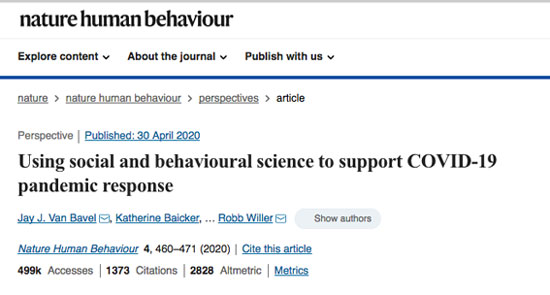
This is a concise and comprehensive description of a scientific theory that we ignored and you ignored – wrongly! It is called The Parasite-Stress Theory of Cultural Values and Sociality1. Without effort, you will recognize that everything we have been “pulling” (hundreds of millions) for 2 years now, under the sanitarian terror campaign, has a scientific theory behind it. And plenty of extra postgraduate and doctoral studies are conveniently underway – in the shadow of the extraordinary victims. (That’s how science progresses, though, and since we are not specialists, we must keep quiet, isn’t that right?)
The various branches of behaviorism have cast their nets where the “layman” would not expect. The “theory of infectious pressure” is not a simple socio/psychological theory about how our species reacts to dangers in general. It starts from the premise that in modern (capitalist) societies, traditional, visible “natural” dangers have either disappeared or are manageable. On the contrary (according to “scientists”), pollution (from invisible microorganisms) takes (or can take, and therein lies the “experimental” character of the recent hygiene terror campaign…) a central place not only in individual/collective fears but also in the modification, potentially definitive, of behaviors. According to behaviorists and various socio/psychologists, collective fears have played a significant role in the evolution of the human species. They do not only refer to how our general relationship with natural factors, living or not, has played a role in the biological shaping of homo sapiens. But also (and often mainly) to how these relationships shaped (different) forms of social organization, (different) customs, traditions, and behaviors. And to how this can be repeated, systematically and organized.
Consequently – and this is the explosive conclusion of the “theory of infectious pressure” – the threat of contamination can act “revisionarily” (we say restructurally) on the social organization, ideas and practices of subordinates. This conclusion is not at all distant from the temptation-of-power; on the contrary, it feeds it: to achieve and guide such a restructuring by using the threat of contamination. It is a branching out of the corporate “management by stress”, the organization of work and the increase of productivity through constant pressure. Except that here it is not about pressure in the specific spaces/times of work, but about a universal campaign of “evolutionary” reshaping of the species’ overall life, including its biological constants. Some, not unjustly or excessively, consider that the theory (and application) of infectious pressure is one of the fundamental means of promoting post-humanism: it can be considered as one of the foundations of applicable, biotechnological/behavioral Darwinism.
Indeed: by assigning a decisive role to bacteria and/or viruses in the social and biological evolution of the human species, the “theory of infectious pressure” leaves considerable room for another theory. The theory of the coevolutionary character of culture and genes (Culture-gene coevolutionary theory). The deterministic view of absolute genetic determinism of life (based on DNA…) is commercially catchy, suitable for mass (and ideological) consumption so far, but is strongly disputed among “experts”2. A 50-50 split of causes, half in the genome and the other half in the (social) environment, is more convenient and clearly offers many more possibilities for management and control.
A key term in the unfolding of the “theory of infectious pressure” is the behavioral immune system. Its inventor is considered to be the psychologist/behavioralist Mark Schaller in 2011, a professor at the University of British Columbia. The “borrowing” from biology has significant ideological and political implications. The “behavioral immune system” is not invisible or internal to bodies; it is external and social. It essentially relies on the senses (sight, taste, smell, and touch) and functions, according to its inventor, as a “first line of defense” for individuals and social groups against anything “suspected of being infectious.” According to this theorem, xenophobia and racism are nothing more than manifestations of this “behavioral immune system,” while analogous (positive: protective) manifestations include familism, localism, and/or nationalism.
Schaller himself wrote in Scientific American on June 14, 2011:
We have prejudices against all kinds of other people, based on external, physical characteristics: we react negatively to a deformed face; we avoid sitting next to people who are obese, elderly, or in a wheelchair; we prefer family friends over strangers. If I ask you why these prejudices exist and what someone can do to reduce them, your answer likely would not include the words “contagious disease.” Perhaps it should.
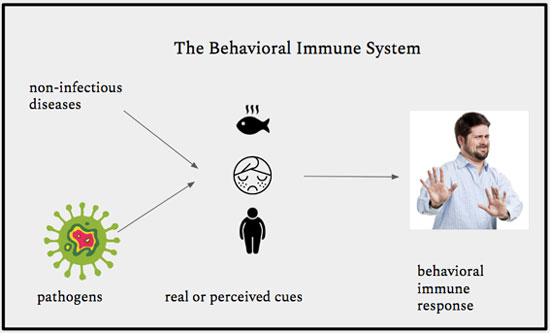
What does a contagious disease have to do with these biases? The answer lies in something I’ve come to call the “behavioral immune system.” The behavioral immune system is the way our brain engages in a form of preventive medicine. It is a set of psychological mechanisms designed to detect the presence of disease-causing pathogens in our immediate environment, and to respond to them in ways that help us avoid coming into contact with them. This has many serious consequences – for prejudice, sexual attraction, social interaction, even for the origin of cultural differences. (And, yes, also for health).
It is immediately striking that people can develop aversion towards individuals who actually have some contagious disease. But why does it happen that they also develop aversion towards completely healthy individuals? Because it is impossible to directly detect the presence of bacteria, viruses and other microscopic pathogens; so we are forced to use coarse surface characteristics. Consequently, we make mistakes. Some of these lead to irrational avoidance of things (and people) that pose no risk of infection at all.
… An interesting consequence is that these prejudices become more intense when people feel vulnerable to infection, while they decrease among people who feel relatively safe. This consequence was exemplified in a study published in the journal Evolution and Human Behavior, where the prejudices of pregnant women were examined. A woman’s immune system declines in the first weeks of pregnancy, making her more vulnerable to certain infections. One consequence is that women become more sensitive to visual stimuli and tastes that induce nausea. Another consequence is that, compared to women in later stages of pregnancy, women in their first three months show higher levels of ethnocentrism and xenophobia.
… Although the behavioral immune system is designed to reduce contact with infectious microorganisms, infections do occur. Fortunately, we also have the “real” immune system, which works hard to eliminate these microorganisms from our body when an infection occurs. These two defense systems against pathogens are distinct from a physiological perspective, but they influence each other in interesting ways. A recent study published in Psychophysiology showed that when people feel disgust (the sensation that signals infection risk), there are increased indicators of immune function in human saliva. And in an experiment that my colleagues and I published in Psychological Science, we found that simply viewing the symptoms of other people (sneezing, coughing, rashes) caused the white blood cells of those who saw them to react more aggressively to bacterial infection.
Medical scientists have been studying immune defense for decades. In contrast, only in the last few years have psychologists begun to investigate the “other” immune system. Nevertheless, it is already evident that this “other” immune system – the behavioral immune system – has a significant impact on a wide range of human behaviors. In order to fully explain why people think what they think or do what they do, we must talk much more about the threat of infectious diseases and the psychological processes that, for better or worse, respond to it.
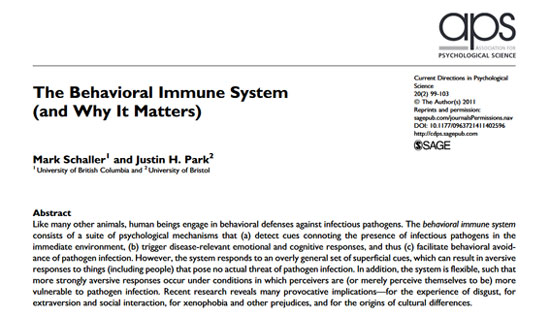
It is a beastly hymn to the “healthy” antisociality of the Self-Capital. It is also another proof of how far the “medicalization” of social relations had gone before the emergence of Sars-Cov-2, direct or indirect, “spontaneous” or paid by the health industries.
The bad thing is that the creators of these theories are now entitled to celebrate, claiming that they were vindicated on an unprecedented scale by social behaviors over the past two years.
In any case, because the “behavioral immune system” is shaped or fed by sensory stimuli, it is susceptible to changes and modifications. It is evolvable, provided that the appropriate stimuli exist. As is generally true for behaviorism, so it is for this its “offspring”; the dogma is this: change the environment and you will change the individuals (and their behaviors).
For someone to change the real physical and social environment of individuals might be easy: if he imprisons them. To do the same on a large scale is impossible. The same does not apply to the virtual environment, old and new media, one-way and two-way; especially at the historical stage when they have begun to largely replace reality.
This explains why the sanitarian terror campaign, as a violent operation to restructure the social factory with a viral siege ram (and the constructed fear of death from infection), proved effective in western capitalist societies in 2020, while it had failed in 2009–2010. In 2020, the “empire of impressions” stood firm in its first maturity, which means that the senses (and consciousnesses) were far more mentally dependent and, at the same time, unskilled.
Here are some characteristic quantitative / qualitative differences between 2009 and 2019:3
In 2009, internet users were (in parentheses the corresponding size in 2019) in millions:
- Asia 764.4 (2,300.47)
- Europe 425.8 (727.56)
- North America 259.6 (327.57)
- South America /
- Caribbean 186.9 (453.7)
- Africa 86.2 (522.81)
- Middle East 58,3 (175,5)
- Australia 21.1 (28.64)
Overall, internet users were 1.1 billion in 2005, 1.77 billion in 2009, and 4.13 billion in 2019.
- In 2009, Facebook was only a year old and had 250 million users. In 2019, it had nearly 3 billion. In 2009, Twitter, Instagram, or WhatsApp did not exist. YouTube existed, with around 400,000 users. In 2019, it had nearly 2 billion.
- The first (and impressive) iPhone appeared on the market in May 2007. By 2009, approximately 480 million smartphones had been sold (and were in use, based on the applications available at the time). By 2019, this figure had reached 3.2 billion.
Without a trace of exaggeration, we argue that whatever forms of species protection may exist (a logical necessity for every form of life), the idea of a “behavioral immune system” provided the “scientific” foundation for its hacking (or mechanization) during that historical period when the senses and the formation of perceptions in the most “developed” capitalist societies had begun to become alienated.

A basic lever in the “practice of infectious pressure” and, consequently, in controlling the “behavioral immune system” was/is (not at all original!) the mass, continuous, intensive production of fear. But with what specifications? “Absolute”? “Relative”? Up to what point?
In one of the many behaviorist papers that began to be published almost from the beginning of the hygiene terror campaign (in relation to it), the specific one in April 2020, someone could read these:
One of the central emotional reactions during a pandemic is fear. Humans, like other animals, possess a set of defense systems to deal with ecological threats. Negative emotions caused by threats can be contagious, and fear can make the threat seem even closer. A meta-analysis found that cultivating fears can be useful in some cases but not in others; calling on people to fear leads them to change their behaviors if they feel capable of addressing the threat, but leads to defensive reactions when they feel unable to act. The findings show that strong fear appeals cause the greatest behavioral change only when people have a sense of efficacy, whereas strong fear appeals with low-efficacy messages produce the highest levels of defensive reactions….
We know of at least one proven case of a state that in March 2020 assigned selected experts (including psychologists/behaviorists) to create guidelines for inducing great fear in the population. This refers to the German state and the infamous “panic paper” as it became known.
In the publications that revealed the existence of this virtual infectious pressure plan, it is described in detail how the German Interior Minister Horst Seehofer, guided by the embedded deceiver Christian Drosten (the German equivalent of the British Ferguson…) and Lothar Wieler, head of the dirty “Koch institute”, created in March 2020 a group of “specialists” willing to express opinions not as independent scientists but as agents with the mission to construct the worst possible health threat, seeking to provoke maximum fear among citizens. Among other things, the “panic paper” contained advice (to the German government) to use children as a lever of this “pressure”, making them responsible “for the painful and torturous death of their parents and grandparents if they did not follow health regulations”. The emotional sadistic blackmail against minors (a crude practice of mass behavior shaping) spread, of course, to all ages: for example, the idea of the “health bomb” was used internationally again and again.
In the “panic paper” guidelines, it was emphatically emphasized that the provocation of fear should be done in such a way as to sharpen citizens’ sense of helplessness, while on the other hand enhancing the recognition of capabilities in the state and in (carefully selected) “experts.” This is exactly what the behavioral excerpt we mentioned a little earlier indicated.
On April 10, 2020, Indian documentary filmmaker and activist Suhas Borker, having experienced the first weeks of India’s version of the planned infectious pressure, made a comprehensive “anatomy” of this practice by writing in the well-known The Wire, among other things, the following:4
Psychological operations (psyops) are operations aimed at influencing the overall personality of the target – their emotions, motivations, the way they understand the world, their behaviors…
… For a psychological operation to succeed, it must delve into the soul of the target… Psyop strategies are shaped only after first “digging” into the values, beliefs, likes and dislikes, capabilities, weaknesses, sensitivities, and vulnerable points of the audience, as well as all of its composite parts… Demographic details are also utilized to create a fluid and dynamic cocktail…… The success of a psyop depends on several key factors. First is motivation. If the audience feels that the leader’s motives are the same as their own, the key to the success of the psyop is already in the pocket of power. The second factor is “shock and awe”. Actions must be carried out in such a way as to cause shock and awe for leadership in the minds of the audience. The third factor is to set in motion a process of “transmission”. The transmission process begins to take shape as an improvised “therapy performance” between the leader and the audience, and spreads as it unfolds over time in a non-linear trajectory…
The fourth factor is that the operation must capture the “minds and hearts” of the audience. To achieve this, the media must be involved, in order to influence the feelings and behaviors of the audience. Information must be “armed” through embedded journalists, cooperating television personalities and news agencies and especially through social media… Social media troll armies must intimidate the few who are disobedient.
Finally, psyops must have a safety net. If for any reason the psychological operation fails, there must be an easy escape route for the leader: to blame someone else, pointing to a scapegoat.
…
For a psyop to work, simple and easily understandable symbols/images are needed… The “dehumanization” of the threat must be illustrated… On the other hand, the audience must be pushed to “do something”. For example, to thank doctors and nursing staff at a specific time of day in a specific way, every day. The repetition of certain actions functions as confirmation of “learning”, that is, acceptance of the content of the psyop…
Behaviorism is a “scientific theory” of the 19th century. Its most famous representative is Pavlov and his dogs. Conditioned reflexes and the mechanistic perception of human behaviors experienced periods of glory and periods of rejection throughout the 20th century – among psychologists, sociologists and other specialists. However, in a historical period where the engineering of everything is the main avenue of capitalist restructuring and the 4th industrial revolution, and where “centralized mass management” is a fundamental requirement of the transition, the disadvantages of behaviorism have been re-evaluated as advantages.
The convergence of certain representatives of it with contemporary expressions of biology (biotechnologies, genetic engineering) and communications (informatics, cybernetics), as evidenced by the declaration of viruses and bacteria as regulators of social relations and beliefs, has already proven effective. This is a mesh of “scientific theories” ideal for military use, where questions and answers must be as simple, fast, effective and “creatively destructive” as possible. The conquest of social relations, their total subordination to capital, is undoubtedly military.
Ziggy Stardust
- The definition comes from the Cambridge Handbook for Evolutionary Perspectives on Human Behavior. ↩︎
- A point at which genetic determinism stumbles is that of criminality. The philosophy of “punishment” as it has been shaped in many legal systems, including the western/urban one, is based on the responsibility of the one who violates the law. However, if the behaviors of individuals and/or groups are genetically predetermined, then these do not have, nor can they have any responsibility. If DNA determinism were to be accepted, this would lead to the collapse of legal systems and, ultimately, to social conditions where whoever shot faster would simply survive. ↩︎
- From Sarajevo 148 (April 2020) ↩︎
- From Sarajevo 150 (June 2020) ↩︎