
The science, biology and techniques of gene drives1
Engineered gene drives are a new form of genetic modification that provide the means for permanent modification or even potentially the elimination of natural species or populations. Unlike recently genetically modified organisms (GMOs), gene drive organisms (GDOs) are not intended to remain where they are released, but on the contrary are deliberately designed to spread and carry their modified genes as far and wide as possible within the corresponding populations…
The realization of functional gene drive mechanisms became feasible only with the establishment of the CRISPR/Cas genetic scissors technique. This technique offered a sense of simplicity and ease, and these, in turn, caused hopes, predictions, statements – and funding. However, intentions and promises must undergo the test of reality, that is, deep understanding of the means and mechanisms involved, including focusing on their risks and limitations.The most advanced type of genetic guidance via CRISPR/Cas is characterized by its ability to modify or eliminate all organisms that it targets. This means that no mistakes should be made, neither regarding the target species nor the ecosystems affected. GDOs must not go where they shouldn’t, must not accidentally escape from laboratory cages, nor have unwanted results on target species/ecosystems, biodiversity, and human health. Many risks of this kind have been expressed in relevant literature, as well as in the “Convention on Biological Diversity” (CBD) and other similar organizations. Additionally, there are serious limitations in the operation of this technology, such as its ineffectiveness in many organisms, the rapid emergence of resistances against it, its irreversibility, and the inability to limit or recall it once used.
As this technology stands, it should not be applied. Have the aforementioned issues been addressed? Have they been resolved? Various efforts have been made to limit or even overcome biological resistance to this technology. The remaining issues that are significant are, so far, stuck at the theoretical model and design stage… All these efforts have not yet yielded results and often exist only as mathematical models, with their own limitations. It is also important to recognize that each new layer of “solutions” will carry its own risks and limitations, and will need to be reassessed…
These developments have significantly expanded knowledge at the genetic level. Unfortunately, there is a regrettable lack of understanding regarding the complexity of real life, under entirely different environmental conditions, with intense genetic diversity in natural populations and the complex network of interactions of each species with others. The behavior of genetic drives and genetically driven organisms may be completely different from that observed in laboratory experiments and model predictions, adding further risks. This powerful technology has, so far, proven neither reversible nor controllable. This means… we must not make mistakes.
This is how a 380-page exhibition on genetically guided organisms began, published in May 2019 by the European Network of Scientists for Social and Environmental Responsibility (ENSSER).
Are genetically guided organisms so much before the gates that they require (and for these applications, not only for these!) strong social resistance? Or is it a “scientific” issue, so it’s better to leave it to the “experts” (and whoever deals with it is a “liar”)? Ultimately: what is it about?
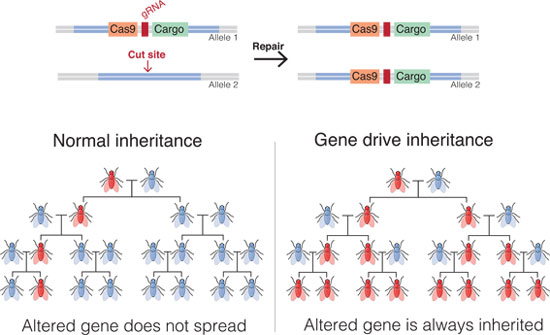
This involves the genetic modification of a sufficient number of members of a species in such a way that the new genetic traits are passed on to future generations. We can talk about piracy in heredity, although the words do not exactly convey the extent of the risk (or, if you prefer, the extent of business opportunities). At first glance, this genetic modification is done “for a good cause”: to eliminate, for example, a natural species that carries a bacterium or virus dangerous to the human species; or to modify it so that it cannot perform this “transportation”.
In October 2019 we had described the epic and spectacular failure of such a genetic guidance campaign to eliminate the Aedes aegypti mosquito in Brazil, which had been accused of transmitting the Zika virus2. But the spectacular failures and dangers of biotechnological sleight of hand seem to have entered a new phase of silence after the terror campaign that imposed mRNA genetic engineering platforms on the human species. Therefore, we need to understand this particular development even better, the construction of genetically guided organisms. Its origin and its consequences.
On July 9, 2019, under the title Self-destructing mosquitoes and sterilized mice: the promises of genetic guidance, the renowned journal Nature wrote:3
Austin Burt4 and Andrea Crisanti5 had been trying for 8 years to hack the mosquito genome. They wanted to bypass natural selection and implant a gene that would spread through the population faster via inheritance than a mutation achieved through the usual process. In their minds, they aimed to control malaria by spreading a gene that would render mosquito populations incapable of transmitting the disease.
Finally, in 2011, the two geneticists from Imperial College received the DNA results they had hoped for: a gene they had introduced into the mosquito genome had spread throughout the population, reaching 85% of the offspring.This was the first case of artificial genetic guidance: a genetic mutation designed to spread through a population at a rate faster than the usual inheritance rate. Genetic guidance quickly became routine technology in some laboratories; scientists can now create a genetic guidance system from scratch in about a month. The technique is based on the CRISPR gene-editing method and some RNA pieces to modify or suppress the expression of a specific gene, or to introduce a new one. In the next generation, copies of the genetic guidance are inserted into the chromosome, so the genome is no longer the natural version it was before, but instead has two copies of the artificial gene. In this way, the change is transmitted to 100% of the offspring instead of 50% as before.
Since 2014, scientists have introduced artificial gene guidance via Crispr into mosquitoes, fruit flies, and fungi, and are now developing the technique in mice…
Is it so important for genetic guidance of various animal species to begin with the ambition to eliminate their natural versions?
On May 28, 2020, supporters of genetic guidance prepared a “position map” in favor of innovation and gene drive research in the EU.6 It is interesting how they respond to the objection that this technique will destroy biodiversity on the planet… No, they say, biodiversity is not endangered by us but by the “illegal” entry of hostile species into the EU… Yes, dealing with these “illegal immigrant” species will touch many hearts, including, we assume, many ecological ones:
Invasive alien species are one of the main causes of biodiversity loss and one of the targets of the EU’s new biodiversity strategy by 2030. Of the 1,872 species currently considered threatened in Europe, 354 are threatened by invasive alien species, costing the EU 12 billion euros annually over the past 20 years. As highlighted by the Intergovernmental Science-Policy Platform on Biodiversity and Ecosystem Services, one million plant and animal species are at risk of extinction, especially on islands where 75% of reptile, bird, amphibian, and mammal extinctions occur. Biodiversity loss is not only an environmental issue, but also a developmental, economic, social, ethical, and security issue…
New measures are needed in the EU to proceed with implementing existing legislation on invasive alien species, in order to achieve the EU’s goal of halving the Red List of species threatened by alien species/invasives by 2030. Research on genetic guidance has been considered a very important research area for new tools for species conservation and public health by major international organizations…
The genetic castration of “foreign” species will protect “our” species from invasion. But also, the castration of “our own” species will protect “us” from diseases. The same “map of positions” emphasizes:
… As became clear from the Covid-19 pandemic, preparedness against dangerous outbreaks of various pathogens is of decisive importance. Climate change and globalization create favorable conditions for the spread of various species/invasive mosquitoes, such as Aedes aegypti and Aedes albopictus, increasing the risks of epidemics from viruses such as dengue fever, chikungunya, and Zika in various European countries. Lyme disease, transmitted by ticks, already infects 650,000 to 850,000 Europeans each year, but has not received the attention it deserves. The global threat of insect-borne diseases, which together represent 17% of all infectious diseases, must not be underestimated. These illnesses cause 700,000 deaths each year and are responsible for additional healthcare costs for both states and individuals, along with losses in productivity, schooling, investments, and tourism.
In Latin America alone, the average annual cost of dengue fever is estimated at 3 billion dollars, while the consequences of malaria in Africa are estimated to reach 12 billion dollars… Reducing infectious diseases such as malaria and dengue is a fundamental step toward achieving sustainable development goals, such as poverty reduction, food security, quality education, and gender equality….
It becomes clear that, besieged by the harshness of nature, there is no other salvation for our species than to lie down on the benches of the geneticists; and perhaps we may never rise from there again…
However, there is also the harshness of rival bosses, and “our own” bosses should put them in their place… Isn’t that right?
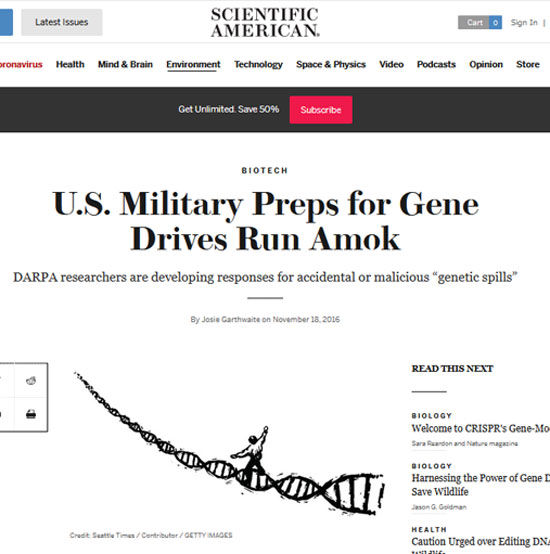
military care
These two good people, researchers and geneticists, Austin Burt and Andrea Crisanti, had been hired by the American DARPA for 2.5 million dollars, to develop their technique – the second one publicly admitted it. For DARPA, rounded formulations are not needed. The issue of gene drive does not arise for these specific genetic mutations. Their name is genetic extinction: genetic extinction. DARPA’s interest is in how critical animal species of adversaries (bees, birds, plants, even animals) will be genetically modified in a way that the mutations are inherited, so that adversaries are left “unwarned” of basic food species.
DARPA is the main funder of these research efforts, experiments, and whatever applications have been made so far. According to the establishment’s guardian, by 2017 it had invested 100 million dollars in gene drive technologies. And because such technologies could be used by enemies, or because there could be some kind of genetic detonation, DARPA also invests in genetic repair research. This program is called “safe genes.” The idea here is just as paranoid as that of gene drives: in addition to “destructive genes,” “reserve genes” will also be introduced into various organisms, which will neutralize the “destructive” ones if something goes wrong…
Beyond these expenditures, DARPA also funds a few more initiatives. It pays British specialists with old colonial ties to Africa, in order for African communities to accept becoming experimental subjects for mosquito gene drives.
The second main funder is (did it not cross your mind?) the Bill and Melinda Gates Foundation. Of course, among the foundation’s grantees are not only geneticists. There are also journalists, politicians, academics, and influencers in general. They are needed. “Emerging Ag,” a private public relations firm focused on agricultural restructuring, was hired on behalf of the Lord of Doors and Windows for 1.6 million dollars to promote within various international organizations dealing with the issue “scientists friendly to gene drives,” to bribe academics and government officials to resist proposals for restricting or even banning their applications, to bribe well-known journalists to highlight their benefits, and other such pastoral and household tricks. “Emerging Ag” managed to recruit over 65 specialists, including government officials and academics as well as 3 experts from the WHO committee on the subject, to “flood” any international process against gene drives with the suffocating dung of “science.” Whatever was done with mRNA platforms, just still at an early stage.
As one of the “front-runners,” the representatives of the general capital (the bioinformatics-security complex), Gates shares with DARPA a common military starting point. In order to biotechnologize and computerize the whole of human life (and why not? life on the planet overall), anything that could be considered natural must be exterminated. The impressive assault on this goal was carried out at the expense of our species, the human one, with attempts to hack, replace, and pirate the natural immune system; through mRNA platforms for genetic modification, up to the last human being if possible, so that no witness or benchmark for comparison remains.
Genetic guidance aims exactly at the same target, in a hereditary sequence of 2 or 3 generations. For insects, viruses or/and plants that have a short life cycle, the elimination of the natural (and its replacement with genetic interventions/mutations) is an easy task in terms of time. Appropriately, DARPA calls the thing by its name: genetic extermination.
Vandana Shiva, speaking recently about old and new colonialism, poses the issue as follows: in order to dispossess anything, its emptiness must first be constructed. Old colonialism occupied lands by claiming that “there were no people living there” (only “sub-humans”…). New colonialism occupies organisms by claiming that “their life so far has no meaning”: Bio Nullius. It will only gain meaning after its dispossession. Genetic extinction is a form of emptiness, upgraded in line with current capitalist technology. The mosquitoes that will disappear might be replaced by others, genetically nutritious (but “safe”) as bird feed; or perhaps the birds themselves will acquire genetically modified versions that do not need mosquitoes and other insects. All this and much more, under the condition of ownership (“intellectual” and commercial) of the “new” species.
Perhaps we need to remind ourselves that Sars-Cov-2 and its successive mutations were a kick in the genitals of the geneticists who spread (and believed) that “they have it under control”? No, but it seems that biotechnologists, once established as the “only techno-scientific reality and truth,” will permanently hold the upper hand: alright, some problems arose with our previous genetic model, but we’ll fix them with the next one… Wait…
There is hard evidence of this, and unfortunately the carabinieri / pfizerians remain ostrich-like. Exploiting the staged “state of emergency,” the pharmaceutical mafia managed to impose that the long-term drug trials, the effectiveness and safety reports, all of these are now over. From now on (already with the mRNA platforms for genetic modification of human cells) trials will be conducted “in the field,” in real-time. Experiments will be carried out directly in the field, massively and unchecked. This new regime could soon lead the pharmaceutical mafia and their lackeys to court with the serious charges of forming a criminal organization and premeditated crimes against humanity. It could…
However, the exact same pattern they follow and will try to continue following is that of all genetic mafias: “in the rough” directly. This is not a “health tactic”. It is a tactic of total dominance, the victims of which will be themselves responsible because they did not conform to the instructions….
We are therefore at this critical historical point: to prevent their universal dominance, as much as possible, as effectively as possible, as quickly as possible.
Ziggy Stardust
- Accessible at https://ensser.org/publications/2019-publications/gene-drives-a-report-on-their-science-applications-social-aspects-ethics-and-regulations/ ↩︎
- Cyborg 16, the castration of flies. ↩︎
- Accessible at https://www.nature.com/articles/d41586-019-02087-5 ↩︎
- Professor of evolutionary genetics at Imperial College London. ↩︎
- Professor of microbiology at the University of Padua, and of molecular parasitology at Imperial College London. ↩︎
- Accessible at https://genedrivenetwork.org/resourses/position-papers/33-positon-paper-on-eu-leadership-on-innovation-and-gene-drive-research/file ↩︎