
We have nanobots that … connect our neocortex to a synthetic neocortex in the cloud… Thought will become … a hybrid of biology and non-biology…
Paranoid or not prophets
You may not know what the neocortex is (excuse the pun…) or who said the above quote (not so much). Ray Kurzweil, 74 years old, is a prominent figure in American techno-futurism. An inventor, entrepreneur, prophet, author, awarded in 1999 at the White House by then-President Clinton with the top “Technology and Innovation” award, a fanatical herald of transhumanism and the singularity, but also extremely hypochondriacal regarding matters of (his) health and (his) immortality, Kurzweil is one of those figures who shape the goals and orientations of the “neuroscientific” and not only sector of the 4th industrial revolution much more than types like Gates. He personifies (something that can easily become misleading) existing and developing capitalist tendencies toward the mechanical colonization of everything.
And if within these “all things” cells hold a central position for geneticists, biotechnologists and related enterprises, for neuro-technicians the focus is on the mechanical colonization of the human brain and nerve cells. The relevant applications may not yet be advertised (yet) or even imposed (yet), but they are much closer than we think.
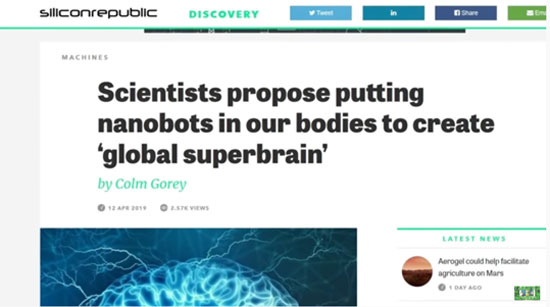
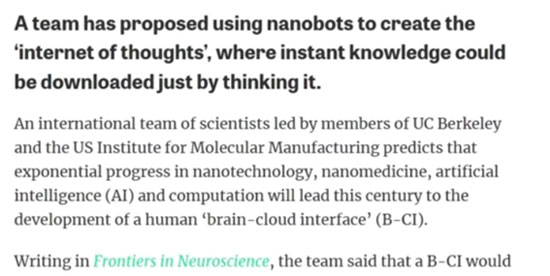
For example, in a randomly selected paper from the American review Frontiers in Neurosciences dated March 29, 2019, titled Human Brain / Cloud Interface1 18 researchers (among them specialized doctors, computer technicians, academics) supported:
The Internet consists of a global decentralized system that serves humanity’s collective effort to generate, process, and store data, and most of it resides in the rapidly expanding cloud. A stable, secure system that operates in real time could allow interaction between the cloud and the human brain. A highly promising strategy, which we refer to here as “human brain/cloud interface” (B/CI), could be based on technology referred to here as “neuro-nano-robotics.” Future neuro-nano-robotic technologies are expected to enable accurate diagnosis and, at some point, treatment of over 400 conditions affecting the human brain. Neuro-nano-robotics could also contribute to B/CI through controlled interfacing between neural activity and external data storage and processing, by directly monitoring approximately 86 × 10⁹ neurons and approximately 2 × 10¹⁴ neural synapses. Moving through the human circulatory system, three types of neuro-nano-robots (endo-neuro-bots, glia-bots, and synapto-bots) would be able to cross the blood-brain barrier, enter brain parenchyma, infiltrate specific human brain cells, and self-install on axonal segments of neurons (endo-neuro-bots), within glial cells (glia-bots), and in close proximity to neural synapses (synapto-bots). In this way, they would be able to wirelessly transmit up to approximately 6 × 10¹⁶ bits per second of electrical information generated by synaptic processing and encoded by the human brain, through auxiliary nano-robotic optical fibers (30 cm³) capable of capturing up to 10¹⁸ bits/sec, thus enabling rapid data transfer to a cloud-based supercomputer for real-time brain monitoring and corresponding data extraction…
… We consider it plausible that within the next 20–30 years, neuro-nano-robotics will have reached a level of development sufficient to provide a safe, reliable, durable, real-time interface between the human brain and both biological and non-biological computer systems, enhancing brain-to-brain (BTBI), brain-computer (BCI), and, specifically, sophisticated brain/cloud (B/CI) interfaces. Such human systems could dramatically change human/machine communication, making a significant enhancement of human consciousness a reality…
Whether these seem interesting and hopeful or dangerous to repulsive, the underlying idea (would be) that 20 to 30 years is a long time, and that the above are speculations for someone to take seriously. Reality is different: steps are being taken, technologies are already being created, and the mechanical colonization of the human brain (and anything that can be called senses, thought, memory or consciousness) is a declared goal of billionaires and particularly powerful “factors” of the modern capitalist world.
Whether considered paranoid or brilliant, they are here. It is possible, of course, for neuro-technologists and their works to be ignored, as has been the case for decades with geneticists and biotechnologists. “These are difficult issues, scientific ones, and we must leave them to the experts” advises the current wisdom of the sleepwalkers… (And accepts to be bound hand and foot).
A small dose of history: electroencephalograms and electric shocks
The brain produces “electric fields” – or “something” that can be considered an “electric field.” This is the discovery that marks the beginning of “reading” the human brain beyond any reason, expression, gesture, or appearance of our species. It is a discovery (or a theory) that began in 1875 when Richard Caton, an English physician, recorded “electric signals” from exposed (through surgical removal of parts of the skull) animal brains. Caton initially placed two electrodes on the temples and detected a small voltage difference using a primitive galvanometer. A few years later, in 1887, Caton announced that he observed variations in these signals when illuminating one eye or the other of the animal…
Western techno-science ultimately credits the Austrian psychiatrist Hans Berger with the first invention of a method for recording these “electric signals” following research conducted between 1924 and 1929: the electroencephalogram. The “abnormal” measurements of the brain’s “electric waves” were considered a sufficient method for diagnosing damage (including, notably, “mental disorders”…) and laboratories performing electroencephalograms by placing electrodes at various external points on the skull (with continuously evolving equipment) began to multiply exponentially before and during World War II.
Almost simultaneously, however, the relationship between the (human) brain and electricity did not remain in a one-way conception, of the kind “the brain produces electrical waves – we record them to detect its damage.” It also acquired the reverse direction: “we send electricity to the brain – to fix some of its damage.” As early as 1938, two Italian psychiatrists, Ugo Cerletti and Lucio Bini, had the idea that they could induce an artificial epileptic seizure by channeling current into the brain – for therapeutic reasons. Specifically: for the treatment of schizophrenia, and later of mania, depression…
The invention of electroshock2 can and should be seen as the significant, complementary aspect of the electroencephalogram. In the sense that in capitalist societies that had begun to familiarize themselves with electricity and various more or less impressive uses of it for the standards of the early 20th century, the idea that the human brain is something like an “electric generator,” whose functional secrets are of an electromagnetic type, and which either “works correctly” or “wrong” (thus requiring external electrical intervention…) was the common basis. The common technical assumption.
If you don’t have some idea about electricity and, moreover, machines that either produce it or record it, it is impossible to have the idea that the brain is an organ that produces electrical signals! This second idea is, therefore, historically and technically determined: it is an idea that was born, quite symptomatically, during the 1st industrial revolution; and matured in the 2nd. This historical and technical overdetermination has greater significance than someone might think hastily and superficially.
For example, the idea that “nerves are wires that carry messages from sensory sources to the brain” is an analogy idea that was born from the establishment of the telegraph. Is it correct or wrong? Can it be considered valid or is it arbitrary? Practically, this idea is forbidden to be questioned as long as electricity remains the “dominant paradigm”, no longer in the form of the telegraph but of the binary electronic/informatics model.
In this sense, the representation of the brain, neurons, and neural synapses as an electrical mega-circuit, with input and output, seems to admit no questioning as long as someone remains within the technocratic frameworks. It admits only new research and even more sophisticated applications…
That’s why nano-robots moving through the bloodstream that “self-install” in various parts of the brain, receiving and transmitting billions of bits of “information” per second, is a technologically coherent idea with the specifications of the 4th industrial revolution. It doesn’t matter what the nervous system actually is (and what it isn’t) as a whole: representations of reality are powerful when they dismiss (if necessary, by forbidding it) any doubt about them… If the “experts” claim that the human brain is simply an upgraded super-computer, then it must be such; doesn’t it go like that?
Electrodes – and control
How, then, are the brain’s “electrical signals” recorded and depicted? And how can electricity (“electrical signals”) be delivered to it? With electrodes… The more, the better.
The ideal would be for the electrodes to touch the neurons directly—this has been known for over a century! But how? Is it possible to fill the skull with holes so that electrodes can reach their target? Engineers and scientists would very much like to do so (always for the sake of research and humanity)—but it’s dangerous and, ultimately, unethical. Here’s a first-rate technological challenge that would surely intrigue dozens, even hundreds of “experts” for many years to come: how to implant electrodes in the brain without turning the skull into a sieve…
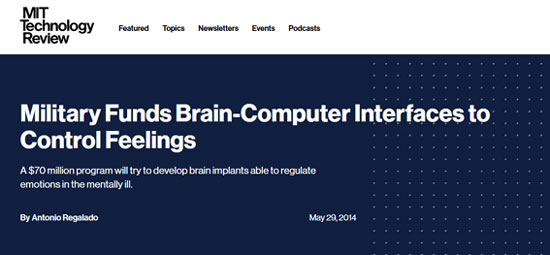
Consequently, the announcement of the well-known MIT on May 29, 2014 was triumphant with all the (capitalist/technological) justice of its: The army funds brain-computer interface to control emotions – a $70 million program will attempt to develop brain implants to regulate the feelings of mentally ill patients…
We are transferring the entire article, for its historical and political significance:
Researcher Jose Carmera has worked for years training macaque monkeys to move computer cursors and robotic arms with their minds. He achieves this by implanting electrodes in their brains to monitor neural activity. Now, as part of a $70 million scanning program from the U.S. Army, Carmera has a new goal: to use brain implants to read, and then control, the emotions of mentally ill people.
Last week, the Defence Advanced Research Projects Agency, or DARPA, awarded two major contracts to Massachusetts General Hospital and the University of California, San Francisco, to build electrical brain implants capable of managing seven psychiatric conditions, including addiction, depression, and bipolar disorder.
“Imagine that I have an alcohol addiction and I have the urge to drink” says Carmera, who is a professor at the University of California, Berkeley, and participates in the UCSF project. “We can detect this feeling and then give a stimulus to the brain to cut it off”.
The US is facing a mental health epidemic among veterans, with suicide rates three to four times higher than that of the general population. Medications and psychotherapy have limited use, which is why the military is turning to neurological devices, says Justin Sanchez, director of Darpa’s program called Subnets, Systems-Based Neurotechnology for Emerging Therapies.
“We want to understand brain networks in neuropsychiatric diseases, to develop technology to measure them, and then to send precision signals to the brain,” says Sanchez. “It’s something completely different and new. These devices don’t exist so far.”
According to the contracts, which are the largest so far implementing President Obama’s BRAIN initiative (the brain mapping program announced last year from the White House), the University of California will receive 26 million dollars and Massachusetts General Hospital 30 million. Companies such as medical device giant Medtronic and startup Cortera Neurotechnologies, a spin-out from the wireless communications lab at Berkeley, will contribute to the effort by providing technology. The initial research will be conducted on animals, but DARPA hopes to reach human trials within two to three years.
This research taps into a small but rapidly growing market of devices that work by directing nerves, both inside and outside the brain. Over 110,000 patients with Parkinson’s have implanted devices that control body tremors by sending electrical pulses to the brain. More recently, doctors have used these devices to treat severe cases of obsessive-compulsive disorders. Last November, the FDA approved the NeuroPace, the first implant that simultaneously records brain activity and influences it. It is used to monitor epileptic seizures and stops them by sending electrical pulses. Additionally, doctors in the US prescribe neural device equipment worth approximately $2.6 billion per year, according to estimates from the relevant industry.
Researchers say they are making rapid advances in electronics, including tiny, implantable computers. With this program, Massachusetts General Hospital will collaborate with Draper Laboratories in Cambridge, Massachusetts, to create new kinds of mechanisms. The team from the University of California is supported by wireless microelectronics researchers from Berkeley, who have already created various prototypes of miniaturized brain implants. Michel Maharbiz, a professor in the Department of Electrical Engineering at Berkeley, says that the Obama initiative for the brain, and now DARPA’s funding, has created a “fed frenzy” around the new technology. “It’s the big moment to create technologies for the brain,” he says.
The new research direction has been dubbed by some “affective brain-computer interfaces,” meaning electronic devices that modify feelings, perhaps under the control of the patient’s thoughts and desires. “Basically, we’re trying to build the new generation of psychiatric brain mechanisms,” says Alik Widge, a researcher in the general hospital’s team.
Darin Dougherty, a psychiatrist who directs the neurotherapies department at Massachusetts General Hospital, says that one approach is to erase fear in veterans suffering from post-traumatic stress disorder. Fear is generated in the amygdala—a part of the brain involved in emotional memories. But it can be suppressed by signals originating from another brain region, the ventromedial prefrontal cortex. “The idea would be to decode an amygdala signal that shows hyperactivity, and then propagate it elsewhere so as to suppress fear,” says Dougherty.
Such research is not free of ominous implications. In the 1970s, Yale neuroscientist Jose Delgado3 showed that he could induce feelings in people, such as relaxation or anxiety, using implants he called “stimoceivers” [a compound word from stimulation and receiver]. But Delgado, who was also funded by the military, left the country after congressional hearings where he was accused of creating “totalitarian” thought-control devices. According to scientists funded by DARPA, the agency was concerned about how the Subnets program would be perceived, and hired an ethics panel to oversee it.
Psychiatric implants will in practice control how people with psychological problems act, although in most cases indirectly, by changing how they feel. For example, a mechanism that cuts the desire for cocaine could change the behavior of the addicted person. “The goal is to change how people feel, and to change what they do. These are inextricably linked to each other” says Dougherty.
Dougherty supports that a brain implant should be done for patients who are truly mentally ill, and cannot be helped by medication or psychotherapy. “It would never be the first choice, of the kind, you have this disorder, let’s go to surgery,” he says. “It would be intended for people who do not see results with other treatments.”
As everyone can easily understand, “ethics committees” are a combination of advertising tactics and “packaging committees”: how every party involved in such research will sell their criminal work as care for fellow human beings. There are many willing to take the bait along with the hook and the fishing line, due to (usually) their intellectual and moral laziness; let alone when it comes to politics.
However, reading the above hymn leaves no room for fools. The mentally ill are simultaneously a primary target group for “brain corrections” but also a testing field, as well as a field for constructing the Example, the Model. Especially in societies and epochs where it is commonplace (official, scientific) to accept that a large portion of the population suffers mentally – however, “we won’t deal with the causes – we’ll deal with the corrections.”
The model of these corrections is the impressive (indeed) and upgraded form of electroshock: transmission of “electric pulses” (which now can even be called “information”…) to very specific points of the brain’s neurons, so that a very specific “signal” result is produced from them and, subsequently, the desired behavior. The informatics part of recording, monitoring erroneous brain functions through electric computers, is one half of the management; the advanced version of the electroencephalogram (or the later magnetoencephalogram). The “correction”, the targeted electrification of the “dysfunctional” neurons, their electrical correction, is the other half. At the core of the matter, in the fundamentals of representing what the brain is, the techno-scientists remain faithful to the dogmas and beliefs of their counterparts a century before. However, their tools have improved significantly.
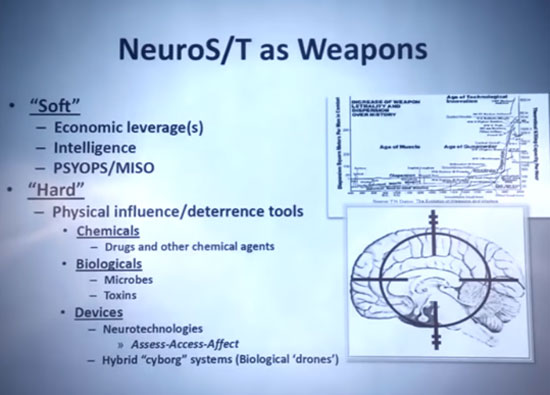
What the militaristic DARPA inaugurated in 2014 with a new funding code and the “techno-scientific community” was sharpening its weapons was not simply the repair of the… disturbed, even though they remain the easiest target. It was rather (and remains) the general know-how, including certainly the appropriate devices and interventions in the brain, for the external, remote control of its operation under any conditions. A highly ominous goal, whatever criteria one uses; however, technically feasible or realistic for the near future.
During the ’70s, in its early steps, this colonization campaign was easy to recognize for what it was: techno-totalitarianism. Delgado (and his team) may have had all the scientific credentials, may also have been pioneering. However, he had to justify his goal of controlling the emotions of others, indifferent to whether they were considered healthy or not. Obviously, the then cinematic suspicion (even hostility) towards the authority of experts played a significant role; the then renewed and enriched humanism of a good part of Western societies; the then rich anti-establishment sentiment.
Half a century later, this authority has been / is restored to such a degree that plans and goals are no longer hidden. Humanism is entirely conformist or/and has been replaced by interest in companion animals. As for anti-establishment sentiment? It has become so shallow and tokenistic that one is more likely to encounter it as an advocate for any technocratic experiment.
Neuralink
Elon Musk has become widely famous for the electric car company he promotes; even more so for the recent acquisition of the Twitter company. His business involvement (in fact: the business involvement of those who fund him, from the toxic elements of the emirates to the co-founder of the PayPal platform…) in neurotechnology applications is (relatively) less known – yet particularly characteristic.
The Neuralink corporation (a neurotechnology company in which Musk is one of the two remaining original shareholders) was founded in 2016. The “Brain Initiative” that Obama had announced 3 years earlier (in April 2013), the federal government funding from various agencies, the direct and indirect funding from DARPA, had already opened the appetite and the path for companies, research centers, universities and other interested parties. Therefore, Neuralink was initially nothing more than an assault on the human brain among several others. However, it had more money (behind it) and better promotion (Musk).
One year after its creation and the appointment of specialists, in April 2017 the company (that is, Musk) announced that the initial goal of electric treatment for serious “brain diseases” was merely a stepping stone toward the ultimate goal, which was none other than human enhancement, or otherwise known as transhumanism. According to Musk, this would be achieved with a digital mantle over and around the brain, which would be implanted not necessarily through surgical intervention, in order to achieve effective “symbiosis of humans with artificial intelligence.”
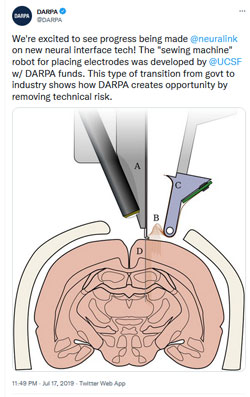
The first step in this campaign to colonize the human brain could be nothing other than the refinement and multiplication of the electrodes that “capture” the electrical function of neurons; the best possible and “finer” upgrade of the old methods. While the construction of extremely thin electrodes and minimal-sized circuits that transmit wirelessly was a moderately sized challenge for microelectronics engineers, the selection of the method for placing this mechanism in contact with neurons was significantly greater. Here, a high-precision surgical robot had to be constructed, since for such delicate work, no one could trust the hands of human surgeons.
In late 2020, Musk triumphantly demonstrated the first experimental trial of the mechanism that had been constructed in the meantime, implanted in pig heads. What did the mechanism (the size of a coin) achieve? The recording of electrical signals related to the animal’s movement; let’s say with the “brain commands” for motion. The most impressive demonstration took place a few months later, in April 2021, when a macaque monkey, with two brain implants, appeared to play the old video game Pong … with its mind: the implanted electrodes “captured” the electrical charges from the monkey’s neurons that corresponded to the commands it would give to its hand muscles (if it were about to use them…) to play the game, wirelessly transmitted them to a receiver, which then forwarded them to the computer4.
For the most part, this technology was already known and in experimental use since the early 2000s, 20 years before Neuralink’s demonstration. The progress made by the company’s engineers was that the electrodes operated wirelessly (and not with cables, as before) and, also, their greater number: 3000 instead of the 200 to 300 that were the usual constructions until then. The large number of electrodes certainly contributes to greater “signal density,” hence greater accuracy in mapping neural cells. The surgical robot, specially designed for such implants, was also a advancement.
Neuralink has been requesting since early 2022 permission from the American FDA to proceed with human trials. No decision is known as of the time this issue goes to press. The company is also seeking (the company) a director for this “clinical trial,” informing that it will collaborate with some of the most innovative doctors and leading engineers.

One would observe that after 15 years of revelatory announcements and fanfare, the result has been rather modest5—and, on the other hand, dangerous, without even taking into account brain electronic manipulation, which many and sundry wish for and do not consider in any way a threat… And indeed, Musk has started to lower expectations for neurolink, at least for now. But is this delay reassuring?
No. Firstly, because in this campaign of mechanical colonization of the human brain and everything that originates from or ends up in it, a lot of money has already been invested, and will continue to be invested even more, even if the achievements are “small steps” for quite some time. Secondly, because even “small steps” can converge into something like a quantum leap in relevant research/applications, in a sudden acceleration.
However, the most important thing is the significance of the mechanical colonization of the (human) brain for capitalist political economy in the historical phase of the 4th industrial revolution. Whatever it is called—the direct and bidirectional connection of the human nervous system, the senses, the human brain with digital machines (“enhancement”, “transhumanism”, “human plus”…)—it is nothing but the most recent “achievement” of capitalist exploitation of labor (intellectual labor, in this case) and life, in which the role of mechanization had been very well described by Marx, in the Grundrisse6, especially in the pages titled Fragment on Machines.
This meaning is strategic! And although (social) objections or reactions against this mechanical colonization could arise from various starting points, only the anti-capitalist direction can illuminate it and strike at the root of the evil.
Marx wrote having before him the first wave of mechanization of manual labor, and the steam-powered moving machines; that is, the 1st industrial revolution. He noted among other things:
… [The machine] is not like the tool, which the worker animates as an organ with his own skill and activity, and whose handling therefore depends on the worker’s dexterity. On the contrary, the machine, which possesses skill and force instead of the worker, is itself the artisan, having its own soul, the mechanical laws that operate within the machine… The productive process has ceased to be a labor process in the sense that labor dominates it as its sovereign unity. On the contrary, it appears only as a conscious organ, as separate living workers scattered at various points of the mechanical system; subordinated to the overall process of the machines themselves; and themselves a mere part of the system…
… In machinery, knowledge appears as alien, external to the worker; and living labor appears subordinated to the objectified [machines], which possess independent action. The worker appears as superfluous, to the extent that his action is not determined by the needs of capital.
It is easy for anyone who wants to understand that the human brain, which connects to the cloud, to the “hard drives” of some owner, and to the “artificial intelligence” of machines (of the same owner), is, precisely, the living component of the mega-machine, subordinate to the overall process driven by the owner’s interests, a mere part of the system.
However, there is a proprietary difference between the machines that Marx had before him and those we have before us today: consciousness. Now consciousness is not an external factor produced by the machine, but becomes part of it. In our opinion, the mechanical colonization of the brain is the mechanization (and ultimately the subjugation) of consciousness. Although the demonstrations so far by neurotechnologists show (intentionally) the one-way “flow of information” from neurons to machines, thus representing the false superiority of the conscious organ of the mega-machine (human thought, sensation…), the real capabilities (and the real value) of a complete interface lie in making this flow bidirectional. That is, when neurons, the brain, receive “information” or, even better, instructions/orders from machines; and respond to them.
The interesting thing is that the targeting towards this “completeness” is not hidden from neurotechnologists. On the contrary, it is advertised as therapeutic: the examples of how dependencies can be controlled or even cut (within or outside quotation marks) are more than indicative! It is enough for the appropriate signal to reach the appropriate neuron in order to achieve the desired behavior, they say with pride, adding with a wink, do not worry though, we will do this only to the mentally ill, to “align” them…
We repeat: it is not only about technologies for digital upgrading of electroencephalograms. But (mainly) about a remarkable digital upgrade of electroshocks: instead of the crude delivery of an electric voltage to the brain so that its function can be “restructured” (;) more or less blindly, the sophisticated and well-targeted emission of electrical charges, with the purpose of detailed, molecular, cellular control of thought.
If these seem distant, the most convincing and accessible indicator of the “prospects” of neurotechnologies unfolds on the website of the American DARPA—and it would be wise not to underestimate such exhibitions, even if not all (military-funded) research efforts conclude swiftly in applications. However, even failures constitute “small steps”…
We cite indicative excerpts:7
Neural Engineering System Design / NESD (Bridging the bioelectric gap)8
A new DARPA program aims to develop an implantable neural interface capable of providing unprecedented signal resolution and data transmission bandwidth between the human brain and the digital world. The interface will serve as a translator, converting between the electrochemical language used by neurons in the brain and the 0s and 1s that constitute the language of information technology. The goal is to achieve this communication link with a biocompatible device no larger than one cubic centimeter.
… “Today’s best brain-computer interface systems are like two supercomputers trying to talk to each other using a 300 baud modem,” stated Phillip Alvelda, director of the NESD program. “Imagine what will become possible when we upgrade our tools to truly open the channel between the human brain and modern electronics”…Next-generation non-invasive neurotechnology (N3)
The N3 program aims to develop a safe, portable neural interface system capable of reading and writing to multiple points in the brain simultaneously. While the most advanced neurotechnology requires surgical implantation of electrodes, N3 seeks high-resolution technology that operates without the need for surgical intervention, so that it can be used by healthy individuals…Active Memory (RAM) Restoration
The RAM program aims to develop and test a wireless, fully implantable neural interface device for human use. The device will facilitate the formation of new memories and the retrieval of existing ones…Replay of active memory (RAM Replay)
The RAM Replay program will investigate the role of neural “replay” in the formation and recall of memory, aiming to help individuals better remember specific events and skills they have learned. The program aims to develop new and rigorous computational methods to help researchers determine not only which elements of the brain are important for the formation and recall of a memory, but also how important they are…Targeted Neuroplasticity Training (TNT)
The TNT program aims to enhance the rate and effectiveness of cognitive skill training through precise activation of peripheral nerves that can, in turn, promote and strengthen neural connections in the brain. TNT will seek to develop a technological platform to improve the learning of a broad spectrum of cognitive skills, with the goal of reducing the cost and duration of the extensive training program of the Department of Defense, while simultaneously improving outcomes….
“Reading” and “writing” in the human brain… “Erasing”, “writing”, “enhancing” human memory: this is the current desired evolution; neuro-digital lobotomy, to name it in a historical way… It is not far away at all – if you think so…
And to make things worse: there will be quite a few clowns who will applaud (and) this “scientific progress.”
Ziggy Stardust
- Accessible at the address https://doi.org/10.3389/fnins.2019.00112 ↩︎
- Since the dominant views on “mental illnesses” are arbitrary (even regarding their causes…), it was/is expected that “therapeutic practices” would be used at the discretion of those in power. Electric shocks were used against “dissenters” (since they could not be anything other than mentally disturbed). For a historical period, in the 1980s and shortly after, they were considered torture by the anti-psychiatry movement, and this influenced to some extent parts of Western societies and their perceptions. However, they were not abolished: they are still used, supported by research that finds them harmless and effective.
We can phrase it as follows: the violent and painful induction of artificial epileptic seizures is therapeutic (!!)…. ↩︎ - Delgado, of Spanish origin, moved to Madrid in 1974, following an invitation from the then Minister of Health, to establish a new medical school at the city’s university. We don’t know what he created, but we do know that in 1974 Spanish society was living under the boot of the fascist general Franco. He died the following year (1975), but the Spanish system was never “de-Chavistized.”
Meanwhile, Delgado, while still in the US conducting his research, had published his only book, with the characteristic title: Natural Control of the Mind: Towards a Psychocivilized Society… ↩︎ - Before learning to move his pong paddles “with his mind,” this particular monkey would have had to become an ace at the game—with his hands. Firstly, because in this way the researchers would capture the “correct brain signals” to appropriately calibrate the receiver and their processing, and secondly, so that the animal itself would later learn to focus on its thoughts without using its hands. We struggle to imagine how this training was carried out and how long it took, but for the sake of argument, let’s accept that it happened.
What Musk did not mention, however, was that during the experiments, from 2017 to 2021, 23 macaque monkeys were used, 15 of which died. Because of the experiments. The official explanation given by Neuralink when this mortality leaked was that the monkeys died due to underlying illnesses—a claim obviously copied from similar explanations for human deaths caused by mRNA genetic engineering platforms…
If, however, the lethality of these trials and the infections that can be caused by such implants is taken into account, then human (brain) enhancement through electrodes in contact with neurons should officially and categorically be declared forbidden. On the other hand, of course, there is the right to techno-scientific progress, indifferent to the corpses it may leave along the way. ↩︎ - The competing neurotechnology company Stenrode follows a different method with the same goal, and has already received FDA approval for human trials. However, one of the disadvantages of “Synchron” is that it enters the brain through blood vessels with a thickness limit (downward), therefore it cannot go everywhere. A second disadvantage is that it does not require implantation through surgical intervention in the skull, the “cable” of Synchron ends in a chest implant, which is the information transmitter that this mechanism receives. ↩︎
- Grundrisse, Der Kritik Der Politischen Okonomie – Outlines of the Critique of Political Economy – 1857/1858. ↩︎
- DARPA and the Brain Initiative. Available at https://www.darpa.mil/program/our-research/darpa-and-the-brain-initiative ↩︎
- The publication on January 19, 2016… ↩︎