
Surveillance has been transformed from an element of governance into governance itself. It is simultaneously government (system) and governability (self-awareness and cooperation, where the imprisoned becomes the guardian of himself). In this sense, surveillance has become the new regulatory mechanism. Law has become its servant. And the state… is a (but not the only) node of the regulatory power of technology. In this sense, it is possible to speak of the “death of the state”… or the “death” of the distinction between private and public…
Larry Cata Backer, Global Panopticism: Surveillance Lawmaking by Corporations, States and Other Entities / 2008. This is how it started in cyborg no 16 (October 2019) the Big data: surveillance and shaping behaviors in the 4th industrial revolution.
A common, “spontaneous” reaction of many (far too many) when the issue of datafication of everyday life is raised, starting from the most familiar, the actual operation of so-called “smart phones”, is the: I don’t care, I have nothing to hide. The conception of the actual operation of 21st century capitalism as a … “detective” à la 20th century, where everyone either has or doesn’t have “something to hide” (something illegal or unethical…) is steeped in deep confusion. This reveals and reproduces ignorance about the “value of personal data”, leaving the path open and undefended for the owners of the world to extend and deepen control even further into areas of social life where such a thing until now seemed either impossible or very difficult.
On a more theoretical/political basis, all those who have nothing to hide should learn (or remember?) that what has been called privacy over the last two centuries and has been recognized (after hard struggles…) as an inviolable right of each and every one of us individually, IS NOT the “sphere” within which we “hide” or “conceal” our… illegal or/and unethical behaviors! It has never been, also, the “sphere” of individualistic antisocial behavior, as various opportunistic supporters of sanitary coups and the abolition of individual rights have been spreading since 2020 and onwards. Privacy was (and should continue to be) the barrier, the wall, the boundary of action of any form of “general” power, whether it is called state, boss/employer, church, or anything else.
In simple terms, privacy did not concern those-who-want-to-hide, but rather what is forbidden for the general authority to know, what it is not allowed to intervene in, what is the inviolable limit of control over social everyday life by states, police forces, armies, bosses. Inviolable against any “justification” of the controlling or repressive action of whichever authority.
To make it (if such a possibility still exists…) absolutely clear what we are referring to, take for example the concept/institution of asylum. University asylum (which is discussed more frequently), family asylum, religious asylum, political asylum. The concept/institution of asylum DOES NOT mean that within the space/time characterized as such, those-who-have-something-to-hide are found, live, or move around!! In whatever form, asylum is not the “den of illegals”! On the contrary, it is the space/time in which no “public authority” (or private power, such as the employer, the company, etc.) can intervene; with very specific exceptions (such as, for example, the commission of a felony in the case of family or/and university asylum). Therefore, for someone to say “I don’t care that my mobile phone is under permanent surveillance, I have nothing to hide” is just as stupid as saying “I don’t mind having a police officer permanently in my living room, I have nothing to hide.” The only difference (an indicator of dangerous ignorance) is that data, their extraction, processing (and utilization) seem “invisible.” And (generally) they don’t wear a uniform…1
Here are now some current practical examples of datafication and the controlling practical value it has on daily life, habits and behaviors – on behalf of, of course, whatever general authority and capitalist interests.
Smart meters
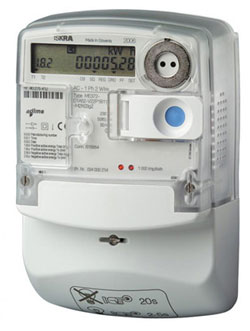
“Smart meters” for measuring electricity consumption have begun to spread in western capitalist societies; another “generous offering for the good of consumers.” Smart meters are not simply digital, as they appear at first glance. They “communicate” one-on-one both with the company that manufactured them (and this remains “hidden”) and with the company that supplies/sells the electricity (this is “visible”). That is precisely why one of the “conveniences” they offer (a convenience, obviously, to the electricity company) is that meter readers are no longer needed: the company records consumption in real time, day by day and hour by hour, based on its own data. Moreover, to the extent that heating (or cooling) of a space is done using electricity (e.g., via air conditioning), smart meters offer consumers something more: they connect to a central thermostat (instead of individual thermostats for each appliance) within the space, so that the consumer has the convenience of adjusting the desired temperature (and thus the corresponding electricity consumption) from a single device in a simple way.
Nice so far? Perfect! “Capitalism, technology, thank you for simplifying and beautifying our lives!”
Not exactly… Recently, 22,000 residential consumers/customers of an electricity company in Colorado, USA, discovered that their “smart thermostats,” which were part of their “smart meters,” had “locked up,” and did not allow them to raise the temperature of their homes above a certain point. No matter how hard they tried, the thermostat screen displayed the message “emergency energy situation”…
These particular households had been enrolled in an energy reward program—and without taking it into account or even knowing it, they had handed over control of their home heating to a “general authority.” In this case, to the electric company and its consortium with the state government… To put it differently: through the “smart meter” and the one-by-one house control of consumption data as well as heating (or cooling) that belonged to the (increasingly more porous) privacy, general authorities of various forms could now impose the “correct behaviors.” Citing, if necessary, “emergency.”
We already hear the curses of those who are “socially responsible” according to state/capitalist instructions: it is antisocial behavior (they will say) when there is an “energy problem” for each person to do whatever they want in their own home – even if they pay to have electricity… In our humble opinion, the only truly antisocial thing is for someone to be indifferent to the causes of the “energy problem”, that is, to be indifferent to state policies and stock exchange tricks of exploiting basic social needs, to take the “emergencies” and diagnoses of the bosses as “truth”, and then to accept and applaud the tactics of the state and capital (tactics of restructuring and controlling social behaviors we insist on shouting!).
Essentially, the technical (which upon first and final analysis are political) capabilities of controlling the electricity supply to homes extend far beyond the alleged “public interest” of saving energy. During the recent mobilizations of truckers in Canada (against health restrictions and mandatory platforming), the Canadian regime decided to punish those found supporting the strikers by, for example, bringing them food. How? By freezing their bank accounts, thus leaving them penniless! The technical-political capability for such person-to-person punishment was naturally due to a) banks (private companies, right?) collaborating with states, and b) the use of “digital payment cards” (considered a convenience) has expanded to such an extent that personal money remains in the banks.
We can now imagine other such punishments, in relation to the household electricity supply. Did you do A or B that is not approved by the authorities? Did you participate in some unauthorized protest? Aren’t you paying the installments of the loan that the bank so generously gave you? As punishment, we will cut off your electricity for one, two, or five hours. And if you don’t comply, next time your darkness will increase… You are socially irresponsible and you must face the consequences.
Is it an arbitrary assumption that such scenarios could happen? Don’t be too quick to dismiss them! They belong to the social credit system and are already happening, in various forms – in the Western capitalist world!…
Guiding behavior
In 2019, when we presented it2, it was in trials. Now it’s being promoted, advertised, and put into practice: a driving behavior monitoring app in our regions called “ergo drive & win”. Back then we had published praises from an automotive magazine. Now that surveillance is being “socialized” we must republish part of that presentation; the hymn, more accurately!
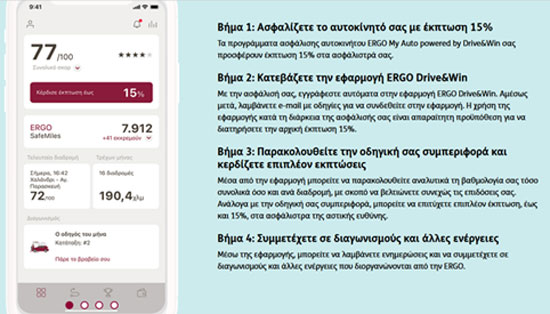
On March 27th we published a Press Release with the new application of ERGO – ERGO Drive & Win. An application created by the startup company O-Seven on behalf of ERGO, which aims to improve people’s driving behavior. Smart and modern. But is it also functional?
…
Curious about how useful and interesting this particular application is, I downloaded it on my mobile phone and tried it for a little over a month. I wanted to experience the user experience, to “test” my driving skills and finally to gain an opinion on whether a driver would remain loyal to the application or simply after the first week would just take up space on their mobile phone (3.0 MB so far).How does it work?
We won’t go into details about the technical part. What the app does, however, is impressive. After you download it to your mobile, accept the terms & conditions and enter some basic personal information, the app records your driving behavior and gives you a score at the end of the trip. All you have to do is keep your mobile in a fixed place – preferably at a specific point inside your car – and at the end of each trip – when you receive the notification – swipe left and declare the type of trip. Were you the driver or a passenger? Were you going to a personal destination or to work? Were you driving a car or a motorcycle?
All new drivers who download the app on their mobile start as “Nubies”. They must therefore complete 400 km or 40 trips until the system recognizes their driving pattern. Once this first step is completed, the app begins to function normally, giving the driver ERGO Stars and ERGO SafeMiles.
Personal experience
Overall, until today 8/7/2019 I have driven 888 km, that is 81 trips. Driving occupies 5% of my time. The average distance per day I drive is 46.7 km, while an average driver drives 28.2 km. I drive quite a lot indeed. Here’s something I didn’t know! My score? A disappointment. 37/100. How was this score formed though? What does the application measure?
- how much you use your mobile phone while driving,
- how abruptly you brake,
- how abruptly you accelerate,
- the speed you maintain when driving as well as
- the hours of the day when you drive. (00.00 to 5.00 in the morning are considered hours with a high probability of fatigue).
Based on this data, the application adjusts your score.
…Conclusion
The app works flawlessly! Not only does it have a very user-friendly experience, but it also keeps you engaged and interested. You want to drive better simply to avoid seeing “your mess” in the final assessment. On a personal level, the idea that an app records how I drive has made me more mindful and cautious while driving. Now my goal is to improve my score and reach the average of 68/100. Overall, the app is discreet and operates accurately. It even provides extra motivation to become a better driver, as by collecting SafeMiles & ERGO Stars you can receive discounts on your car insurance premiums (up to 20%), make donations for environmental protection, or participate in contests that are created periodically.
I didn’t expect to say this but the app can help you become a better driver. As long as you want it.

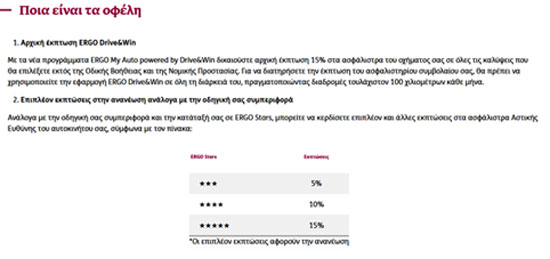
Perfect! Thank you, company! Thank you, company, for following me, for collecting my data, for processing it, and for making me a better driver! (Tomorrow, why not? Other companies, with or without state collaboration, will make me a better person! Social credit…)
However… Does “I have nothing to hide” apply here too? Is the affirmation so easy and foolish when it comes to digital surveillance, to digital profiling?
Let us repeat two paragraphs from that presentation, three years ago:
…
How, then, does the insurance company define “driving kindness”? What are its criteria? What does it measure through data collection? What does it reward?
If one excludes the use of a mobile phone while someone is driving, none of the company’s remaining “criteria” fall within what is called the “road traffic code,” that is, the state-defined legislation determining “safe driving.” Normally, whoever complies with the r.t.c. is sufficient as a driver; and from a legal perspective, they are not liable for a traffic violation, even if involved in an accident. The issue is serious. Until yesterday, the practice of insurance companies concerned compliance with the r.t.c. From an insurance perspective, “OK driving” coincided with adherence to the rules of the r.t.c. And when insurance companies urgently needed to reduce their expenses, they pursued and achieved supportive state legislation (as happened, for example, with the mandatory seatbelt and helmet laws). Until yesterday, the norms emerged (even through “reductio ad absurdum”) from the narrowly defined state legislation. No longer: in the age of big data, both the norms and the mechanisms promoting them are expanding. The criteria of this specific insurance company, the specifications it itself sets to shape the behavior of the “good driver” upon which it builds its “rewards” (and in the future, “punishments”), lie beyond formal legislation.This issue is far more significant than it appears at first glance. The insurance company legislates, not with the “validity” of the state (which formally still holds the monopoly on legislation), but with the “attractiveness” of its pedagogy. Going beyond the law, the insurance enterprise shapes a much broader normativity (social behavior); but also a new normativity of acceptance / compliance with the specifications of corporate legislation. The projection, via data and algorithms, of “rules of proper driving behavior” that serve the interests of the insurance company creates a mesh of digital legitimacy / real behavioral channeling.
We have and say: Do you brake suddenly? Do you accelerate suddenly? Do you drive within, indeed, the legal speed limits but outside the (insurance / business) convenient limits? Do you drive at night? You are “problematic,” that is, a “bad driver.” The company is not obligated to provide explanations for its choice of criteria; and even less willing to “negotiate” them, as usually happens in the formation of state constitutions. It has its own constitution—the acceptance of which is served like a seed. You “gain points” (or “lose points”), meaning you gain “gifts” or face penalties. In any case, you must acknowledge some kind of “moral legitimacy” in corporate tactics.
…
Who are willing to understand, not only what this specific “offer” means but the entire process of colonization and control of everyday life; We few are afraid…
Payments without wallet

A telecommunications service provider company (cosmote) suddenly transformed… into a bank! An “app” that nobody had asked for (but everyone was expecting!!! right;;;;) allows… so many nice things! “Purchases/payments from your mobile”, “sharing amounts between friends”, “bill payments”…
From a technological/social perspective, it’s just another step on an already prepared path – with a dark ending that the happy victims of hype are unable to (and mostly: indifferent to) see. Card payments (for “cracking down on tax evasion” of course!) are commonplace, and payments via virtual card have also started to become commonplace, meaning through the megaloofian device that everyone devoutly keeps in their hands, pockets, and bags. Not to mention the fact that this way, banks (private companies, right;) collect data on their customers’ daily transactions, shaping the corresponding profiles of each person’s habits and behaviors: they have nothing to hide… They are transparent!

But a telecommunications company? How does it “get involved” in monetary transaction processes that so far have been the responsibility of banks and their databases? From where to where?
Welcome to the jungle of the 4th industrial revolution!!! Banks have more and more payment and financial transaction data; telecommunications companies have at their disposal all the data of tele-communications, cyber-chatter, and geolocation… Why shouldn’t they cooperate with each other? Truly big data, from different aspects of everyday life; and some “smart” algorithms that, by combining them, would gain even greater knowledge/power, both individual-to-individual and for social groups or subsets, urban and geographical zones, habits, customs and traditions… Even more complete profiles.
No-one-has-anything-to-hide; but few realize that becoming increasingly transparent to corporate and state authorities is not necessarily going to turn out well for them. Of course, the bait looks attractive: more and more conveniences… However, as some who know have observed, when they sell you (or give you) “convenience”, you are the merchandise! And not just the merchandise: also the captive, helpless, constantly monitored infant.
So let’s examine this subtle but crucial shift in concepts and procedures, which is so easily swallowed by human infants. As a money merchant, the bank is so far obliged, apart from electronic conveniences, to also provide cash. Cash. In contrast, the telephone company has no such obligation. Both the bank and the telephone company can promote exclusively “electronic wallets”. However, the former might arouse suspicions that “it’s up to something”. The latter, not at all: it simply swears by facilitating people’s lives!!! Therefore, if the telephone company manages to create a mass of infants and infantile trust, it is in a better position to forge the “truth” of digital currencies, of (exclusively) “digital money” and of (exclusively) digital transactions, which is the holy grail for monitoring everyday life – and punishing “irresponsible behaviors” (remember Canada…). Together with the still more complete mapping of life, together with the appropriation of so many and such data, the telephone company bypasses conventional banking obligations by “cutting a path” towards the desert of “you have nothing and you’re happy about it”…
But (some will say): won’t there be a salary? Of course there will be – only it will now be co-ownership between you and the party (or companies) of the bosses. “Digital money” is not promoted to facilitate something that has been commonplace for centuries (: payment), nor to supposedly protect from wallets. It’s done so that even the salary (especially that one!) can be directly recalled, at any time and for any disciplinary reason! The numbers that are “stored” somewhere far from you and only appear on the screen are “yours” only conditionally. This is technically/politically the electronic wallet!
Now, if the power goes out or the internet “falls” for a while? Well, the state will distribute coupons…
Don’t believe the horse…
In Virgil’s Aeneid, Laocoön appears, telling the Trojans something that, over time, was condensed into the phrase “beware of Greeks bearing gifts.” They did not listen: the wooden horse (the Trojan horse) was considered sacred because that’s how the besiegers of Troy “sold” it to Poseidon… History (or mythology) tells us what followed.
Following the tactic of both carrot and stick, the most powerful capitalist bosses are demolishing anything that had been socially conquered in the 20th century, handing out “gifts” here and there. The entrenched cheer loudly with all their might, while the ignorants simply shrug their shoulders and take advantage (: or so they think).
Credite in Latin means “faith”. (Now it also means “loan”). Equo ne credite means “do not believe in the horse”. Un-reasonable? Today we would say: the rhetoric of power…
Do you believe it?
Ziggy Stardust
- Another form of privacy: I do not relinquish control over my body. Absolutely clear and correct, since control by any authority over bodies is synonymous with slavery. Absolutely clear and correct when expressed as a slogan and orientation by women against the prohibition of abortions. The provocatively servile act, however, is that this control was not simply conceded but imposed with mass applause and acceptance when the state-form and capitalist enterprises appeared as “protectors of public health” during the recent sanitization campaign. Of course, both the bosses and their various lackeys invented and used arguments of a “higher interest” in the name of which individual self-control over the body should be abolished, and whoever insisted on it should be punished as “antisocial,” etc.
What does this mean, however? It means that what was (or should have been) non-negotiable becomes relative, placed on the butcher’s counter; and it suffices for any general authority to invent and impose some “higher interest” to abolish it. That is; It suffices for any general authority to impose the “higher interest” of “national/social protection against population decline” (and it is very easy to do so, much easier in western capitalist societies than the average citizen believes…) to abolish women’s right to abortions. ↩︎ - Cyborg 16, big data: surveillance and shaping behaviors in the 4th industrial revolution ↩︎