
Three studies showing large DNA deletions and rearrangements increase concerns about safety regarding the editing of the inherited genome.
A series of experiments using the CRISPR-Cas9 gene-editing tool to modify human embryos revealed how the process can cause large, unwanted changes to the genome at the target site or near it.
The studies were published this month on the bioRxiv preprint server and have not yet undergone peer review. But together, they give scientists a good look at what some say is an underappreciated risk of CRISPR-Cas9 editing. Previous experiments have revealed that the tool can cause off-target gene mutations far from the target site, but the nearby changes detected in the latest studies might escape routine evaluation methods.
“The on-target effects are more significant and would be much harder to eliminate,” says Gaetan Burgio, a geneticist at the Australian National University in Canberra.
These safety concerns are likely to influence the ongoing debate over whether scientists should edit human embryos to prevent genetic diseases—a procedure that is controversial because it creates a permanent change in the genome that can be passed from generation to generation. «If editing human embryos for reproductive purposes or editing the germline were a space flight, the new data would be equivalent to the rocket exploding on the launchpad before liftoff,» says Fyodor Urnov, who studies genome editing at the University of California, Berkeley, but was not involved in any of the recent studies.
Undesired results
Researchers first experimented with using CRISPR to edit human embryos in 2015. Since then, a handful of teams around the world have begun investigating the process, which aims at precise gene editing. But such studies remain rare and are generally subject to strict regulations.
The latest research highlights how little is known about how human embryos repair DNA that is cut by genome editing tools—a key step in the CRISPR-Cas9 editing process, says reproductive biologist Mary Herbert from the UK’s Newcastle University. “We need a basic roadmap for what’s happening in there before we start hitting it with enzymes that cut DNA,” she says.
The first preprint was posted online on June 5 by developmental biologist Kathy Niakan at the Francis Crick Institute in London and her colleagues. In the study, researchers used CRISPR-Cas9 to create mutations in the POU5F1 gene, which is important for embryonic development. Of the 18 gene-edited embryos, about 22% contained unwanted changes that affected large stretches of DNA surrounding POU5F1. These included DNA rearrangements and large deletions of several thousand DNA letters—much larger than those typically sought by researchers using this approach.
Another group, led by stem cell biologist Dieter Egli of Columbia University in New York, studied embryos created with sperm carrying a mutation that causes blindness in a gene called EYS. The group used CRISPR-Cas9 to try to correct this mutation, but about half of the embryos examined lost large segments of the chromosome—and sometimes the entire chromosome—on which EYS is located.
And a third group, led by reproductive biologist Shoukhrat Mitalipov of Oregon Health and Science University in Portland, studied embryos created using sperm with a mutation that causes heart disease. This group also found evidence that the editing affected large regions of the chromosome containing the mutated gene.
In all studies, researchers used the embryos only for scientific purposes and not for creating pregnancy. The lead authors of the three pre-publications refused to discuss the details of their work with Nature’s news team until the articles are published in peer-reviewed scientific journals.
Unpredictable repair
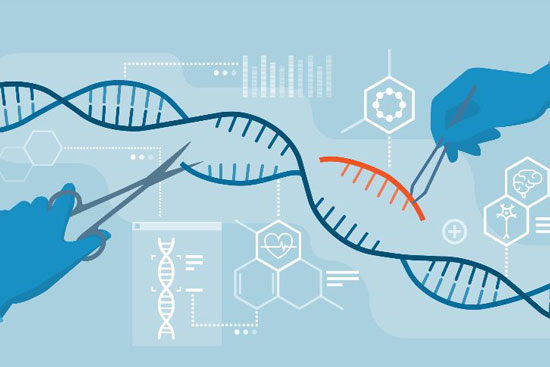
The changes are the result of DNA repair processes that are exploited by genome editing tools. CRISPR-Cas9 uses a small RNA strand to guide the Cas9 enzyme to a location in the genome with a similar sequence. The enzyme then cuts both strands of the DNA at this point and the cell’s repair systems heal the gap.
The repairs occur during this fix: most of the time, the cell seals the cut using an error-prone mechanism that can insert or delete a small number of DNA letters. If researchers provide a DNA template, the cell can sometimes use this sequence to repair the cut, resulting in a true rewrite. But the broken DNA can also cause scrambling or loss of a large region of the chromosome.
Previous work using CRISPR in mouse embryos and other types of human cells had already shown that chromosome editing can cause large, unwanted effects. But it was important to demonstrate the work in human embryos as well, says Urnov, because different types of cells may react differently to genome editing.
Such rearrangements could escape detection in many experiments, which usually look for other unwanted changes, such as changes in a single DNA letter or small insertions or deletions of just a few letters. Recent studies, however, specifically searched for large deletions and chromosomal rearrangements near the target site. “This is something that all of us in the scientific community will take, starting now, more seriously than we have already,” says Urnov. “This is not a one-time random event.”
Genetic changes
The three studies offered different explanations for how the DNA changes arose. The Egli and Niakan teams attributed the majority of the changes observed in their embryos to large deletions and rearrangements. In contrast, Mitalipov’s team stated that up to 40% of the changes they detected were caused by a phenomenon called gene conversion, in which DNA repair processes copy a sequence from one chromosome of a pair to heal the other.
Mitalipov and his colleagues reported similar findings in 2017, but some researchers were cautious about whether frequent genetic conversions could occur in embryos. They noted that maternal and paternal chromosomes are not located next to each other at the moment when genetic conversion is supposed to occur, and that the tests used by the team to detect genetic conversions could have detected other chromosomal changes, including deletions.
Egli and his colleagues looked directly for genetic modifications in their latest preprint and failed to find them, and Burgio points out that the tests used in Mitalipov’s preprint are similar to those used by the group in 2017. One possibility is that DNA breaks heal differently at various positions along the chromosome, says Jin-Soo Kim, a geneticist at Seoul National University and co-author of Mitalipov’s preprint.
Original title: «CRISPR gene editing in human embryos wreaks chromosomal mayhem»
Source: https://www.nature.com/articles/d41586-020-01906-4
Translation: Harry Tuttle