
As a miner for 40 years I have worked in various mines around the world. Gold, platinum, copper, coal, lead, zinc, oil and salt. I will tell you something, and I will tell you here. We will destroy the earth in the name of “green energy”. Read below and I will explain to you.
The organization MiningWatch Canada estimates that “three billion tons of metals and minerals will be needed to feed the energy transition” – a huge increase especially for six critical minerals: lithium, graphite, copper, cobalt, nickel and rare earth minerals.
In the next 30 years, 7.5 billion of us will consume more metals than in the last 70,000 years or the last 500 generations, that is, more than all the 108 billion people who have ever walked the Earth.
Mining means extracting solid minerals, often after removing enormous quantities of overlying rocks. Subsequently, the mineral must undergo processing, creating a massive amount of waste – approximately 100 billion tons annually, more than any other human waste stream.
Cleaning just one ton of rare earths requires the use of at least 200 cubic meters of water, which then becomes contaminated with acids and heavy metals. Additionally, imagine the destruction and energy required to obtain these essential metals:
18,740 kilograms of purified rock to produce 2.2 kilograms of vanadium,
35,275 kilograms of ore to produce 2.2 kilograms of cerium,
110,230 kilograms of rock to produce 2.2 kilograms of gallium,
2,645,550 kilograms of ore to produce 2.2 kilograms of lutetium.
By 2035, demand is expected to double for germanium, quadruple for tantalum, and quintuple for palladium. The scandium market could grow ninefold, and the cobalt market could expand 24 times.
The potential demand for rare metals is exponential. We already consume over two billion tons of metals every year, a quantity equivalent to more than 500 Eiffel Towers per day.
There is nothing sophisticated about mining. It involves breaking down rocks and then using a mixture of chemical reagents such as sulfuric and nitric acid, a lengthy and repetitive process that uses many different techniques to obtain a rare earth concentrate with purity close to 100%.
As rare metals have become ubiquitous in green and digital technologies, the extremely toxic sludge they produce pollutes water, soil, the atmosphere, and is released from the flames of refineries.
Do you think solar panels are “green”? Think again. There is nothing green about solar panels. Did you know that we cut down forests, not for placing the panels, but for the wood required for their production?
I have seen the destruction of mountains, lakes and pristine water systems, all in the name of Green Energy. A recent report by the Blacksmith Institute identifies the mining industry as the second most polluting industry in the world. Soon it will be number one. Why? Because “green energy”…
The “green” technologies require the use of rare minerals, the mining of which is anything but clean. Heavy metal discharges, acid rain and contaminated water sources – all of these touch the limits of environmental destruction. Simply put, clean energy is a dirty business.
Wind turbines consume more raw materials than previous technologies: For an equivalent installed capacity, solar and wind installations require up to 15 times more concrete, 90 times more aluminum, and 50 times more iron, copper, and glass than fossil fuels or nuclear energy.
If you have reached this point still believing that renewable energy sources are clean and green, then you have believed in rabbits with petrachilis. We thought we could rid ourselves of the shortages, tensions, and crises created by our appetite for oil and coal. Instead, we are replacing them with a new era of unprecedented shortages, tensions, and crises.
Testimony of John Lee Pettimore,
mining engineer
Translation by Harry Tuttle
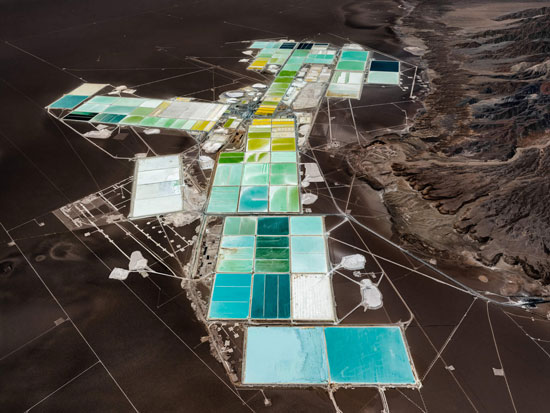
More than 50% of the world’s lithium reserves are located in South America, in the lithium triangle between Bolivia, Chile, and Argentina. The Salar de Atacama salt flats in northern Chile contain more than a quarter of the world’s lithium reserves. It is one of the driest and least populated places on Earth. But mining industries are changing the landscape. The largest evaporation ponds for lithium production in the world are even visible from space.
Underground lithium-rich brines, found more than 100 meters below the salt flats, are pumped into massive pools. The sun evaporates the water in the ponds, increasing the concentration of lithium. The turquoise-colored brine is transferred from pond to pond for over a year until the lithium concentration in the water reaches 6% and takes on a deep yellow hue. The concentrated brine is then transported by trucks for further processing in chemical plants. Lithium production through evaporation ponds uses vast amounts of water—approximately 21 million liters per day. Around 2.2 million liters of water are needed to produce one ton of lithium.
In the technologically advanced world, this is called a “green revolution.” In the rest of the world, it is known as black destruction.