
A new report by Amnesty International documents how the Israeli government uses an experimental facial recognition system to track Palestinians and control their movements. The findings are part of “Automated Apartheid,” which reveals a continuously expanding surveillance network with cameras in the occupied city of the West Bank, Hebron, and East Jerusalem—two areas in the occupied territories where Israeli settlements expand into Palestinian areas. “Surveillance increases as the activity of illegal settlers increases,” says Amnesty researcher Matt Mahmoudi, who adds that surveillance technology is part of an overall occupation structure that Israel uses against Palestinians. “In practice, facial recognition increases, enhances, and solidifies aspects of apartheid.”
[The following is a transcript of a discussion that took place on the Democracy Now website’s online broadcast, between journalist Amy Goodman and members of Amnesty International.]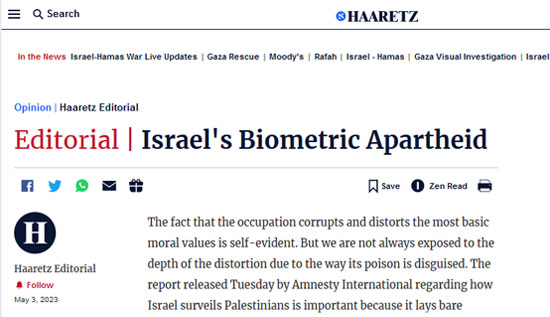
AMY GOODMAN: We begin today’s show by examining how the Israeli government is using an advanced facial recognition system to track Palestinians and control their movements. The findings are part of a new Amnesty International report titled “Automated Apartheid,” which reveals an ever-expanding surveillance network of cameras in the occupied city of Hebron in the West Bank and in East Jerusalem—two cities in the occupied territories where Israeli settlements are expanding into Palestinian areas. High-resolution cameras are pointed at mosques, hospitals, schools, and even inside people’s homes. In Hebron, a program called Red Wolf is used at military checkpoints to scan the faces of Palestinians and add them to massive surveillance databases without their consent. This is an excerpt from a video accompanying Amnesty’s new report, and this is Matt Mahmoudi speaking:
“Imagine you are a Palestinian from a small village in the occupied territories. You have not been registered at any checkpoint and you have not been arrested. You have not given your consent to the state. Now, let’s say you are going to visit a sick family member in Hebron, so you pass through a checkpoint. A small yellow light blinks on the guard’s screen, but you don’t think anything of it. However, at that moment, this camera has taken a small picture of you and compared it with other images and databases. It did not recognize you, so it took a photograph and fed a system without your consent. And this in turn feeds a giant system, so that from now on every checkpoint in the occupied Palestinian territories or in Israel knows who you are. Scans with other bio-sensors, other cameras, other databases, all on a massive scale without your consent.
Now, move forward until the next time you pass through a checkpoint. You go through the revolving door and a border guard you have never seen before on the other side says “hello, Mat, how are you?”. And you realize you are now in the system. You hope to God that the light behind the screen won’t turn red for some reason you can’t control. This is the Red Wolf.”
When Palestinians are arrested at checkpoints or elsewhere, their so-called biometric data is added to the surveillance network. This is another excerpt from “Automated Apartheid,” with Alia Malak, researcher and AI advisor for Amnesty International: “Israeli soldiers started organizing competitions about who could take the most photographs of a Palestinian to check them against the database and see if they could find any matches. And they say this among themselves and refer to it as Facebook for Palestinians. It is deeply dehumanizing to be treated as if you are part of a video game.”
The new exhibition “Automated Apartheid” follows last year’s major Amnesty International exhibition, which documented how Israel subjects Palestinians to the crime of apartheid under international law. In the excerpt that follows, Cambridge University professor Saul Dubow speaks: “There are undoubtedly compelling and very worrying parallels between the situations under the apartheid regime in South Africa and in Israel-Palestine, but I think the differences are also significant. The South African system, however oppressive it was, was never fully operational. The expectation that a high-tech apartheid central service processing data could collect all useful information about Black people simply did not exist, because it was not sustainable with the technology of that time, however terrifying it was to be arrested. The information was paper copies – it was not digital. Having survived to this day, this practice, with digital capabilities and artificial intelligence being so much more advanced, gives the Israeli state far more control.”
The Israeli newspaper Haaretz published a main article on Wednesday in response to the Amnesty International report, which partially states: “There is no other way to describe this system but only as a biometric apartheid…”
For more, let’s go to London. Joining us is Matt Mahmoudi, lead researcher of Amnesty International’s new report titled “Automated Apartheid: Facial Recognition Entrenches the Suppression of Palestinians.” Matt, can you continue and tell us what you found?
MATT MAHMOUDI: Thank you for having me. What we found is essentially a facial recognition system, particularly in Hebron, which follows a series of experiments with facial recognition technologies against Palestinians, especially in Area H2, which is under the authority of the Civil Administration, which is a sub-unit of COGAT, actually under military law, let’s say. And really, what we see here is how facial recognition experiments are being used against Palestinians under the pretext of protecting the approximately 850 Israeli settlers who are illegally located in the area. So Palestinians who previously depended, for example, on a soldier when passing through a checkpoint, now must be checked by an algorithm, which has collected their biometric data without them knowing it and without their consent, in order to be able to recognize them. And in case it doesn’t recognize them, they will suddenly find themselves in a difficult position, in which they may be held back at the checkpoint. A soldier will ask to match their ID with a facial capture that has already been taken, so that the facial recognition algorithm can be trained and identify them in the future.
In East Jerusalem, we see similar trends where, in fact, surveillance breeds the illegal activity of settlers and the illegal activity of settlers breeds surveillance. We see how surveillance has increased after the suppression of demonstrations that arose as a result of the expulsion of seven Palestinian families from Sheikh Jarrah in 2021. Here we have seen, in Sheikh Jarrah specifically, as well as at the Damascus Gate, as well as in Silwan, areas that have deep significance for Palestinian communities, that surveillance has increased as the illegal activity of settlers has also increased. And we see this as part of a coercive environment that aims to force Palestinians to move away from areas of strategic interest to the Israeli authorities.
And that is why we say that, essentially, facial recognition increases, strengthens, and entrenches aspects of apartheid, such as the aspect concerning restrictions on freedom of movement, which is the fundamental right that Palestinians must have in order to access things like housing, education, employment, and medical care, as well as the component of the coercive environment, which instills a chilling effect on Palestinians and prevents them from resisting, while introducing an additional factor that makes it more dangerous for them to do so.
NERMEEN SHAIKH: Matt, could you explain when this surveillance technology was put into use in the occupied territories and whether there are indications that Israel plans to expand the use of this technology?
MATT MAHMOUDI: Well, to speak specifically about the two systems we had under investigation, namely the Mabat 2000 system, which is a networked surveillance system used in East Jerusalem, and the Red Wolf system, we can talk, for example, about how the Mabat 2000 system was implemented at the turn of the millennium. But only by 2017 and 2018, further investments by the Israeli police meant that the system was now capable of extensive facial recognition. We initially started with about 400 networked cameras, only to subsequently end up with thousands of cameras that are able to connect with each other and perform facial recognition on Palestinians, who at times, as we have seen, are pulled from crowds and identified simply and merely because they participate in a protest. We have also seen, in places such as H2, in Hebron, the unregulated use of facial recognition experiments. Of course, surveillance constitutes an inseparable part of the experience in Hebron since the initial division in 1997 between the H1 and H2 areas. But since 2015, specifically, surveillance cameras have been placed almost everywhere on the streets of H2.
In 2021, we began hearing reports about an app called Blue Wolf, used against Palestinians in Hebron, where soldiers would enter homes, target Palestinians in the streets, and enter their faces into this database that contained further information about Palestinians, in an effort to automate the process so they could identify them in the future on the streets. The Blue Wolf app incentivizes military units to be able to record as many faces as possible and makes it almost inevitable for Palestinians to be confronted with surveillance.
Now, Red Wolf is simply the latest of a series of such tools that have been used against Palestinians. And we believe there is a major risk that the tool will be linked to the Blue Wolf database, so that information will be presented to a soldier at a checkpoint where in reality a Palestinian passing by may have no idea that there is information about them.
NERMEEN SHAIKH: Matt, could you tell us a few words about where this technology comes from? The US is said to be the second largest exporter of surveillance technology, particularly facial recognition technology, and China is the number one exporter. What did you find regarding the origin of this technology?
MATT MAHMOUDI: While we know that the Mabat 2000 system and the Red Wolf system do not have a clear origin from the manufacturer’s perspective regarding the software, we know about some of the companies that supply the cameras, the CCTV cameras, which are connected to the Mabat 2000 system in areas such as East Jerusalem. Thus, a series of reports have been made by various collaborating organizations that led us to this point, but we found in our investigation that specifically Hikvision, the Chinese surveillance technology company, as well as TKH Security, which is a Dutch-owned surveillance technology company, are particularly present in East Jerusalem.
Hikvision cameras, in particular, appear to have increased only in the last two years, alongside the illegal activities of settlers in Silwan. And I want to emphasize here that in Silwan, we see extensive excavation projects in the locations of the City of David [Wadi Hilweh], followed by settler activity, whereby they occupy demolished Palestinian homes, evict their inhabitants, and subsequently install surveillance cameras in the areas to further restrict Palestinians from resisting their illegal activities there. Thus, TKH Security and Hikvision, in particular, risk becoming complicit in serious international crimes, unless they explicitly issue a plan to remove their products and clarify what due diligence process they followed regarding human rights, as well as what their business relationships were with Israeli security forces in the region.
AMY GOODMAN: Matt Mahmoudi, can you talk about the impact this has on the right to freedom of expression, the right to assemble, when this kind of surveillance exists?
MATT MAHMOUDI: It is important to note that Palestinians are of course still resisting the occupation. They are still resisting apartheid. But we have seen in places like Hebron, where Palestinian groups, such as the Youth Against Settlements group, have essentially been placed under house arrest, with cameras outside their house pointed into their home, making it very difficult for them to participate in their normal activities. In East Jerusalem, we see Palestinians who participated in protests, both after the crackdown on evictions in Sheikh Jarrah and after the assassination of Shireen Abu Akleh, being pulled out of the crowds and undergoing identification procedures. This discourages people and introduces a kind of diffuse fear, which makes it very, very difficult, and at great cost, for Palestinians to participate in protests and resistance.
In Silwan, we had many reports from witnesses and those questioned who spoke about the feeling that every time they need to cross a street, not even to participate in a protest, but simply to go have coffee with someone, with a neighbor, with a family member, they have to think about where the surveillance cameras are located. They have to consider what risks they might face in order to participate in simple aspects of normal social life. In Hebron, we had testimonies that specifically spoke about how this form of militarization and this form of surveillance has almost killed all aspects of social life.
NERMEEN SHAIKH: Matt, you have also documented the widespread use of a CCTV camera network. Could you talk about the connections between the use of this facial recognition technology, the way it operates together with this CCTV camera network, as well as the impact of the quite daily use of facial recognition technology, for example, on smartphones, which is now quite widespread?
MATT MAHMOUDI: Absolutely. First of all, to talk about the surveillance we see in East Jerusalem, as I said, the Mabat 2000 system was put into operation in 2000, at the turn of the millennium, but it was only equipped with facial recognition technologies in 2017 and 2018. The way it works is that any camera capable of capturing faces, that is, any high-resolution cameras, which means that most cameras produced in the last 10 years that are capable of recording video, can be connected to a software-based system located on a computer, which can effectively perform facial recognition on these CCTV cameras, and therefore, in our previous research with Amnesty, we have made it clear that most cities are just one software upgrade away from having facial recognition capabilities everywhere. East Jerusalem is no exception to this, with the difference that we are dealing with a framework that is internationally recognized as illegal annexation. And so we are dealing with a double-edged sword, as we have the technology that we consider fundamentally incompatible with international human rights law, while at the same time it is applied in a framework that is fundamentally contrary to international law, that is, in the framework of apartheid and in the framework of illegal annexation.
Regarding the everyday nature of facial recognition technologies, it is important to note the differences between the systems we are talking about here. So, the facial recognition you can find on your phone is what we call one-to-one facial recognition, that is, a match that is made provided you know and consent to your face being recorded and stored locally on your phone for later recognition, so that you can log into your system. You can also think of it as what some call facial recognition for authorization. Sometimes it is applied in buildings. You will enter a space where you have already registered only your face in your profile. It will recognize you and allow you entry.
For facial recognition for mass surveillance or facial recognition for identification, what we also call one-to-many facial recognition, we are dealing with a system that relies on curating a large-scale database without their knowledge and consent, usually collecting millions of images from, for example, social media, or, precisely in the context of Hebron, for example, through soldiers roaming the streets and taking photographs of Palestinians without their knowledge and consent. And these then feed this database, which is then used in combination with a facial recognition algorithm that determines which people appear in specific footage from closed-circuit television cameras. Now, because these systems depend on this large-scale database, we consider them to be, by design, incompatible with the right to privacy, because they are, by design, mass surveillance technologies.
AMY GOODMAN: What are the final recommendations of Amnesty International on artificial intelligence—and what you call automated apartheid?
MATT MAHMOUDI: We are calling for the immediate termination of facial recognition technologies, the prohibition of their sales, exports, development and advancement, and specifically, we are calling on companies that provide tools that can be used for facial recognition to immediately halt their sales destined for the occupied Palestinian territories. We also call on the state of Israel to dismantle the apartheid system it implements against Palestinians. And we believe that by stopping facial recognition, we are taking a step towards dismantling apartheid.
Source: Democracy Now, 4/5/2023
Original: https://www.democracynow.org/2023/5/4/automated_apartheid_amnesty_report_israel_palestine
Translation: Harry Tuttle