
The application of artificial intelligence (AI) by Israel in Gaza marks another significant shift in the landscape of modern warfare. However, the extensive destruction of homes and infrastructure in Gaza – along with the enormous number of dead – has raised concerns about the use of automation and robotics in operations dubbed as «counter-insurgencies».
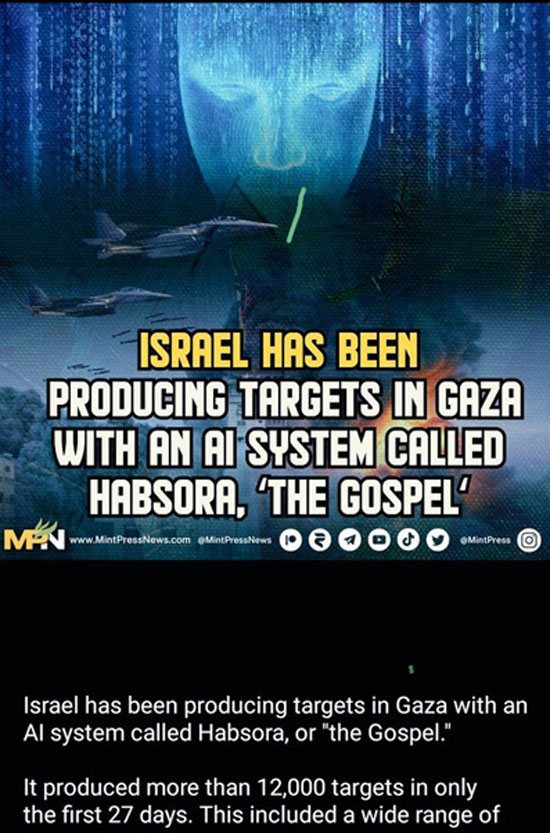
As highlighted in a recent groundbreaking investigation by the Israeli publications +972 and Local Call, at the forefront of Israel’s attack is a system called “Habsora” (“Gospel”). This artificial intelligence platform is said to enable faster target selection in Gaza for bombings, as well as quicker monitoring of Hamas positions, while providing an estimate of potential deaths before an attack.
Indeed, while older systems could produce 50 targets in a day, the Habsora system now allows the Israeli army to produce 100 targets. But how exactly does this system work? In short, it creates targets using a method called “probabilistic inference,” a key feature of machine learning algorithms. Essentially, these algorithms analyze large amounts of data to identify patterns.
The effectiveness of these algorithms depends largely on both the quality and the volume of the data they process. The algorithms use these patterns to make predictions or suggestions based on probability. If an individual shares sufficient common characteristics with other individuals who have been identified as enemy fighters, the system may also characterize that individual as a fighter. This process is based on case studies or the probability that they share the same pattern, not on absolute certainty.
Israel’s strategy for artificial intelligence
The significant collection of data and information from Israel constituted a basic element that allowed this new strategy. “Over the years, Israel has accumulated a huge volume of information using surveillance equipment, unmanned aircraft and spies within Hamas, as well as from Palestinians crossing the borders,” stated Antony Loewenstein, independent journalist and author of The Palestine Laboratory, to The New Arab. “This massive collection of information allowed Israel to create and draw this huge number of targets,” he added.
Habsora’s ability to select bombing targets is so sophisticated that a former Israeli intelligence official called it a “mass assassination factory.” According to the investigation, it allows the army to carry out mass strikes on residential complexes where only one Hamas member lives, even if it is a lower-ranking cadre.
However, Palestinian testimonies have shown that aerial raids have targeted numerous residential buildings where no known member of the organization resided. “The use of the new artificial intelligence targeting system called Habsora is partly responsible for the high number of Israeli strikes in Gaza throughout this war,” said Rob Geist Pinfold, lecturer in Peace and Security at Durham University, to The New Arab newspaper. “Israel has long had the capability to carry out so many strikes, but did not have the intelligence to do so with relative accuracy, so the use of artificial intelligence enhances Israel’s intelligence and consequently its military capabilities,” he added.
“This artificial intelligence uses existing accumulated data to identify potential targets in Gaza and map the number of theoretical civilian casualties that a strike on these targets would cause. All of these are categorized with a ‘traffic light’ system: red would mean many Palestinian casualties, while green would indicate the opposite.” Using this AI, Israel also revealed the application of another artificial intelligence system, alongside Habsora, known as “Fire Factory.” This system uses data regarding military-approved targets to calculate explosive payloads, prioritize and distribute thousands of targets to aircraft and drones, and suggest a timeline for the next raids.
Israel’s endeavor in the war with the help of artificial intelligence is not new. The Israeli army claimed that it conducted the “first artificial intelligence war” during the 11-day war in Gaza in May 2021, highlighting the continuous push towards incorporating advanced technology and supercomputers into its military strategy. Meanwhile, Israeli forces had begun using artificial intelligence for target selection in air raids and logistical planning since July 2023.
Israel is actively seeking to intensify autonomous warfare, as announced by the Director General of the Israeli Ministry of Defense Eyal Zamir in May 2023. This initiative includes the creation of a special military robotics department and a significant increase in funding for artificial intelligence research and development. Key pillars of this strategy were the development of drone swarm strike platforms and autonomous battle systems with artificial intelligence. Given that it maintains a small numerically-sized army, while prioritizing technological advancements, Israel also seeks to bridge gaps, with the stated ambition to become an “artificial intelligence force,” according to Zamir’s words.
[…]
“The risk here is that this system produces so many targets that it makes human oversight much more difficult, which implies that more ad-hoc decisions are being made, which may partially explain the high number of civilian casualties,” added Rob Geist Pinfold.
[…]
“Based on what we have seen, Israel’s strategic primary goal is more to cause significant damage than accuracy, to make Gaza uninhabitable and to force the world to overthrow Hamas,” he added. Indeed, according to +972’s investigation, senior officials of Israeli intelligence services ordered their agents to “kill as many Hamas agents as possible,” while simultaneously loosening every restriction around causing harm to Palestinian civilians. […]
The future of war
The use of Habsora and similar strategies by Israel represents a further advancement in the integration of Artificial Intelligence in warfare, a leap with historical precedents. From the Vietnam War, which marked the initial endeavor to test laser-guided missiles, to the Iraq War, where there was evolution into biometric systems for identifying insurgents, along with more advanced guided munitions, the continuously intensifying adoption and evolution of AI equipment in warfare is evident.
Governments around the world seek to militarily upgrade AI in order to strengthen themselves. Emphasizing the role that war in Gaza can play in this trend, a former White House official, whom the Guardian cites, supported that “other states will watch and learn” from Israel’s application of AI in its war.
“Israel has released numerous videos from its airstrikes and this is not done merely to address domestic audiences or influence international public opinion,” Antony Loewenstein declared. “The primary goal is to showcase their capabilities to other governments, essentially attracting foreign buyers.”
Israel’s arms exports are expanding, having doubled their value over the past decade, according to the defense ministry. Among its key customers are countries such as India, states in Southeast Asia, Latin America, Africa, and Arab states that have normalized their ties with Israel following the 2020 Abraham Accords.
“Israel actively markets its equipment and methods, creating a precedent that other states may imitate in the future, particularly those claiming to engage in ‘counter-insurgency’ operations,” Loewenstein added. “Which specific states will follow this example may be unknown for now, but the trend is clear.”
Source: The New Arab, 13/12/2023
Original: https://www.newarab.com/analysis/gospel-israels-controversial-ai-used-gaza-war
Translation: Harry Tuttle