
The threat and the promise (a genealogy)
…We need to achieve symbiosis with artificial intelligence, in order to achieve the democratization of intelligence. How will we start? By implanting a microchip with bundles of microscopic fibers in the brain… So, if millions of people have such a connection, it will be their extension into artificial intelligence, and this will make each one super-intelligent… If we don’t do this, the increasing power of artificial intelligence will lead our species to be confined in small enclosures, like zoos. Just as happened with the monkeys, who lost their natural environments because of a smarter dominant species…
These were his words 5.5 years ago, in November 2018, when the well-known and controversial Elon Musk was interviewed. For someone who founded a specialized company with precisely this purpose—the implantation of microchips in the brain—such statements are nothing more than “product placement.” However, he is not the one who conceived (without chips…) the necessity of this “symbiosis,” the risk, that is, of becoming monkeys fed by the owners of “artificial intelligence” in parks so we can “run free.”
The first appearance of a statement titled Transhuman Manifesto was a 1983 work by an American artist (and designer, and philosopher, and so on and so forth) with the artistic name Natasha Vita-More. With all the freedom-of-art, she wrote then:
I am a superhuman.
With the goal of unifying creativity and logic
for the purpose of self-awareness and longevity
driven by perseverance
knowing the probabilities, informed about the risk
in vigilance for new discoveries, welcoming challenges
everything changes.
I become.I am the architect of my existence. My life reflects my vision and represents my values. It carries the very essence of my being, combining imagination and logic, challenging all boundaries.
Transhumanism requires an increased sensitivity to reveal the multiplicity of spheres that have not yet been discovered, that have not yet been realized. We explore how current and future technologies affect our senses, consciousness and life. Our attention and understanding of these relationships become fields of art as we participate in the most direct and vital issues of transhumanity: life extension, increase of intelligence and creativity, exploration of the universe.
Transhumanists invent and design through technology and collaborate with the universe, act in multiple realities, self-morph their minds and bodies, understand, innovate and explore. We forge indelible mimetic blueprints of longevity. We are the neo-cyberneticists who use high-spec creativity, mechanical skills, scientific data and automated tools to compose our visions.
Transhumanists encourage experimentation and abundance trends and emphasize the infinite possibilities of self-transformation as we seek new values necessary for the creation of ourselves. We are not interested in focusing on self-destructive thought or entropy. We achieve sophisticated emotions through provocative bold thinking and analytical techniques.
Every individual influences social and cultural change: how we live and who we are. Every individual creates a sense of self, autonomous yet connected to the continuum of culture. How we will achieve our additions is a matter of selective individual choice – whether abstract or concrete, whether it is a contrivance or something without form. Our criteria for art remain open and we welcome interdisciplinary innovations.
Our unique inventiveness will spread far into the capillaries of society. We are active participants in our own evolution. We shape the image of who we are becoming.
We can be reasonably certain, based on the chronology and the prevailing “atmosphere” of the American underground, that the 33-year-old Vita-More in 1983 was influenced by or belonged to a broader “current” of exploring and expanding consciousness, which had as its main core the use of psychoactive substances and not so much the use of technology… She had lived for some time in a Navajo indigenous settlement… she had traveled (as much as this was possible) to the Amazon jungle…
Here, for example, is a similar declaration 20 years before Vita-More’s, in 1963, by an American psychologist who became famous as a strong advocate of psychoactive substances. It is the 1963 declaration of Timothy Leary, and we are entitled to argue that this underground current is indeed the primal matrix of the Transhuman Manifesto:
The fifth Freedom: the right to be high
… So where will the next evolutionary step take place? Within the gray matter of the human brain. We Know, yes, we Know that science has provided methods for a dramatic change and expansion of human knowledge and human capabilities. The unmapped region lies right behind your own forehead. Inner geography. Inner politics. Inner control. Inner freedom.
The nervous system can be transformed, completed, recycled and expanded in its function. These capabilities physiologically threaten every aspect of the established order…. We should adopt non-verbal methods of communication if we wish to liberate our nervous system from the tyranny of the rigid simplicity of words…
…
Make it or Break itThe danger of LSD is neither physical nor psychological, but sociopolitical. Don’t make the mistake: the effect of consciousness-expanding psychedelics is to transform our perception of human nature, human potential, existence.
The game where it’s at is changing, ladies and gentlemen. Man, very soon, is going to use this wonderful electric network that runs through his skull.
Today’s social establishment would be better prepared for this change. Our cherished ideas are in the path of a tidal wave that has been swelling for two million years. The verbal dam is collapsing. Run for the hills, or prepare your intellectual vessel to sail with the current.
…The Fifth Freedom
The political issue involves control; “self-driving” means that the free citizen operates his own vehicle in external space. Internal self-driving. Self-management. The freedom and control of the empirical mechanism of the individual. A license will be required. You must be trained to function. You must prove your proficiency in handling consciousness-expanding psychedelics, without risk to yourself or others. The fifth freedom – the freedom to expand your own consciousness – cannot be denied to you without serious reason.
A final piece of advice for those who have ears to hear. Open brown substance induces an ecstatic state. The nervous system, functioning freely from learned vagueness, is a completely sufficient, completely capable, ecstatic instrument. To deny it is like placing learned human perceptions above the preferences of two million years. A disrespectful act. Trust your natural mechanism. Enjoy the social game you play. Remember, the natural state of man is ecstatic wonder, ecstatic intuition, ecstatic, precise movement. Don’t settle for less.
The technology that Vita-More invoked in 1983 could indeed allow indefinite promises, ideal escapes towards a rather bright future, but nothing more, nothing more specific. Ultimately, Vita-More’s declaration in favor of transhumanism moved within the boundaries of (separate) art, roughly repeating the spirit of the “Manifesto of the Futurists” (1909)… In any case, her “manifesto” turned out well: it was the starting point of a great career that continues even today.
Sixteen years later, in 1998, the Transhumanist Declaration was much more serious, not at all “artistic”, rather threatening. Among the 23 signatories one finds, among others, a specialist in computational neuroscience (Anders Sandberg), a former hacker and later specialist in cybersecurity (Arjen Kamphuis), a geneticist (David Pearce), a president and CEO of a cryonics foundation (Max More), a well-known programmer at the time (Lee Daniel Crocker), and a “philosopher futurist” (Nick Bostrom) – along with the already established “professional transhumanist” Vita-More.
Here things seem to have started taking their course:
- Humanity is about to be profoundly affected in the future by science and technology. We envision the possibility of expanding human potential and overcoming aging, cognitive limitations, involuntary labor, and our confinement to planet Earth.
- We believe that human potential is still, for the most part, unrealized. There are various possible scenarios that lead to wonderful and extremely valuable improved human conditions.
- We recognize that humanity faces serious dangers, especially from the misuse of new technologies. There are plausible realistic scenarios that lead to the loss of most, or even all, of what we consider precious. Some of these scenarios are drastic, others are insignificant. Although every progress is change, not all changes are progress.
- Research effort must be invested to understand these prospects. We must carefully consider how to reduce risks and accelerate beneficial applications. We also need dialogue opportunities where people can constructively discuss what should be done, just as we need a social framework where responsible decisions can be implemented.
- The reduction of existential risks and the development of means for preserving life and health, alleviating severe suffering, and improving human foresight and wisdom must be pursued as urgent priorities and seriously funded.
- Policy-making must be guided by responsible and comprehensive moral vision, taking seriously into account opportunities and risks, respecting autonomy and individual rights, and showing solidarity and concern for the interests and dignity of all people throughout the world. We must also consider our moral responsibilities towards the generations that will exist in the future.
- We defend the well-being of all sentient beings, including humans, non-human animals, and any future artificial intelligences, modified forms of life, or other forms of intelligence that may arise from technological and scientific progress.
- We support allowing individuals broad personal choice regarding how they shape their lives. This includes the use of techniques that can be developed to aid memory, concentration, and mental energy; life-extension therapies; reproductive choice technologies; cryonic procedures; and many other possible human modification and enhancement technologies.
This declaration, in 1998, was the founding act of the establishment of the “World Transhumanist Association” (World Transhumanist Association / WTA).
Between 1983 and 1998, much had happened. The hippie spirit of “expanding consciousness” (whether through natural psychedelics of the mescaline and psilocybin type, or through chemicals of the LCD type) had now evolved into the “California spirit”; that is, of Silicon Valley: innovation as the goal of (aggressive) capitalist entrepreneurship.
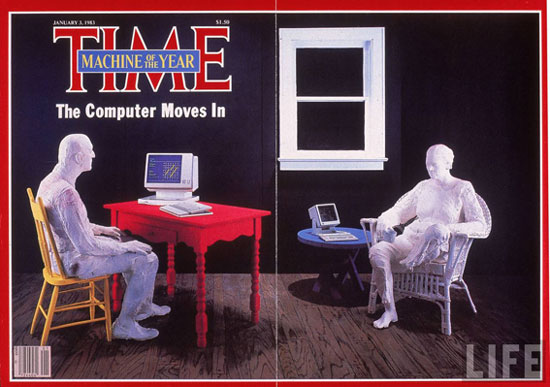
Many things had happened in the two key technoscientific fields that could inspire transhumanists. In computing/cybernetics, the 1980s saw the “birth” of personal computers (PCs and Macintosh), the internet, the World Wide Web, compact discs (CDs), and emails. In early 1983, Time magazine, for the first time in its history (since 1927), named the personal computer as “Machine of the Year” instead of “Person of the Year.” It was a proposal that caused a great sensation…
In 1997, a machine (IBM’s Deep Blue computer) would defeat grandmaster Garry Kasparov at chess, in an impressive demonstration that computers (algorithms) could now be “smart enough” to play world-class chess…
In biotechnology, after the birth (in 1978) of Louise Joy Brown, the first “test-tube baby” (through in vitro fertilization), the decades of the ’80s and ’90s were impressively prolific. Indicatively,
- In 1984, the first vaccine using genetic engineering against hepatitis B was announced – which would be definitively approved in 1986…
- In 1985, the first major private investments in biotechnology research and application companies were announced…
- In 1985, the first court decision based on “DNA fingerprinting” is issued (in the USA)…
- In 1990, the first experimental use of “mRNA introduction” was announced, aiming to alter cell function and guide protein production…
- in 1990 (on October 1) the official announcement was made for the “decoding of human DNA” campaign, the Human Genome Project…
- in 1994, DARPA, the technological arm of the U.S. military, officially enters the map of those interested in genetic engineering (becoming a key funder and research guide) for reasons of “biosecurity”…
- in 1996 (July 5) Dolly is born, the first cloned sheep…
- in 1999, on September 17, the first human genetic therapy experimental subject dies, resulting in suspicion and strong retreat in this field…. (It turns out that back then, just one (1) death of a human genetic experimental subject was enough to form a completely negative idea about the technology. Were those times “anti-scientific”? No. They had not yet become completely cynical…)
Even if these, under the light of newer innovations, seem clichéd, in the ’80s and ’90s they were impressive, and could ignite unlimited imagination about the possibilities of specific technologies/technosciences. Moreover, from the late ’80s, these possibilities began to “magnetize investors,” large sums with many zeros, who wanted to buy the future – to definitely have the majority of its shares. We recall that the 1990s decade is that of the neo-liberalism party (after the dissolution of the eastern, “socialist” bloc), of the “end of History,” etc… The victory of the West was attributed mainly to its technological freedom, which (with the myth of the kids-who-improvise-with-their-screwdrivers-in-their-family-garage) proved that “central planning” was a recipe for failure – capitalist failure!
Consequently, the ideas that technology is as such an indicator of superiority to dominance; that western societies and their members possess something «over», which they can and should extend; and that money drives inventiveness and inventiveness drives «growth» (generally) ultimately sprang from the altars of the end of the «cold war» (3rd world war…) like Athena from Zeus’s head. Supporting that, consequently, the «syntax» of transhumanism was from the outset warlike is not as arbitrary as it seems at first glance.
The «hippies» of the ’60s became ideologists of the bloodless «liberation» from the media of the ’70s and after, of the «liberation» of humanity supposedly but in reality of their own Self. Here, for example, is what one of the sacred monsters of the American movement, Jerry Rubin, said in an interview in 1985:
- Question: Today you are a yuppie. You used to be a hippie and now you are a yuppie. What exactly is a yuppie;
- Jerry Rubin: As I told you, the activists of the ’60s and ’70s realized they were henceforth the driving force of society. They have evolved greatly over these twenty years. They have changed their stance regarding anti-war movements, women’s equality, and the importance one should place on their body and health!
They are young, urban, and professional. Young, because they remain healthy. Urban, because they have mastered the big cities and hold significant positions. Professional, because they are active and effective. Y, U, P – the yuppies! Thus, a movement was created, which brings together the best of the ’60s and their heirs.- Question: What does it mean “to be healthy”;
- Jerry Rubin: In the ’60s, nobody paid attention to their body, nobody worried about health problems, we consumed drugs, ate poorly, didn’t think about our physical condition. In the ’70s we realized that all these things were important and we understood that if we ate well, if we exercised, if we took care of our body, the body would return the favor. My parents died from heart attacks and cancer. They died in the ’50s, murdered by diseases created by our culture. I will be an old man protected from this threat.
- Question: Did you program it?
- Gerry Roubini: Of course. Come see, I’ll show you. (He opens a cabinet full of bottles and boxes of medicines). I’m engaged in a struggle for the maximum extension of my lifespan. I take vitamins and metallic salts. I eat cereals for breakfast and salad for lunch. I never consume meat or fattening foods. I treat my body as if it were a revolution. I eat to nourish myself, not for pleasure.
Here are the natural supplements I take for my overall balance. I consume forty to fifty of these per day. Here’s the Max Epi which protects against heart accidents. Beta-carotene extracted from plants, which delays cellular aging. Here are others that prevent cancer development or cleanse the body of its impurities. Here’s the ginseng that boosts my energy and prepares me for my athletic performances. I also take vitamins, like these here, which help me sleep at night, and B vitamins.
Many of the “driving force of society” from the ’80s onwards began to become bold, innovative techno-entrepreneurs, in biotechnology and information technology / cybernetics. It is under this light that one should read the transition from Natasha Vita-More’s artistic call (sprinkled with a bit of Nietzsche and a bit of Baudrillard…) to this “venture international” of ideas and capital (one of the many that were about to sprout to conquer the world, now free from obstacles…), the World Transhumanist Association.
Elon Musk, born white in 1971 in (apartheid) Pretoria, began experimenting with one of the first 8-bit personal computers, the Commodore VIC-20, after his 10th birthday — a keyboard, cassette programs, and a television as a screen. He thus earns a place among the “geek-kids-who-…”. In the ’90s, when the (mainly entrepreneurial by then) idea of “transhumanism” was ripening in the “California spirit”, young Elon was spreading his entrepreneurial wings, jumping from idea to idea; and he was somewhere around there. And, at the same time, with a “long gaze”: in 2001 he began dealing with the exploration of Mars… which led to (along with quite a few million dollars) the now well-known SpaceX in 2002. With the purpose (according to his founding statements) “of creating a true spacefaring civilization”.
Poetic? Not exactly. Venture… Capital venture.
The “product placement” (in his 2018 interview) for the “symbiosis” of machines/humans through the literal integration of the former into the latter, far from saving unwired humanity from the fate of returning to the trees, has at its center posthumanism as super high-tech capitalism. The “return to the trees” is rather the punishment for those who refuse – and are cast out or simply fall away…
noble 2.0
A strategically significant move included in any “reason-for-the-posthuman” is that it pushes the center of attention to what is (and what is not) human. It could be an interesting intellectual engagement for people who have time and no pedestrian knowledge, half-philosophical half-ideological for people who may be paid as philosophers and futurologists or simply doing some doctoral work. What is human and what is not is also a discussion gladly promoted by various specialists, of the kind bio-ethicists, cyber-ethicists, etc. Because it can continue indefinitely without a definitive conclusion, leaving undisturbed the relevant technical experts to design and impose their “leaps.”
Meanwhile, what is obscured in this way is particularly significant. The machine (in its most general sense) and the meaning/purpose of mechanization, especially capitalist mechanization. And History, and especially the history of eugenics.
…We explore how current and future technologies affect our senses, consciousness and life… stated Vita-More in her “manifesto” in 1983, while the words technology and mechanical (as the “skeleton” of her poetic transhumanism…) are mentioned two more times. It couldn’t be otherwise. If someone were to remove anything mechanical or/and generally “assistive” (including chemical substances) from the vision of the “trans-” (or “hyper-“), what would remain in the early 1980s to assure the possibility of “upgrading” (or even better “transcending”) the “human” as it was conceived by the white, privileged classes in the West at the beginning of the 1980s? Perhaps meditation and/or some religious practices of enhancement. Although it wouldn’t be wrong to make such a comparison, between faith in the capabilities of current and future technologies and faith in a higher being, the culture that Vita-More represented became much more practical and entrepreneurial over time.
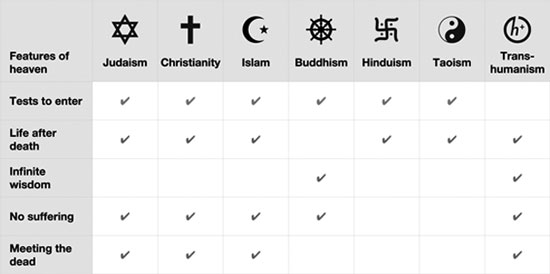
In an interview in August 2015, already recognized as a “guru” of transhumanism, Vita-More made a brief retrospective:
Question: How do you see transhumanism today? Has it changed over time? What are the main areas of focus today?
Answer: Transhumanism is no longer just a subculture and an emerging academic field. It has become a worldview that represents contemporary trends in the global community. These trends concern the sciences, technologies and innovations that are changing the way people act – in their health, in their lifestyle, in their communication and self-awareness, in how they accept the new.
… The scientific research on human physiology and consciousness, the development of biotechnology … have shaped the basis of many of these ideas. Technological Singularity shaped a similar but different direction of deeper enhancement of humanity’s future, and warned about specific artificial intelligence, something that promoted general artificial intelligence and new connections between fields which developed forming the ground for creating innovative ideas. The trends towards entrepreneurial practices, being innovative, founding a company, making a change in the world, created the current culture that aims to educate and inspire others to think about what is needed today to have a secure future…
Technology companies (innovative in one way or another) were already, by the mid-2010s, the obvious foundation of transhumanism. For the good of humanity – or, more realistically, of some part of it. The mechanics of this “enhancement” are diagonally visible in Vita-More’s discourse, as “technology”; the machines themselves are invisible, mainly because they are “innovative” – or already clichéd…
What machines, however? Vita-More provides (still in the same interview, in 2015) a pre-answer that sounds like a tailored echo of Jerry Rubin:
Question: Would you support the use of a technology such as Crispr-Cas9 for enhancement, that is, not only for correcting, let’s say, a mutation that causes a disease, but also for improving potentially desirable traits such as intelligence, delaying aging, strong bones, better muscles, and so on?
Answer: Yes, certainly, provided it is safe. Let’s examine what pharmacology and neuropharmacology offer today: for bone mass loss, improvements currently include calcium and vitamin D, and for greater improvement needs, Fosamax and Actonel. For muscle loss, current interventions include anaerobic exercise, and for more aggressive treatment, growth hormone, testosterone, and HRT. Intelligence enhancement is achieved with nootropic drugs, but also computers, smartphones, etc. increase human intelligence because, although they are external devices, they interface with cognitive functions (memory, logic, calculations). The likelihood of hypergnosis will form a type of meta-brain, whether it is an internal or external brain attachment.
(Internal or external attachment? Elon Musk proposed an answer…)
If someone approaches the issue abstractly, then they can only agree: from the moment one of our species’ ancestors, somewhere, sometime used something as a tool, they enhanced their action, their work… The term homo faber, meaning “man who creates,” is quite old, and is attributed to a Roman engineer, Appius Claudius Caecus, around 3 centuries BC: Homo faber suae quisque fortunae.
There is, however, a strategically significant difference between the tool (which enhances or facilitates some human ability, activity, etc.) and the machine in the phase of the capitalist system. A difference that Marx correctly identified. The tool mediates whatever human intention and is under its absolute control. On the contrary, the machine appears as if it acts on its own.
The Crispr/Cas9 technology, for example, is not even a tool for the subject in whose cells it has been applied. It is a machine that is not controlled in any way by it. (In fact, it is not even controlled by the geneticists who apply it…) It acts on its own, even beyond or against its original design. Just as the mRNA platforms that were recently imposed en masse as “vaccines” act on their own within bodies. Just as gene drive acts on its own, the technology for transmitting genetic mutations from generation to generation in insects (initially, but not only in the future…). Just as the implant of neurolink acts on its own.
From this perspective, the “symbiosis” of human and mechanical as preached by (every) Musk or/and the integration of the human into the mechanical (and vice versa) as pursued by transhumanists is not an equal relationship; and under no circumstances is it a relationship where the living has conscious control over the mechanical. It is rather a relationship of subordination (of one) and dominance (of the other). More accurately: dominance of the owner of the mechanical; machines don’t fall from the sky!
From the moment this unequal relationship becomes understandable and clear, new possibilities for questions—and answers—open up. For example: towards what end is transhumanism? Why “must” the living incorporate (literally) machines? Musk (and many others) answers: so as not to end up as monkeys in parks… Others, more fetishistic and without imagination, innocently reproduce the rhetoric of the ’70s: in order to multiply our capabilities. Could the common ground of these (and other) answers be eugenics? Vita-More’s answer is “yes”—for a good purpose:
Question: Some people make comparisons between transhumanism and eugenics. How do you feel about this comparison? Is it valid? Is there a beneficial role for “positive eugenics” in the world today?
Answer: There is no comparison between transhumanism and the forced manipulation of human beings. By its very nature, and certainly in what can be considered its core, transhumanism respects human rights. Human rights include individual freedom and the right to enhancement, as well as the right to never be enhanced. It is about healthy enhancement with healthy results, based on the freedom of choice.
I believe that the word “eugenic” has a very bad taste in the mouths of humanity to be considered positive. Historically, the horrific abuses against the human race by criminal minds are condemned by humanity. These abuses are committed by criminals who commit abusive acts – from clitoridectomy to the enslavement of others through violent and insane acts against their psychology and physiology. One could call this eugenic, but in reality it is not. It is a term that was attributed to the Germans under the influence of Hitler, who did terrifying, criminal things against those they despised.
We don’t have many requirements for the transhumanism representative to have basic historical knowledge. Clitoridectomy is a horrific practice, but it’s not included in eugenics! As for eugenics; it’s an American invention of the 19th century, which the Nazis copied several decades later. Moreover, eugenic practices (such as, for example, forced sterilizations) continued long after the Nazi defeat, in states and regimes “beyond suspicion” of fascist deviations. Such as, for example, in Sweden.
The substantive point is that the so-called “positive” part of eugenics can now be called by another word: enhancement. And to be considered an “individual right.” What is the problem?
As is the case with various competitive-type “individual rights” (such as, for example, “having more money,” or “having more power”…) the “enhancement” behind which the eugenic spirit of transhumanism hides is a relative concept (and condition): enhancement in relation to something that is not enhanced. If the average human height is 1.60 meters, then 1.70 meters is “enhancement in relation to those who remain at 1.60.” If everyone rises to 1.70, then the previous “enhancement” ceases to be such. A new one is needed. And so on.
This is a process of hierarchical (even class-based) distribution. If everyone is “enhanced,” then no one is—comparisons are not made with 2 or 3 generations ago, but within current social life. Consequently, transhumanism as a “human right” is identical to the core, historical essence of eugenics, with only a slightly different formulation: some are “better” than others, and this “better” means they are superior.
a typical Tailor-made layout
On their official site, the transhumanists who are organized as “humanity+”1 explain how they mean the expansion of human capabilities:
Man is a biological animal that evolved 200,000 years ago as Homo sapiens. The western world’s perception of what is “normal” for human biology, lifespan, intelligence, and psychology has created certain parameters. Outside of these would mean that a person is sub-physiological or super-physiological. An individual affected by some physical ailment, mental disorder, or degenerative disease would be considered to be outside the spectrum of normality. Similarly, an individual who has enhanced physiological performance or cognitive abilities or lives beyond the maximum human lifespan (122–123 years) would also be considered outside the normal range. This definition of “normal” does not align with the progress of technology and science.
Human enhancement, both therapeutic and elective, challenges the physiological status quo and aims to extend human capabilities that expand human physiological functions and maximum life expectancy. External devices such as smartphones, smart watches, wearable biosensors, Google glasses, etc., extend human abilities. In the field of medical technology, cochlear implants and bionic eyes have broken the glass ceiling of biological determinism. Regenerative medicine, stem cell therapies, smart prosthetics, genetic engineering, nanomedicine, cryonics, nootropics, neuropharmacology, have already done so…
What transhumanists mean by “enhancement of human capabilities” clearly does not refer to moral composition, perception of justice, good humor, or calmness without sedatives. It refers exclusively to performance/output, and, of course, the eternal fetish of those who possess (or want to possess) power: eternal youth and immortality… In performance/output, it is understandable that machines/technology have the first and last word!
In transhumanists, Galton2 encounters Taylor3 (or the other way around, it doesn’t matter). Both pursued the same goal, albeit in different ways: biology and mechanical engineering were still separate in their era.
The “enhancement” within the specific environment that has been conceived (and could not possibly be conceived differently!) is noble at its core; indifferent to whether the supporters of transhumanism admit it through their teeth or not. The “enhanced” must dominate or even neutralize the “non-enhanced” or the “less enhanced”; otherwise, their “enhancement” is useless.
Thus, quite naturally, those most competent to design, promote and utilize posthumanism are the military mechanisms!
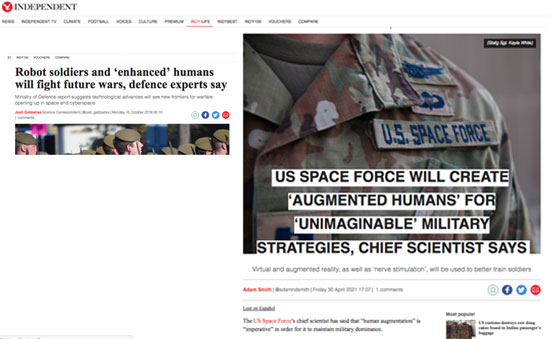
In an extensive study (282 pages…) from 2018 (the same year as Musk’s statements at the beginning of this report) on behalf of the British Ministry of Defence4 the “enhancement of human capabilities” which in 1983 was formulated as “poiesis” and by 1998 was already a commercial sector, officially found its true position: the annihilation of enemies.
Human enhancement technologies, including genetic engineering, physical and cognitive prosthetics, and pharmaceutical enhancement, are now emerging, and their development over the next 30 years is likely to offer a clear extension of the limits of human performance. The application of these technologies and the integration of human and machine in the battlefield offers opportunities to enhance military capability and improve force performance. The willingness and disposition of an actor to utilize these technologies may offer a competitive advantage over an adversary.
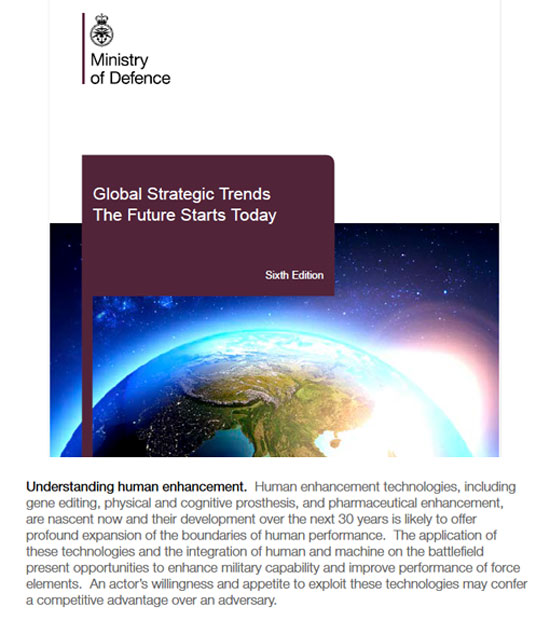
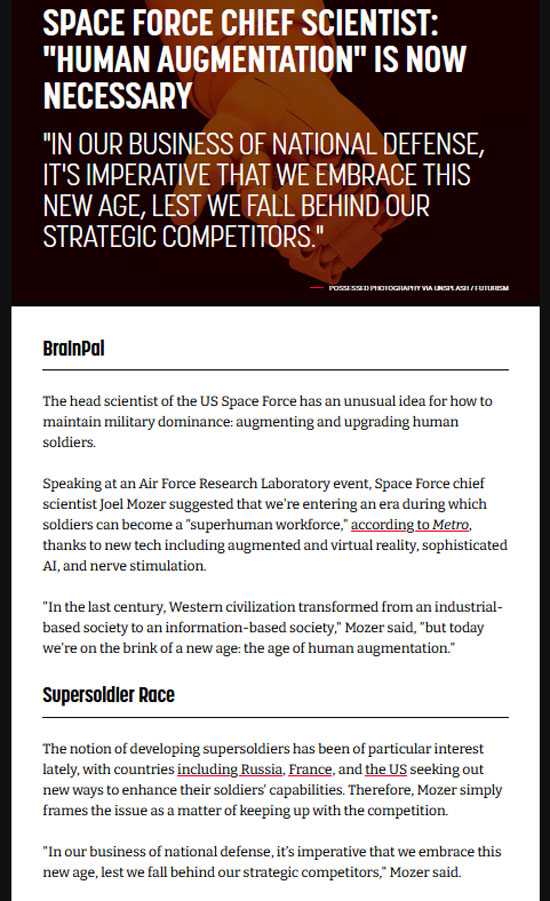
At the same time, Joel Mozer, a high-ranking official at the American Pentagon and head of the “war in space” program, emphasized the practical prospects of transhumanism5:
Speaking at a meeting of the (Military) Air Force’s Research Laboratory, Army Space Commander Joel Mozer supported that we are entering an era where soldiers can become a “superhuman workforce”… thanks to new technologies including extended and virtual reality, advanced Artificial Intelligence, and neural system simulation.
Last century, Western civilization transformed from an industry-based society to an information-based society, but today we stand on the brink of a new era: the age of human augmentation…
… In our work … it is imperative to embrace this new era, otherwise to find ourselves behind our strategic competitors…
The characterization “superhuman labor power” is almost accurate; as accurate as it could be from the mouth of a caravan: Taylor, in his time, would not use the word “superhuman” but rather the more targeted word “hyperproductive.” Even if it is about the (war) production of death.
This is precisely what it is about, when the fairy tales are removed: the “increase of the human” is an increase in his productivity, that is, in the intensity of exploitation. And since posthumanism promotes hyper-increase, it means hyper-intensity.
the machine breaks
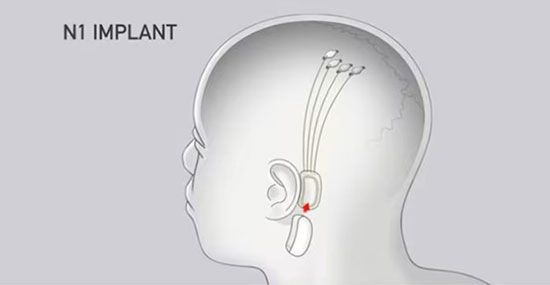
When the neurolink company announced that it was looking for volunteer experimental subjects with tetraplegia to select a few for the first PRIME (Precise Robotically Implanted Brain-Computer Interface) experiment, namely the implantation of the “magic” chip, it is said that several thousand were found very quickly. It’s logical: the promise of a treatment is always attractive. But it’s not exactly a “treatment”: even if everything proceeds perfectly, these people who cannot walk or grasp with their hands will not gain that ability. What they will be able to do is communicate with their mobile phones or computers “by thought.” Not insignificant, but absolutely embedded in a kind of integrated “symbiosis” that will prove much more useful in military applications (and for augmented individuals).
Exactly this “able-bodied individuals” need emphasis. The implantation of such an “advanced” circuit in the human brain would most likely cause depression (in the “general public”) if not anxiety… Precisely for this reason, for “public relations” purposes, the announcement of the first implantation (and the subsequent “experimental” ones) had to be communicated in relation to people who have serious problems, motor-related in this case. So that the idea that the implant is therapeutic would be “produced.”
Some steps have been taken regarding artificial (robotic) arms for individuals with amputated upper limbs; but in these cases the goal is for the mechanical limb’s cables to connect directly to the human body’s nervous system.
The neurolink does not belong to this restoration technology! That’s why the company’s CEO (see the statement at the beginning of the report) made no mention of anything like this. The neurolink is not restoration of function; it is enhancement! Transhumanism! And its intended use, at least in a first phase, is military. Of the kind where drone “pilots” control flight “with their thoughts”; or to enhance the capabilities of pilots of regular warplanes when they move at hypersonic speeds and reaction times approach zero…
A few weeks after the first implantation, it was announced that “the implant presented some problem” in the first human test subject: several of the hair-like electrodes that go into the brain had come unstuck from their base… so they stopped sending signals. However, the good company was reassuring in its related announcement: its engineers managed to make the remaining ones more “sensitive” by increasing their performance.
It is a first, complete and characteristic moment of applied posthumanism: the company has reassured its public (thus saving its stock…) regarding its machine (the implanted chip) and its performance (with fewer hair-like electrodes); not regarding the human experimental subject’s brain! What will happen to these “inactive” components that remain inside the brain now that they are no longer “insulated” in some way from their micro-electricity?
We assume that Western (capitalist) societies are already being educated not to pay particular attention or significance to such concerns. And perhaps they are being educated successfully, if we judge from the fact that very few people protest about the mRNA platform debris that filled millions of human bodies, poisoning many of them. Even if not all of these people are willing to sacrifice themselves for the sake of technology (and corporations), it is certain that there are some who would sacrifice them – and they only ask for “tolerance and understanding.”
Damage occurs and (mechanical) failures, every conscious or unconscious transhumanist will say. But instead of being seized by zombie-like emotions (it will continue…), it’s better to look at the cost/benefit relationship. As in every war.
Ziggy Stardust
- In 2008, the World Transhumanist Association considered that it had been exposed with its positions. It decided to change its name and become “Humanity+”… ↩︎
- Sir Francis Galton (1822 – 1911), an exceptionally influential English “polymath” of the 19th century, Darwin’s cousin, is among other things the inventor of the term “eugenics” in 1883 – and a great promoter of it, mainly in the Anglo-Saxon world, USA and Great Britain. ↩︎
- Frederick W. Taylor (1856 – 1915) is the researcher of the human body and its movements in various jobs and the designer of their replacement by various machines in order to increase their efficiency/productivity (initially in manual labor), and ultimately the author of Scientific Management (The scientific organization of work) which constituted the cornerstone of the 2nd industrial revolution, essentially shaping capitalist production (and control) as we have come to know it. (It is available in Greek from antischool editions). ↩︎
- Available in English at https://assets.publishing.service.gov.uk/media/62828be5e90e071f69f22596/GST_the_future_starts_today.pdf ↩︎
- More at cyborg 21, The dream of transhumanism is a nightmare! ↩︎