
At the recent Davos (which is steadily declining but still exists…) a “round table” discussion took place regarding the future of global water management – which, because it was provocative to the mainstream perception, the demagogues made sure not to promote it.
And just hearing the phrase global water management in worldly clubs of the Davos kind is enough to signal a general alarm. We suspect that for now, and until the-knot-reaches-the-tap, there won’t be any widespread concern matching the plans for “global management.” It’s not the best, it’s not the most effective, it’s not optimistic—it’s ominous—but we can’t say that anything else holds true.
Among the speakers at the “round table” was Tharman Shanmugaratham, president of Singapore, a figure in global financial and business forums. You may not know him, but perhaps you’ll become more familiar if you read “The Defense of Nature: Resistance to the Financialization of the Earth” in the previous issue (cyborg 32): Singaporean was/is the showcase company Hoch Standard, which attempted to appropriate (officially: manage and trade natural capital/ecosystem services) two million hectares of a forest system in neighboring Borneo for 100 to 200 years. While this may not indicate direct involvement of President Shanmugaratham in this specific deal, his views fit the glove.
He is not someone random. He has been the president of Singapore since 2023 until today, and has served as president of the state’s monetary authority from 2011 to 2023, deputy prime minister (in 2011 and 2019), and minister of finance (from 2007 to 2015). He is a member of the board of directors of the “World Economic Forum,” and president of the board of directors of the “Group of Thirty” (G30), where various central bankers participate.
Very busy but focused! The core of his presentation at Davos proves it:
… We are dealing with something that science is very clear about, but this needs to be translated into our intergovernmental approaches, into policies and funding strategies, including one of the most dynamic sectors, which is the development of credit markets. Just as we have carbon credits, we need to develop water credits and biodiversity credits.
Nature-based solutions are very important…
Two campaigns together: “the carbon credit market” and “nature-based solutions”!
The second, dirty one in its initial simplicity, wants to say: “we…” (who will be revealed in the following) “… and our experts studied nature and concluded that our actions are based on it.” Do not dare to ask nature, there is no such interlocutor, it will not answer you. It is a monologue, simple indeed but also grotesque in its conception: if here there is a concentrated pollution and there, further away, everything is clean, then “nature” will balance the “pluses” and “minuses” and will create a welcome equilibrium – for us.
For example, the atmospheric pollution caused by Nestle’s industry would be “balanced” if the company, through the global “pollution trade,” undertakes the “management of 4 million hectares of forest.” And since it won’t find such an opportunity in the Netherlands, Nestle, for the sake of global good (and “nature-based solutions”), will undertake this “management” hmm… somewhere in Southeast Asia or Latin America—privatizing the forest and depriving locals of it. With the help, of course, of business-friendly governments.
This is the “carbon credit market”: an opportunity for Western overlords, under the banner of the “climate crisis”, to re-colonize as much of the rest of the planet as they can, as “caretakers” of nature; particularly through stock exchange trade of pollutants, which leaves profits both for the “caretakers” and the intermediaries. Shanmugaratham’s idea/proposal was this: just as there are “carbon credits”, that is, a scam by overlords to re-colonize the “natural oxygen production” (forests) and therefore also the areas where they are located, so too should there be “water credits”. Another scam, where overlords who abuse water for business reasons will “offset” the damage they cause, through the stock exchange of credits, as “great caretakers” of rivers, lakes, underground reserves. Perhaps even of rainfall.
In this design, the stock exchanges have been renamed to …. “ecosystem”!!!
In a twist of his words, Shanmugaratnam indicated the way:
… I think that for now it will be very difficult to create a complete ecosystem of water credits, sustainable water credits and biodiversity credits alongside carbon credits. Theoretically it can be done, but it will exhaust the private sector. Much better is to work on a reliable carbon credit system with water credits and biodiversity credits as basic elements…
Although we cannot be entirely sure about what the … “water savior” proposed, we assume that the idea is to add private “water management” (rivers, lakes, underground reserves) to the stock exchange accounts “plus/minus” “climate protection”.
Such “water credit” schemes based on “carbon credits” have started to sprout here and there. For example, last June the largest bottled water company (that is: piracy!!) in India proposed a framework for establishing “water credits” so that the country’s beverage industry could become more “responsible” in water usage. And if India seems “third world” to you, in England the Cambridge City Council also invoked “water credits” as a solution to the city’s serious water shortage problem, while an ambitious housing expansion project is beginning in East Anglia, one of England’s most arid regions: the ambition is to build over 250,000 homes and transform the area into the “Silicon Valley of Europe”…
the big bosses
These are warning signs; the “pioneers.” But which are the culprits that are already exploiting and will further exploit water resources, while at the same time advertising themselves as the “great protectors”?
You know one major category, or should: the tourism industry (and crafts…). In a 2010 edition that did not receive the attention it deserved1, we wrote among other things:
… As we know, mass tourism means mass and organized mass movement of large, often huge numbers of people from areas of high population density to areas of low population density for a short period of time. Tourist nomadism of people with high expectations of their needs and desires, among other things, also affects water usage/consumption.
Tourist facilities that sell nature are built in rural areas. Which, as documented, previously had neither water supply / sewage infrastructure, nor necessarily have the capacity for mass, coordinated, urban-type water use. Moreover, tourism is symbolically and literally identified with some kind of “waste.” It is estimated, for example, that individual water use for someone vacationing in a hotel in southern Europe can be 30% higher than the individual use made by the local inhabitant with the same water. The annual water consumption of a golf course facility equals the needs of a provincial city of 12,000 residents. Let us not add here how much water is needed for the maintenance of grass fields in dry climates, full of sunshine.
For example, in 1994 Jakarta was hit by intense rainfall, and the residents’ wells dried up. But the city’s golf facilities, one of the pleasures of Indonesia’s tourism industry customers, continued to be supplied with 1,000 cubic meters per course per day. In 1998, at the height of a three-year drought that dried up the rivers and almost depleted the underground water reserves, the southern Cyprus government cut water supply to farmers by 50%, ensuring that the 2 million tourists of its flourishing industry would have the water they needed for as long as necessary…
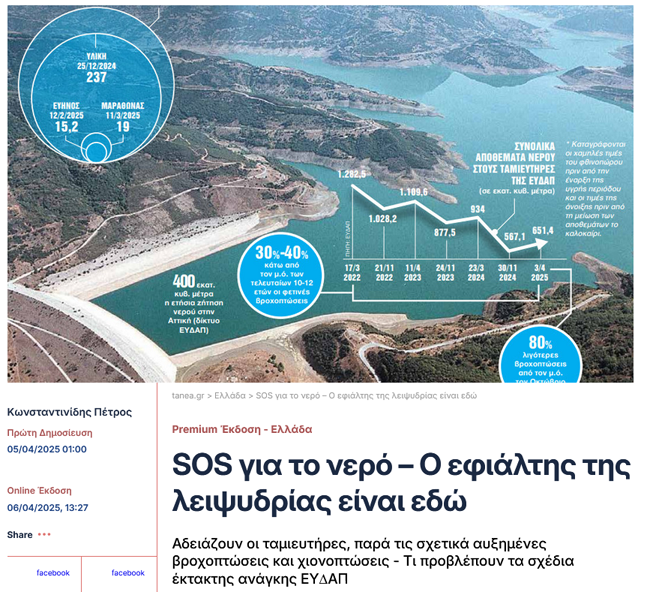
The other major category of water-abusing entities (and with all due credentials to appear, either directly or through partnerships, subsidiaries etc as the “protectors” of water through “water credits”) are the mammoths of information technology/communications: data centers…
Not some anarchist autonomists but the mainstream newspaper “Ta Nea” wrote on May 10, 2025 under the title How data centers drain the driest regions of the world, among other things, the following:
… Amazon, Microsoft and Google operate data centers that use huge amounts of water in some of the world’s driest regions and are building many more…
… Responding to questions from SourceMaterial and the “Guardian”, representatives of Amazon and Google defended their investments, saying they always take drought into account. Microsoft refused to comment.
Data centers, the massive warehouses that contain networked servers used for remote data storage and processing, as well as by computing companies for training artificial intelligence models such as ChatGPT, use water for cooling.
SourceMaterial’s analysis identified 38 active data centers belonging to the three major technology companies in parts of the world already facing water scarcity, as well as 24 more under construction.
The locations of data centers often constitute industry secrets. But using local news bulletins and industry sources… SourceMaterial has compiled a map of 632 data centers, either active or under construction (including the one planned in Attica, in Spata) that belong to Amazon, Microsoft and Google.
It shows that the plans of these companies include a 78% increase in the number of data centers they operate globally…. In parts of the world where water is abundant, the high water consumption of data centers is less problematic, but in 2023 Microsoft disclosed that 42% of its water came from “water-stressed areas,” while Google announced that 15% of its water consumption came from areas with “high water stress.” Now these companies are planning to expand their operations to some of the driest regions of the world.
“It is not coincidental that they are built in dry areas, as data centers must be constructed inland, where low humidity reduces the risk of metal corrosion, while seawater also causes corrosion if used for cooling,” clarifies Lorina Palazhi, founder of Ethical Tech Society.
… Meanwhile, in December, Amazon requested permission from the regional government of Aragon to increase water consumption at its three existing data centers by 48%… “Your Cloud Dries My River” (Tu Nube Seca Mi Rio) is the name of a group campaigning for a moratorium on new data centers in Spain due to water scarcity…
Apart from water, all these foundations also want their peace. But also the increase of their profitability and dominance. The “water credits” are an invention with merits: they will not appear as they are (that is easy), the stock exchanges where “guardian” shares will be bought and sold will be called “ecosystem” or even “care cloud”. They will grant to their “financial capitals” rights for the protection of sources, flows, estuaries, lakes, waves, wells; anything that falls under the title “water care”. They will not necessarily appear at the retail level; they learned the lesson of their dangerous exposure to those who exploit them. On the contrary, they will remain in the sky of “benefactors”, “sponsors”, “philanthropists”, “non-governmental…”. And when they come down lower, it will be in the form of S.D.I.T., so that they will be some state or “public” forms that will collect the proceeds.
We must emphasize here that in both tourism and even more so in data centers, users are so massive that the activities of these industries already have social recognition. It’s crude but not wrong: every time someone “user” engages in chat with ChatGPT, they place a new mortgage on their tap.
And then? Then, one way or another, directly or indirectly, the bill comes.
Z.S.
- water under pressure: the construction of water scarcity, commodification, privatization of urban water supply, ed. Antischool ↩︎