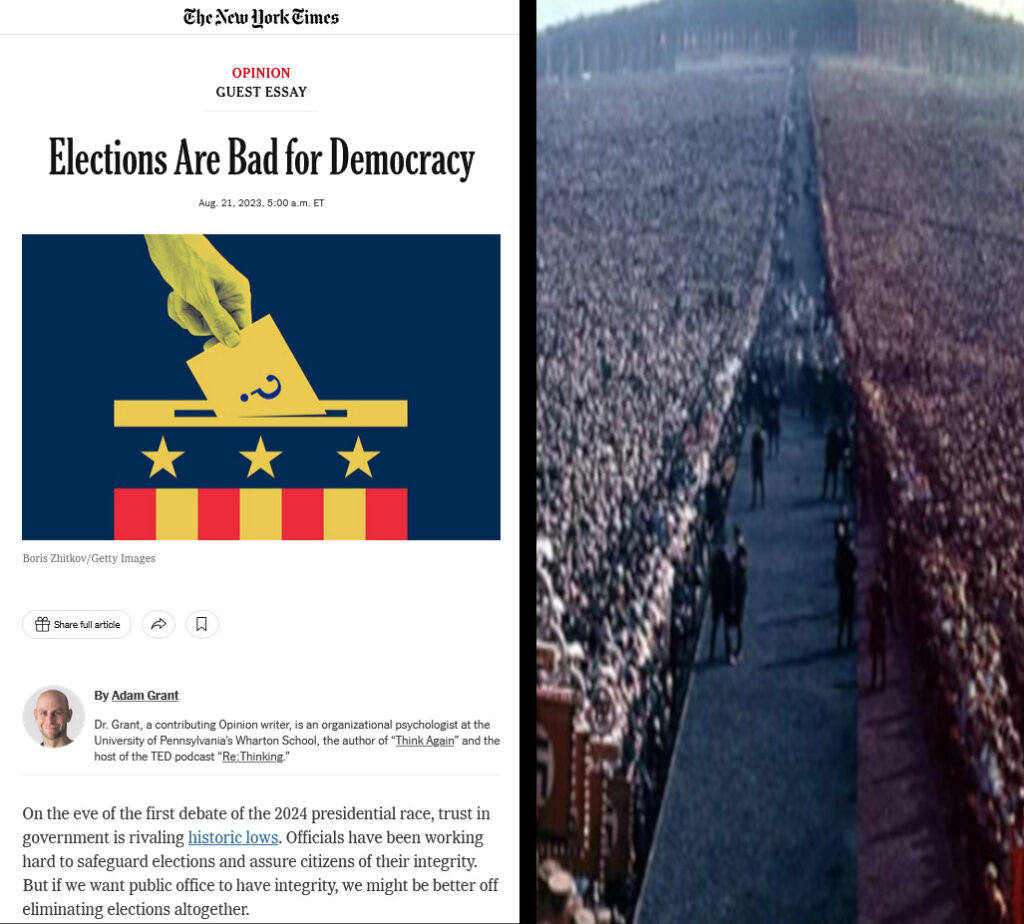
Historical fascism is generally (and often abstractly) known, although it is condensed into personalities (e.g. Hitler) facilitating misunderstanding and confusion: obviously “national socialism” either in its German version or in any other version of it (and internationally there were many, from the USA to Japan) was not the work of one, ten or a hundred individuals!
It is more useful to point out that historical fascism was the hard core of the industrial machine. Of the 2nd industrial revolution – against the proletariat that this very revolution, in its organization of production/consumption, created. In Germany, for example, the interests of industrialists such as Fritz Thyssen and Gustav Krupp ultimately imposed the transfer of power to the “national socialists” as a bulwark against the communist working class: the success of the revolution in Russia was very recent and the revolutionary triennium of 1918–1920 was too dangerous to leave German industries to the “uncertainties” of any kind of democracy. The same applied to Italy: facing the pan-Italian wave of mass armed factory occupations, only fascist power could guarantee the protection of industrial profitability. The exact same pattern was repeated throughout most of Europe, and later in Latin America and elsewhere.
The issue that concerns us here is that historical fascism, as the “ideal” of the 2nd industrial revolution, had at its center the factory-form: the organization of discipline in production/labor within the mass factory was the model for organizing the remaining significant sectors of production and social reproduction: the hospital, the school, public administration were disciplined factories. In other words, historical fascism had production at its center; and from there it spread to circulation and to workers’/social reproduction.
The post-World War II capitalist organization and management was termed “Keynesian,” primarily for economic reasons. But more importantly, it was based on Keynes’s political stance: the recognition of the working class, its interests, and its trade union (or even political) representation as an independent variable within capitalist accumulation. What the postwar generations in the Western world called “democracy” was essentially the acknowledgment of capitalism’s need for “negotiation”; as such, “democracy” was essentially the recognition of a negotiation controlled by capital, yet still a negotiation between class subjects (“social partners”…) with different, even opposing interests.
Undoubtedly, the wrapping of post-war democracies (within or outside quotation marks…) or, put differently, the wrapping of regulated negotiation between the “social partners” (and the arbitral or even paternalistic role of the “social state”) was served as the end, as the culmination of a journey of centuries of social organization. As the “end of History.” But the illusion of the eternity of the institutions of this historical period in the capitalist West had serious presuppositions that were not listed on the packaging. First, that on the planet outside the West, the intransigence and violence of primitive accumulation (of raw materials and labor) would continue undisturbed. And second, that a capitalist challenge to Western capitalist hegemony, to Western hegemony in the so-called “globalization,” would not emerge. We know that these presuppositions no longer hold.
Western neoliberalism, from the 1990s onwards, reduced as much as it served the bosses’ obligation to negotiate. Moreover, the “shift of responsibility” for key decisions from “state policy” to “experts’ opinions” began to technocratize (and depoliticize) class/social confrontations, discretely already from the 1980s; and with acceleration during the brief period of the “end of history.”1
Indicatively, among other things, we wrote then (the emphasis is current):
… The re-foundation of the desired “oligarchic meaning” of democracy – of the representatives – began, thus, from the 1980s decade alongside the continuous expansion of market mediations; of monetary mediations. Accompanied (this transformed democracy) not only by the strengthening of its repressive arms, but also by the spread of corporatism, both in relation to workers and in relation to any other claimant subject. The party cadre could now more easily enjoy (though not openly) its corporatist interests. And we need not remind: corporatism, as market power correlations, had at its highest peak those who held the power of money. … What we attempted to show (or remind) is that what appears as the “political center” of the modern capitalist state, that is, parliament, government, parties, elections and the descending institutions of political administration/direction, do not constitute the reality (nor even the main reality) of power, but only a part of its representations. And moreover, the most agile, fluid (and therefore particularly misleading) part of the representations of “central” capitalist power, because there, in these institutions, “social consensus” is ensured (or extorted). If our own analysis is not enough and some need “heavy names” to give meaning to this reality, they can turn to Johannes Agnoli’s “The Transformation of Democracy.” At some point, critically examining the view of “peaceful revolution within (and through) institutions,” Agnoli notes: … Peaceful revolution with the consent of the majority of the people presupposes the consent of the sovereigns to this process; and this means: their agreement that the people are allowed to make the rules of an oligarchic game into combat rules of a social revolution. And at this point, where parliamentary left opposition could become practical and de-parliamentarized, this idea [of peaceful revolution…] dissolves. The conservative agreement lies in the continuously renewed agreement of oligarchies about the form and content of politics. This agreement, which is manipulatively directed downward and becomes general consent of the population to the governmental system, always leaves sufficient room for pragmatic and tactical differences: in the area of subsidy policy, social policy and for decisions taken at the lower, most insignificant level of social interests. …
The fact that Agnoli was writing such things in 1967 gives his approach the force of a forecast2. Between (roughly) 1965 and 1975, most developed capitalist states fell into a real “crisis of direction,” and this was due to the intensification of class and social conflict. The coordinated turn toward “oligarchic management” and virtual democracy (as regards institutions) began as a response by the bosses to very real problems; and it was consolidated in the following decades, starting with the 1980s.
The response to the “governance crisis” between 1965 and 1975 was neoliberalism and the Self-Capital. The response to the “Self-Capital crisis” was/is the medicalization/mechanization3. But what would be, from the perspective of Western masters, the response (within or outside quotation marks) to the challenge—which comes from outside—the structural crisis of their planetary hegemony?
We see it already taking shape: the bio-informational-militaristic complex, which, utilizing elements of historical fascism, fascism 1.0, establishes itself as fascism 2.0. Not at all unpredictable!
algorithmic completion
The “shift” in support from the American tech oligarchy (so-called Silicon Valley) in the 2024 elections from the “democrats” to Trump was visible. However, it was rarely, very rarely analyzed as a strategic change in orientation regarding the form and content of exercising capitalist power in the West. Whatever is happening in the declining former “sole superpower” is constantly attributed to the whims of an 80-year-old man and to “his” imperial ambitions!!! As if his full days of absence abroad (wherever he may be, he steps on 80…) at some point earlier or later were to signal the end of this transformative “parenthesis.” Not at all! The “personification” is yet another (trivial) tactic of misdirection.
However, nothing happened suddenly and “idolatrously”! American academics Martin Gilens (of Princeton) and Benjamin Page (of Northwest University) published in September 2014 (on the Cambridge University Press website) a study titled Testing Theories of American Politics: Elites, Interest Groups, and Average Citizens regarding whose interests the decisions of the American legislature/Congress served. They examined 1,800 cases to document that decisions benefiting the “average American” (whatever that “average American” is) were negligible, statistically insignificant compared to those serving the bosses—the bigger they are, the more so. The interesting point is that the period they examined was from 1981 to 2002—a 21-year period that would be considered among the “most democratic” in American power/history. It wasn’t—and nor did it appear to be what it actually was!
What such a study did not seek to show was the change in the composition of the masters of American capitalism on whose behalf the legislative and (increasingly) directly the executive worked (and works).
In 1960, the 10 largest industries in the USA (based on their balance sheets) were in order: General Motors, Exxon Mobil, Ford, General Electric, US Steel, Mobil, Bethlehem Steel, Texaco, Chrysler, Esmark. Three steel industries, three automobile industries, one electrical machinery industry, three oil industries: the peak of industrial capitalism.
In 1980, the 10 largest industries in the USA were in order: Exxon Mobil, General Motors, Mobil, Ford, Texaco, ChevronTexaco, Gulf Oil, IBM, General Electric, Aramco. Two automobile industries, six oil companies (with operations both within and outside American borders), one electrical machinery company, and one computer company. No steel industry (: raw material…)
In 2024, the 10 largest companies in the same capitalist territory were, in order: Walmart, Amazon, Apple, United Health Group, Berkshire Hathaway, CVS Health, Exxon Mobil, Alphabet, McKesson, Cencora. One “capital investments”, two information technology, one oil, two commercial (one also “internet services”) and four health services trade. One will find industry in the classical sense only in positions 18 and 19, General Motors and Ford, within a forest of retail chains, banks, health services trade companies and one information technology (Microsoft).
The above elements are indicative indeed, but strongly indicative of the issue that concerns us here. Fascism 2.0 does not have (in the US primarily…) and cannot have as its center the form-factory; nor as its primary field of formation the mass industrial labor/production. It has at its center, on the contrary, circulation and social reproduction; and the form-network. It also has as its primary target-subject the contemporary working class of the tertiary sector (who works but also lives “networked”…); but also anyone else! On behalf of the terms and specifications of the 4th industrial revolution.
“Change the algorithm!” Because the circulation of opinions is directed by some invisible digital traffic cop who has an owner…
It is not about a small shift but about a “paradigm change” regarding the core (that is, the characteristics) of fascism 2.0. From an ideological point of view, for example, fascism 1.0 copied and exploited various clichés of blood aristocracy, regardless of the Second Industrial Revolution, yet useful for a historical back-and-forth in order to increase the conscious confusion of citizens at the time. The bosses of fascism 2.0 also copy clichés of aristocracy (of the “…spirit” and of the monopoly of innovation!) which are not intended for mass brainwashing. They “sit on top of” the fascism of cultural difference (“differential racism,” a phase in the evolution from fascism 1.0 to fascism 2.0: immigrants), moving back and forth where necessary, promoting the end product for mass consumption. Their main field / initial target, however, is the social factory as a whole. Not only as a producer of goods (in the Global South) but also as a producer of services, circulation of ideas, social relations, consumption, models, and biological reproduction.
These are de facto fluid processes. The goal of the masters of fascism 2.0 is to control this fluidity / multiplicity: not to let it overflow without them, not to turn against them. An example is the struggle-for-censorship on the internet, starting from the densities of “circulation” in it, in (social) media. The specific targets of censorship change each time. Sometimes “vaccine denial”, sometimes “denial of ukrainophilia”, sometimes support for Palestine – and many more await. Since there is no single, compact functional center (as was the control of industrial labor / production for fascism 1.0) whose perimeter guarding would require the control of everything else outside that center, but, on the contrary, flows must be channeled / controlled without completely eliminating the “communications” of – social – material (with digital being the first and best), these communications shape a prospective dimension for fascism 2.0. Until now.
A small digression here. It is not at all fashionable to associate fascism 1.0 with the material/technological basis of capitalism of that period. The reason is that its destructive elements (mainly the concentration camps, the 2nd World War) are emphasized in a way that does not allow the general trust in capitalism to be shaken. However, periods of violence, barbaric violence, mass “cleansings” of entire populations, had existed earlier. Not only in the 19th century but also in the previous ones, of colonialism/imperialism. The distinctive feature of fascism 1.0 is not its violence but the industrial organization of it. Moreover, it was exactly the same even before the outbreak of the 2nd World War: no one divides fascism 1.0 into two periods, a peaceful one and a warlike one! Before the war, fascism 1.0 was original fascism, revolving around the “great factory”, mass production, Fordism/Taylorism, technological discoveries (e.g. radio, cinema), which were particularly impressive for the conditions of that time. The slogan “work sets you free” in the concentration camps would not be found in the cotton plantations of America full of thousands of slaves: it was a slogan of scientific underestimation of labor (and wage workers), “consistent with its time”.
In the (expanded) circles of techno-aficionados, the so-called “artificial intelligence” is affectionately called “tailorism 4.0.” And the users of complex algorithms are called “data generators.” Although the latter is not particularly complimentary, it is much closer to the truth than the metaphysical and misleading idea of a supposed two-way relationship between operators of machines and algorithms. More or less complex ones.
The reason why digitization as a whole is firmly rooted in the foundations of Taylorism (the 2nd industrial revolution…) is a major topic requiring its own analysis. But the element of interest here is that digitization does not only concern the scientific management of labor that Taylor convincingly advocated, that is, the mechanization of manual labor. It concerns (digital) mechanical mediation, and ultimately the control and organization of everything: from flirting to hygienic struggles, including of course all forms of labor.
Paradoxical or not, Taylor himself, convinced of the value and efficiency of mechanization, had envisioned – there, in the early 20th century – the generalization of mechanization beyond factories. In several aspects of public administration as well as daily life.
It took decades for this performance-monitoring project to move forward everywhere. The “turning point” began with the gradual mechanization of intellectual work; it has now progressed to the mechanization of every intellectual, aesthetic, or even moral living process (: complex algorithms / AI in the service of wars). Thus, whatever was considered by various philosophies as the solid foundation of any social life, the subject, fell into a “data generator”, for mechanical processing and shaping.
And so “suddenly” democracy (its facade, let’s call it that way, of discreet post-war oligarchic power) is unnecessary, bad, and potentially dangerous. The oligarchic masters of the 4th industrial revolution are “disembedded”: they do not have, in their respective domains, a specific working class of the specific production / extraction of surplus value facing them. They profit through (easy) software copy circulation and, mainly, through collecting rents from electron (“information”) traffic on the internet. Consciously or not, they place themselves in a position analogous to that of the pre-capitalist aristocracy, which accumulated wealth from land rents. That is precisely why they hold and promote neo-Malthusian ideas. They perceive historical “democracy” as a nuisance, as an unnecessary expense.
And they also consider freedom problematic on a case-by-case basis, meaning by freedom (of course) the scope of action and expression of the (often altered, confused…) Self-Capital. The years 2020 and 2021, with the lockdowns and the punishments “if you don’t give a hand” were the fascist 2.0 “education,” which should not be forgotten. (As well as who supported it in the name of… “the common good”…)
In other words, fascism 2.0, as it develops and is imposed, does not demonstrate its power through massive physical gatherings that glorify the “leader.”
Such things exist naturally, but they concern the deification of goods; they concern consumption. Leaders can now (and must!!!) claim that regulations are made and decisions are taken through mechanical neutrality and “impartiality” (: complex algorithms / AI) whose owners are, of course, themselves. They don’t need “hurrah!!” and “hurray!!!”: they can grant this pleasure to “frontmen”, political window-dressing.
The newspaper “Naftemporiki”, which could not resist the temptation of personification, under the title The circles of power and the “eye” of Palantir: How Peter Thiel became the most powerful man in the world silently, wrote on September 28, 2025 on its site, among other things:
At the crossroads of artificial intelligence, state security, mass data collection, and the ideological pursuit of a «efficiency» technocracy, a company and a man emerge: Palantir and Peter Thiel.
The quiet investor who started with PayPal has evolved into an architect of a power grid that extends from data centers to the decision-making rooms of the White House.
Robert Reich explained in an article he wrote for the Guardian months ago how Thiel expanded his power. Draw four circles on paper: in the first, all the assets of American artificial intelligence; in the second, the means and resources of the American military; in the third, what is devoted to the mass collection and stitching together of personal data of millions of citizens; in the fourth, that piece of Silicon Valley which, with ideological zeal, wants to replace representative democracy with a technocracy of “efficiency.”
Where these circles intersect, a name emerges: Palantir Technologies. And behind it stands Peter Thiel – investor, founder, and “king” of a new order of power that extends from data centers to the decision-making rooms of the White House.
In Tolkien’s world, the Palantir is a seeing sphere: it shows, but also deceives. The namesake company founded in 2003 by Peter Thiel with Alex Carp, Steven Kohen, and Joe Lonsdale became the tool that promises to “stitch” every fragment of information into a single image.
(From time to time, someone is advertised as “the strongest man in the world.” Before Thiel it was Gates. It’s perhaps for consolation: if we all the rest-of-the-world concentrate our thoughts on this one (whichever) strongest, we might break his leg. Or his head, and rest in peace…)
Palantir? Yes, it turns out to be a good manipulative tool, one of the basic weapons of fascism 2.0. It is a monstrous algorithmic data absorber from any device and operating system of Western (mainly American) manufacture that is connected to the internet. Without the approval or knowledge of anyone – of course! It manages and shapes the output according to the client: military police complex, complex of depravity, etc.
It’s not the only one. It’s just that all owners, manufacturers, and handlers of these weapons forget something: everything relies on a continuous and uninterrupted flow of data. If this stops, then the… “seeing bullet” is blinded. It has no idea what’s happening.
A prolonged power outage… Or, even better, a deliberate, mass “strike against using digital machines and creating data”: if the bosses of fascism 1.0 openly hated workers’ strikes, the bosses of fascism 2.0 are forced to secretly hate what they publicly consider unthinkable: that the masses they underestimate by considering them dependent… should react.
Ziggy Stardust
We described this process in three consecutive installments in the paper Sarajevo no. 78, November 2013, no. 80 January 2014, and no. 90 December 2014 under the common title parliamentarianism, power, state. (It turned out in practice that we simply served our labor duties in vain once again). ↩︎
Agnoli’s analysis was written in 1967 and was first published in Greek in 1972 by the publishing house “Epikouros”. If we know correctly, it has been reissued in a collection (and subsequent) texts of Agnoli by the publishing house “KPSM”. ↩︎
In detail in the notebook for worker use no 4, December 2019 (The self as capital, capital against the self, psychologization and mechanization) and no 6, September 2022 (The vital force and its appropriation, dissolution and resynthesis of the Self-Capital). ↩︎