The rather triumphant imposition of (the companies of) antisocial media and, subsequently, the enlightenment regarding neural algorithms1 has intensified over the past decade – always speaking relatively and mainly among academic and journalistic circles in the West – concern regarding data and datification. To argue that this is a political and not merely a technological issue would be what you’d expect from a cyborg. On the other hand, this concern, although interesting in terms of the “circulation of ideas” insofar as this is still not carried out by neural algorithms, often avoids the damned word capitalism. Or it adopts a light version of it.
An article published on November 2, 2025, titled I Am a Factory of Data (And So Are You)2 written by freelance journalist Nicholas Carr will serve indicatively (and) as an introduction to this reflection:
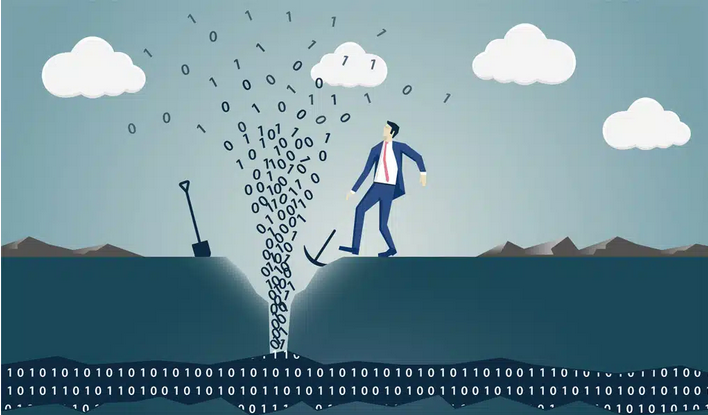
Am I a data mine or a data factory? Is data extracted from me or produced by me? Both metaphors are repellent, but the distinction between them is significant. The metaphor we choose shapes the sense of power exercised by so-called platform companies like Facebook, Google, and Amazon, and shapes the way we, as individuals and as a society, react to this power.
If I am a data mine, then essentially I am a piece of real estate and control of my data becomes a matter of ownership. Who do I belong to (as a site of valuable data) and what happens to the economic value of the data extracted from me? Should I be the owner of myself – the sole owner of my data mine and its wealth? Should I be nationalized, my little mine becoming part of some kind of public property? Or perhaps ownership rights should be transferred to a set of companies that can effectively gather the raw material from my mine and all others and convert it into useful products and services? The questions raised here are matters of economics and politics.
The metaphor of mining, as well as the mining business itself, is quite straightforward and has become popular, especially among left-wing writers. Thinking of platform companies as mining companies, with personal data being analogous to a natural resource like iron or oil, brings clarity and precision to discussions about a new and complex type of company. In a March article in the Guardian, Ben Tarnoff wrote that “thinking of data as a resource like oil helps illuminate not only how they operate, but also how we might organize them differently.” Building on the metaphor, he continued by arguing that the data business should not simply be subject to strict regulation, as mining industries tend to be, but that “data resources” should be nationalized—placed under state ownership and control:
…Data is no less a form of common wealth than oil, land or copper. We produce data together and we make it meaningful together, but its value at this moment is captured by the companies that own it. We are in the position of a colonized country, with our resources being mined to fill distant pockets. The wealth that belongs to the many – wealth that could help feed, educate, house and heal people – is used to enrich the few. The solution is to adopt the resource nationalism model and nationalize our data reserves….
In another article in the Guardian, published a few weeks later, Evgeny Morozov proposed a similar view regarding what he called “the data wells within us”:
… We can use recent data controversies to formulate a genuinely decentralized, hands-on policy, according to which state institutions (from the national to the municipal level) will be developed to recognize, create, and promote the creation of social rights in data. These institutions will organize various data sets into groups with differentiated access conditions. They will also ensure that those who have good ideas with little commercial viability but promise significant social impact will receive funding for entrepreneurial ventures and implement these ideas beyond these data groups…
The simplicity of the mining metaphor is its power, but also its limitation. The mining metaphor doesn’t capture enough of what companies like Facebook and Google do, and by adopting it, we very quickly limit the discussion about our possible responses to their power. Data doesn’t sit passively inside me, like a vein of ore or a lake of oil, waiting to be extracted. Instead, I actively produce data. When I drive or walk from one place to another, I generate location data. When I buy something, I generate purchasing data. When I send messages to someone, I generate collaborative data. When I read or watch or buy something online, I generate preference data. When I upload a photograph, I generate not only behavioral data, but data that is itself a product. In other words, I am much more like a data factory than a data mine. I construct data through my labor – the labor of my mind, the labor of my body.
Platform companies, in turn, act more like factory managers than owners of oil fields or copper mines. Beyond controlling my data, companies seek to control my activities, which for them are essentially production processes, in order to optimize the production of my data (and, from the platform’s demand side, the consumption of my data). They want to schedule and regulate the work of my factory – that is, my life – just as Frederick Winslow Taylor attempted to schedule and regulate the work of factory workers at the beginning of the last century. The control exercised by these companies, in other words, is not only that of ownership but also that of management. And they exercise this management through the design of their applications and other software, which increasingly regulate everything we do during the hours we are awake. Applications are, like factory routines and industrial machinery, tools for behavior modification. They have been designed to maximize the effectiveness of people in producing valuable data.
The metaphor of the factory makes clear what the metaphor of mining conceals: We work for the Facebooks and Googles of the world, and the work we do is increasingly disconnected from the lives we live. The questions we must grapple with are political and economic, certainly. But they are also moral and philosophical. The metaphor of mining suggests that we lack personal responsibility and autonomy. The metaphor of the factory emphasizes our responsibility and autonomy. We are agents, not mere resource pools.
Either one “metaphor” or the other could convince… And that would be the end of any deliberation: either we will be nationalized/state-owned, or we will demand some kind of salary (unknown how it would be calculated to be fair).
What escapes both of these approaches is the universality of datafication, upon every animate and inanimate thing, not only of the planet but of the universe; and in every creation, event or phenomenon since the beginning of the world! As data, everything can be encoded: from solar flares to black holes; from the flight of flies to the orbits of comets; from the geoglyphs of Peru to the latest paleontological/archaeological discovery; from the weather to the entire libraries of the planet… In this sense, either the universe and all known and unknown History should be considered a “mine”, or a “pan-labor theory” should be adopted claiming that everything (literally everything!) “works”. Ultimately, confined to our species, data can be extracted even from our sleep; and this indeed happens. Do we “work” in our sleep? Or are we “mines” that yawn, snore and change sides? Are we “mines” that delight in dreams, or “hard workers in the factory” who… create nightmares?
We argue that no matter how convenient such approaches may seem, they quickly lead to a logical dead end. Not to mention the political deadlock: should galaxies be nationalized/state-owned? Or should industrial-use robots be paid a salary?
Code
The word / concept of encoding is fundamental if someone intends to unlock the “mystery” of generalized datafication. Certainly, code means some method of transcription of whatever it deals with; and immediately afterwards, a kind of normalization. “Normalization” in the sense of creating rules that cannot indeed be directly attributed to whatever the encoder deals with, but as code-rules can be considered (or imposed) upon whatever is encoded as its truth.
Coding, whatever form it takes, is a linguistic practice. Linguistic. And at its core, at its foundation, this linguistic practice has mathematics.3 We can put it in other words by saying that “data” are units of a specific translation∙ under the strict condition that it will be understood that this is not a transfer from language to language but a “linguification” of everything. Ultimately, the most recent achievements of mechanical neural algorithms are called large language models∙ even if their users consider them “friends”, psychologists or reflections of wisdom…
This particular encoding began as an attempt to overcome the deadlocks of mathematics at the end of the 19th and the beginning of the 20th century. And it was launched when it was weaponized during World War II: encryptions and decryptions of communications (: enigma). However, from the outset it was (even as a “framework”) geared as mechanization. Mechanizable (linguistic) encoding. Major figures of this process, beyond suspicion of militarism, not only had the awareness but also the ease to declare it. The Swiss linguist Ferdinand de Saussure (1857 – 1913) for example had written:
… A language constitutes a system… This system is a complex mechanism; one cannot master it except through thought; and those very people who make daily use of this mechanism profoundly ignore it…
This was his position on common languages, a position considered scientific and universally accepted: those who speak them “deeply ignore their mechanism,” which, however, the … “expert” knows… A few decades later, a famous person who did his doctoral work on behalf of the American army but, paradoxically, was placed in the pantheon of “anarchic intellectuals,” Noam Chomsky, said – and analyzed even further – exactly the same things.4
What goal, what “meaning”, what desired outcome could this universal mechanizable (linguistic) encoding of everything have, which is so commonly but also so unexploredly called digitization? To turn everything into “mines” that should be nationalized? To turn everything into “factories” that should acquire militant unions?
Or the control and exploitation / embezzlement of everything regardless of its material form?
Colonization and primitive accumulation
Reading the above, one might wonder how the digitization / mechanizable linguistic encoding of everything ended up becoming something so exploitative / dominant that today it can be compared to a “mine” or a “factory.” However, recalling historical forms of capitalist exploitation (such as the mine or/and the factory) without the foundations of capitalism, one doesn’t get far.
Attempting to explain how Britain became the first and for a time the dominant industrial state, Marx identified two key factors beyond the establishment of wage labor and its exploitation: the enclosure of previously common agricultural lands, and the theft / accumulation of raw materials through colonialism. Thinking and writing in the mid-19th century, with the 1st “industrial revolution” in full swing, Marx may well have viewed these two structural features—the enclosures (i.e., the privatization of natural resources that had previously, for centuries, been common)—and the plunder of colonies—as a one-off event, as a one-time historical anomaly, as the “prehistory of capital.” History has proven otherwise. And that the combination of enclosures and plunder occurs again and again, especially as a precondition for capitalism’s technological / industrial revolutions, which were not / are not just one single event.
With this approach in mind, it becomes easier to understand why machine-readable language encoding/digitization is a new, original form of colonization—of everything. Both living and non-living. Because it can represent everything in a (nearly) convincing way, as if it were their truth. So that immediately afterwards, ownership, the “possession-of-representations,” equates to control and the ability to exploit everything. It also becomes easier to clarify why generalized datafication is an ongoing and original primitive accumulation. Enclosure and plunder/possession/primitive accumulation are in fact inherent characteristics of capitalism, which needs to find or construct new, initially unknown continents to conquer.
It is a fact that from the early 1990s, when the “internet” was first made available for public use until the 2000s media of the decade, until 2004 to be precise, the mechanical linguistic encoding/digitization of communications and verbal and/or visual exchanges seemed like a puzzle from the viewpoint of profitable exploitation. A “virgin continent” that allowed various myths to emerge about it. From “new space of global freedom” (!!!) to “new space of entrepreneurial gambling.”
Undoubtedly, even a superficially careful observation would have already suggested back then that the authorities and their states did not decide to commit suicide by providing uncontrolled “new spaces of freedom”! And that, given the history of classical (analog) telecommunications, the least one should have expected was the utilization of this mechanical linguistic encoding/digitization for control and surveillance purposes.
As for (premature) entrepreneurial luck hunting? A moderate relative reference in wikipedia shows the tone:
Between 1995 and 2000, new internet companies encouraged investors to throw large amounts of money at companies that had “.com” in their business plan. When the commercialization of the internet became more accepted and gained faster rates, such companies began to be created quickly… in order to take advantage of easy money…
This period ended abruptly with the dot-com stock market crash in 2001, where many of these newly formed companies failed to generate profits due to a lack of concrete structure in their business plans. Investors stopped funding simply because a particular idea was “promising.” This led many to argue that the internet was overvalued from a business perspective. But what happened was a revolution-within-a-revolution of the internet called Web 2.0. The idea was first discussed at a conference in San Francisco and gradually evolved from 2004 to 2011.
Some of the characteristics of web 2.0 were:
Development of “user-friendly” advertising with banners and pop-ups that had been developed by google and overture companies∙
Transition from static to dynamic HTML for web applications
Content that is created by users
Creation of “social networking media”
The most significant innovation from an entrepreneurial perspective, however, was the placement/embedding within the programming of sites of application programming interfaces / APIs that separately connected each user, unbeknownst to them, with the site creators and other applications: thanks to this connection, companies finally gained access in real time to the online digital behavior of each and every one. The primary accumulation of data now had the technology!
In 2004, Facebook was founded by a Harvard student named Zuckerberg… Quite symptomatically, this particular “platform” caught the interest of a “venture capitalist” named Peter Thiel, who invested $500,000 in it… Quite symptomatically, Twitter also first appeared in 2004…
And once again, entirely symptomatically, in the middle of the technological frenzy of the then fearsome and terrible Silicon Valley, in January 2007, the until then “primitive” wireless telephone was about to pass into history and be replaced by the remote control of everyday life, enchanting the entire planet: Steve Jobs of Apple presented the (first) iPhone. The company’s motto for its potential customers was precisely this: we don’t follow their needs trying to satisfy them. We create new ones for them (!)…
The mass creation of new digital needs, starting with citizens of the first world (iPhones were expensive – until competitor Samsung appeared, and later a series of Chinese companies…), was a bold commercial move. It had the wind in its sails, however: the creation of new material needs in the classical sense (of the kind of consumer goods typical of the Second Industrial Revolution) had begun to wane, at least in terms of their originality. What is interesting (for us), however, is that these new digital needs, which began to rise rapidly in the mid-2000s, were and still are “needs of representation”! Let us recall our initial thesis:
… The code certainly means some way of rewriting whatever it deals with; and immediately afterwards, a kind of normalization. “Normalization” in the sense of creating rules that cannot indeed be directly attributed to whatever the encoder deals with, but which, as rules-of-the-code, can be considered (or imposed) upon whatever is encoded as its truth…
Certainly, all those who “discovered” since the 2000s onwards that they live under a regime of permanent-emergency-need, 24 hours a day, to justify to themselves (for example) their permanent dependence on so-called “mobile” devices, had no objection whatsoever either to the pathological acceptance of mechanical mediation for almost every aspect of their daily lives, nor to the (not so) “invisible rules” governing this original yet absolutely capitalist form of continuous primary accumulation of digital representations/data of their everyday existence.
They can, in the end, after more than 20 full years of this development’s frenzy, think that they may have become “mines” (there is, after all, the term data mining!) or/and “factories” (many new forms of wage labor related to digitization have already been created, for many of which to pass again into machines with neural algorithms…).
What they will find it difficult to admit is that they have become (and are becoming increasingly) “unskilled” in their own daily lives!
Expropriation of daily values (usage)
The terms “specialized” and “unspecialized” historically originate from the division of labor not only in industry (: Taylorism / Fordism) but also earlier, already from the 19th century, in office jobs. Therefore, it can create misunderstandings here: if we use the term unspecialized in everyday life, do we perhaps mean that every moment of everyday life is some form of work?
No! We simply don’t have a better word to indicate what was actually at the core of Taylor’s “scientific organization of work” (the transfer of workers’ knowledge to machines and engineers), but it has already gone far beyond that and much further from wage labor itself and its spaces/times. Throughout life as a whole, not only of the human species but of every living species: with digital mechanization / generalized datafication.
From this perspective, data, as the material form of (generalized digital) encoding (of everything), is not “production” but abstraction. And as such, extraction.
In other words, the process of datopoiation, as the most recent culmination of capitalist exploitation (a la 4th industrial revolution), does not transform us into “mines” or “factories”, forms that is of the 1st or/and 2nd industrial revolution (about which we know something…), but into “fallen beings”, living things. Datopoiation is the most technologically upgraded version of pragmatopoiation. Which is not dealt with (by whoever/whomever considers it hostile…) neither by “nationalization” nor by “wage”. But by generalized rejection, except perhaps from strictly selected areas of the social that would be considered (socially) useful.
The objectification is not unknown to (Western) scientific philology. The American academic “moral philosopher” Martha Nussbaum identified in 1995 seven dimensions of the objectification of the living: instrumentality, denial of autonomy, inertness, interchangeability (:”exchange value”…), violability, ownership/property and denial of subjectivity. According to her approach… the process of objectification leads to a kind of organic fragmentation in social perception, the splitting of a whole individual into parts that serve specific goals and functions for the observer…
But perhaps the most accurate critique of this realization can be found in Marx and in the famous “Fragment on Machines” from the Grundrisse (1857). There, Marx describes how mechanization removes knowledge and the sense of creativity from living labor, from craftsmanship, making machines appear as “creators,” and transforming living workers into mere components of machines. By analogy, generalized datafication (as universal coding) removes from life itself its autonomous qualities and values, presenting “code,” that is algorithms (and “databases”), as the content (of life), and living itself as a simple “cellular ‘inorganic’ container” of data. A “living data center” towards sublation – and guidance.5 This is the despecialization of everyday life.
Some Marxists have attempted to highlight this modern capitalist process of realization/objectification/dehumanization through datafication by drawing comparisons with historical colonialism, always keeping primitive accumulation at the center.
In 2021, Nick Couldry and Ulises A. Miejas signed the edition of the book How Data Colonizes Human Life and Appropriates it for Capitalism (How data colonizes human life and appropriates it for capitalism). A brief (and rather simplistic) presentation gives a preview of this approach. Our emphasis:
The view put forward by Nick Couldry, Professor of Media, Communications and Social Theory at the London School of Economics, and Ulises A. Mejias, Professor of Communication Studies at the State University of New York at Oswego, concerns the relationship between capitalism and colonialism. Yes: colonialism. Literally. Not “coloniality.” According to Couldry and Mejias, we are witnessing the final stage of what, in Marx’s terms, is known as “primitive accumulation” or, in a more contemporary formulation, “accumulation by dispossession.”
“Primitive accumulation” describes how capitalists acquire power and money. It is not only through hard work, and thus struggle, and through the exploitation of law and state institutions designed to protect the wealth of the rich, but also through brute force and subjugation. People must be driven off the land they cultivate in order to become willing to exchange their autonomy for labor. Historically, “primitive accumulation” was established through colonization. This is why capitalism and colonialism are in reality simply the two sides of the same coin – “one side that enacts dispossession in a shameless and unrestrained manner and the other that normalizes this process by externalizing it (outside the present, outside the civilized, outside the measurable, and so on).”
How does this relate to data? Here’s the bridge: The Conquistadors, the Spanish conquerors of the 16th and 17th centuries, read proclamations in Spanish to the people they encountered as inhabitants of America – demanding that the natives submit to the church. Nothing different, claim the authors of “The Cost of Connection”, happens when technology and social networking companies ask their users to sign lengthy end-user agreements. Users, like the natives, are not in a position to understand what they are being asked to accept.
… It is quite impressive to read how the two communication professors correlate the appropriation of resources and the occupation of people’s living space in the digital world. The price is an issue. Every Facebook user, Couldry and Mejias declare, is worth more than $230 for the company, every WeChat user more than $540. For the companies, it is money. For the users, it is a complete undervaluation of social relationships, which suddenly become market commodities. In order to convert social relationships into currency, an entire empire of digital technologies has been constructed, extending from users’ end devices to cables, IT infrastructures and data. What we must not forget: Data from private end users, which are treated in the “social quantification sector”, is only the tip of the iceberg. The amount of data produced by businesses exceeds the data per sector of social quantification.
… Within the broader framework of analyses on capitalist-colonial nexus, issues such as fake news, media regulation and digital surveillance appear merely superficial. Details. Couldry and Mejias explicitly state that, in their view, transparency, laws, knowledge of writing and reading in the media, or even digital activism will not do their job when it comes to resisting today’s digital capitalism-colonialism. They do not implement any hope that the state … Could intervene to help. The opposite, in fact. Although they do not go so far as to claim that the nation-state (or the EU) is simply the fulfillment assistant of colonial capitalism (according to their Marx-inspired interpretation), they are willing to point out that also the public sector must be considered on the side of the offender, not the victim. When social services in the United Kingdom or the USA … use artificial intelligence, for example, to predict areas of high crime or child injuries in families, public authorities do not have access to the algorithms that produce the risk assessments. In the era of “datafication”, what was based on written or oral arguments is now solved only with numbers. Decision-making on public issues has been handed over to the control of algorithmic processes, which in turn are controlled by private companies.
At first glance, it is difficult to find similarities between the “conquests” of colonialism, which as “primitive accumulation” (of raw materials and labor/slavery) gave birth to capitalism, and today’s hyper-ripe capitalist period of the 4th industrial revolution and generalized datafication. However, there are already quite enough “samples” of how datafication, and indeed under state direction, can be exploited even for contemporary forms of slavery: the sanitization terror campaign is a very recent proof.
However, the different, historically (and technologically in the broad sense of the word: the available methods) determined ways of dehumanization do indeed constitute on the one hand the genealogy and on the other hand the standardization of the “data empire”.
The encoding and its enforcement as the “truth” of what is encoded, simultaneously as ideology and as mechanical linguistic practice, is the invisible thread of exploitation, of usurpation, of superficially consensual and in reality violent capitalist sovereignty.
Ziggy Stardust
After mature research, Wintermute proposed that the term “composite algorithms” is not the appropriate term to refer to so-called “artificial intelligence,” and that “neural algorithms” are more suitable. It is understood that we have adopted this view. ↩︎
In the not yet fully utilized notebook for worker use no. 3, titled “The Mechanization of Thought,” we made a good (though not absolutely complete) genealogy of this encoding. ↩︎
The “selfie empire” is the easiest proof: it’s worth much more to immortalize what you’re doing and digitally circulate this representation than the moment you’re living. Life-without-selfie-on-the-internet becomes second-class life… ↩︎