CyberMagdalenes! We read from a Greek mainstream media outlet (“Ethnos”, 22/12):
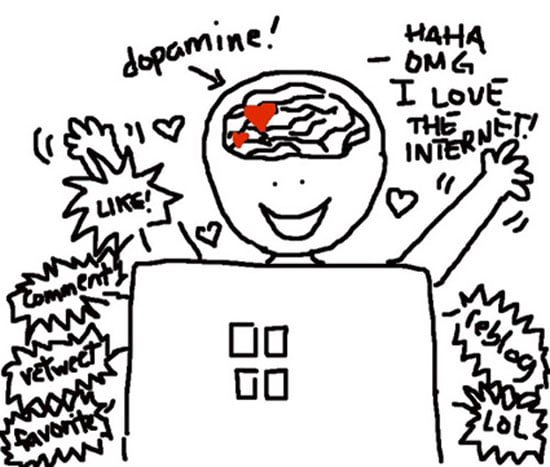
Sean Parker. The 38-year-old was the first president of Mark Zuckerberg’s social network, Facebook, and co-founder of the popular Napster service. Today, he declares he has a “crisis of conscience” regarding social media. Parker became widely known through the movie “The Social Network,” in which he was portrayed by singer Justin Timberlake. He admits that Facebook’s founders knew from the beginning they were creating something addictive, exploiting “a vulnerability in human psychology.” “It changes our relationship with society and likely interferes with productivity in various ways. Only God knows what it’s doing to children’s brains,” he notes, revealing that Facebook was designed to “absorb as much time and attention as possible.” As he explains, that was also the reason for creating various features, such as the “Like” button. It is, he says, a “hit of dopamine,” intended to encourage users to upload more content.
Chamath Palihapitiya. The 41-year-old recently caused a stir with his statements about social media, especially Facebook. He was formerly the company’s vice president in charge of user growth. Having now left the company, he says he feels “tremendous guilt” for his role in developing these tools. “We created something that is tearing apart the social fabric,” he said and urged users to quit social media. “The short-term dopamine-driven feedback loops we’ve created are destroying how society functions and how people interact,” he pointed out, referring to features like “like,” “love,” etc. As he emphasized, there are forces that can manipulate large groups of people, while users worsen the problem through a narcissistic approach that presents an idealized version of themselves. “You don’t realize it, but you’re being programmed... Now you have to decide how much of your intellectual independence you’re willing to give up.”
Tristan Harris. The former Google executive recently expressed remorse for all the technologies he helped develop. He was responsible for three years at the internet giant for ethical issues, particularly regarding how technology affects the thoughts and actions of billions of users. “We are all caught up in a system that can take control of all our minds. Our choices are not as free as we think,” warned Harris, who resigned from Google in 2016 to work at the NGO “Time Well Spent.”
Evgeny Morozov. The “internet guru,” in contrast to his colleagues from Stanford University and Yahoo fellows who founded many startups and made it into Silicon Valley, writes books and articles about the dangers of internet technology. As he points out, “there is no digital paradise,” and in the long term, “the consequences of the digital revolution will be comparable to those of climate change.” Moreover, the 33-year-old Belarusian warned about the social and economic implications and the misuse of personal data long before these issues became apparent to American authorities and Brussels, which today are trying to rein in internet giants. “They offer all kinds of services for free, but what we don’t see is the price: the thirst for likes and the concentration of so much personal data in corporate hands,” he emphasizes.
The phenomenon of “repentant” high-ranking executives first emerged in the 1980s with a few characteristic cases of former NATO officers who, at some point, joined the anti-war or/and anti-nuclear movement. We did not doubt that their new views, contrary to their previous ones, were sincere. However, such shifts - like those of today’s high-ranking executives of companies involved in the widespread mechanization of social relations - seem to confirm that one can awaken their moral conscience only after having made enough money to live without material worries for the rest of their life... They repent, are forgiven, and move on.
In any case, what the cyber-repentants are saying is, in general, correct - though without the melodramatic tone. And what’s interesting - for us - is why so many tens of millions of people so easily and cheerfully adopted the electronic/mechanical mediation of their social relationships. We absolutely disagree that they were corrupted by corporate advertising! We hold the opposite view. Social relationships (certainly in the developed world, though not only there) had already begun to disintegrate - before and especially during the 1990s - for reasons unrelated to the internet and related applications. It was this disintegration that was “healed” by the ease, anonymity, and artificial personas offered through mechanical mediation. Because if it were otherwise, these “advantages” of new media would have caused repulsion. Anonymity, pseudonyms, and artificial personas were once synonymous with dishonor, not “freedom.” Constant self-promotion was synonymous with vanity and arrogance, a sign of antisocial behavior, not “sociability.” No advertiser could have changed that.
This is a particularly interesting topic from a social/political perspective for future research...