
So far, robot swarms have been constructed from artificial materials. Mobile biological constructs have been created from muscle cells that develop on precisely shaped scaffolds. However, exploiting emergent self-organization and functional plasticity in a self-directed living machine has remained a significant challenge. We report here a method for producing biological robots in vitro from frog cells (Xenopus laevis). These xenobots exhibit coordinated movement via cilia present on their surface. These cilia arise through natural tissue morphogenesis and do not require complex fabrication methods or genetic engineering, making production amenable to high-throughput applications. The biological robots arise from cellular self-organization and do not require molds or microprinting. Amphibian cells are highly amenable to surgical, genetic, chemical, and optical stimulation during the self-assembly process. We show that xenobots can navigate aquatic environments in various ways, heal after damage, and exhibit emergent collective behaviors. We built a computational model to predict useful collective behaviors that can be elicited by a swarm of xenobots. Additionally, we provide initial proof of the capability for writable molecular memory using a photoconvertible protein that can record exposure to a specific wavelength of light. Together, these results introduce a platform that can be used to study many aspects of self-assembly, swarm behavior, and synthetic biology, as well as to provide flexible soft-body living machines for numerous practical applications in biomedicine and environmental science.
This was undoubtedly the celebratory description of a paper published in 2021 in the journal Science Robotics titled “A cellular platform for the development of synthetic living machines.”
Living machines? When system technologists talk to each other (and the papers are not intended for wide consumption!), they can call things by their name. They don’t need pseudonyms of the kind “drug”, “salvation”, etc. But what is the origin of this kind of living machines called “xenobots”? (There are other kinds too!) And what are the intellectual (and political) consequences of living machines?
“Life and death have traditionally been considered opposite states,” write some experts in the media in September 2024 under the title “Biobots pushing boundaries of life, death and medicine”1. The “boundaries” (or determinations?) of life and death? “Life after death”? And medicine as an arch? They continue: “But the emergence of new multicellular life forms from cells of dead organisms introduces a ‘third state’ that lies between the traditional borders of life and death.”
If you have managed, technologically, to get your hands on cells (that is, to control them); if you have managed, technologically, to divert cells from their natural state; if, in short, you have captured this “living unit” called a cell and, therefore, vital force at its sources, what do you care about a dead organism? What do you care if the remaining cells (beyond those you have extracted and artificially kept alive) of whichever organism feed the worms? The transcendence of the distinction between life and death does not happen in a transcendent way! It happens by changing scale!
Not all the cells of an organism that has departed this vain world die at the same time – the biotechnologists discovered this, and their discovery was equivalent to, indeed, “life after death.” For example, human blood leukocytes die 60 to 86 hours after the death of the human organism. In mice, skeletal muscle cells can “revive” even 14 days after death. Fibroblast cells2 of sheep and goats can be “resurrected” (and cultured/utilized in laboratories) almost even a month after the animal’s death!
We have here a chapter of life that persists for some time in the passage from the organism’s life to its death! A real chapter and truly unclaimed, even by the most formal definition of ownership. Why did the mysterious nature make such a metabolic division into different types of cells in every organism? Unknown but also indifferent to biotechnologists and their bosses who can (and mainly want) to exploit this unclaimed cellular capital of life, if they discover something there that can be bio-industrialized. However, one could think that since every living organism is exposed to various difficulties (injuries, pains, malfunctions), it is an animal wisdom that the totality of its cells is not a single army with a unique general (and a single timeline). For example (specialists say they have discovered that) the genes related to the immune system (and the production of immune cells) continue to function for a while post-mortem as a “response” to the necrotic dysfunction of various organs. It appears that various organisms possess a kind of “reserve” against this necrotic dysfunction of their various organs, an unknown kind of “animal memory” that keeps certain categories of cells alive in order to attempt to transform into those (organic) forms that have ceased to live.
These possibilities may be fantastic or lyrical; they are, however, indifferent (if they cannot become objects of exploitation) to the technicians of capital. On the contrary, the interest lies in the deviation of the function (and mainly of this “regenerative” dynamism) of certain cell categories, using (of course) techno-scientific methods and hacks. This is how the first xenobots were constructed: from the modification of the life of skin cells from the embryos of a frog species called Xenopus laevis. Under laboratory conditions, these cells developed “behavior” different from the expected, reaching the point of self-reproducing (something that shocks a part of the contemporary capitalist core that wants, precisely, to universally control not only social but also natural reproduction!) but also to assemble, transforming into a minimum multicellular entity.
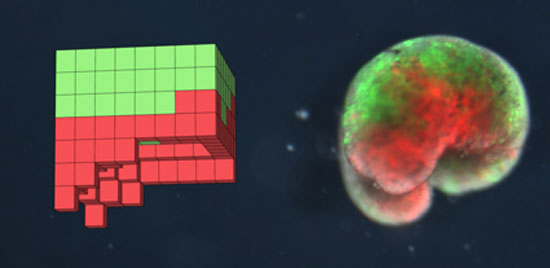
Nice with the skin cells of Xenopus laevis. Something else, more catchy? Of course! Individual human lung cells can “self-assemble” (under laboratory “encouragement and guidance” always) into micro-multicellular structures, which moreover self-move if placed in the right environment! But these are not xeno-… They are anthro-! Anthrobots! Here’s how a recent paper presented, triumphantly, this technological progress at the end of 2023, in the journal Advanced Science:
…Here we present anthrobots, a multicellular biological robot (biobot) platform with a spherical shape, diameter between 30 and 500 microns, and flagellated-motor capabilities3. Each anthrobot starts as a single cell, derived from adult human lung, and self-assembles into a multicellular moving micro biobot when cultured under extracellular conditions for 2 weeks and transferred to a minimally viscous bio-environment. Anthrobots exhibit diverse behaviors, with mobility patterns ranging from tight loops to straight lines, and speeds ranging from 5 to 59 microns-1. … We found that anthrobots are capable of traversing the necessary short distance and inducing rapid repair in bundles of cultured laboratory and injured human nerve cells…
Impressive! An immeasurable time before the vital force falls under the scrutinizing gaze of capital’s specialists, it had already created capabilities beyond every imagination (of the specialists)! Capabilities even in the intermediate state between life and complete, universal death. No, it was not and is not a “third state”! That’s what they call them (these vital capabilities under constant discovery) those who want to alienate them.
“For example…” (they write in another paper…) “…we could force these anhtobots to transport drugs…” Which means: first we could modify them as much as needed to patent them; then we could make additional modifications to make them transgenic; and finally we could sell them at high prices (because cutting-edge technology is expensive!). In short, we would ensure they work for us!!!
Indeed, this is what is likely to happen. But this is not any “third state”… It is the familiar (;) condition: the capitalist alienation of animal power as such. The real subsumption of life under capital.
And if life can be cut into exploitable pieces (yes, we can!) then even the subjugation of death to capital is profitable.
Ziggy Stardust
- Accessible at https://asiatimes.com/2024/09/biobots-pushing-boundaries-of-life-death-and-medicine/ ↩︎
- Fibroblasts are a type of cells that synthesize the extracellular matrix and collagen, produce the structural network of tissues and play a key role in wound healing. ↩︎
- With the term “eyelashes” hair-like structures on the outer surface of certain cell categories have been characterized, which allow them to move in specific types of fluid environments. The term “eyelash-steam engine” refers to the observation that these particular lung cells move (relatively…) quickly. ↩︎