
…A cryptocurrency coin is simply a digital currency, created to facilitate payments. Coins are created to function as money, in other words, they represent a unit of account, a store of value and medium of transfer. Cryptocurrencies tend to have the form of their native blockchain, as is the case with Bitcoin (BTC), Bitcoin Cash (BCH), Litecoin (LTC), Monero (XMR) and many others.
On the other hand, a token is a digital representation of an asset. Many projects in the cryptocurrency space issue their tokens as a representation of an asset or the utility they offer. They usually give their tokens to their investors during a public sale called an ICO (Initial Coin Offering).
In blockchains, while tokens are valuable, they cannot be considered as money in the same way that cryptocurrencies can be considered. They can be used for payments due to the value they receive from the project that issued them.
In some blockchains, tokens are used for community voting on key business decisions or even for technical changes to the platform, thus giving tokens more functionality than regular cryptocurrencies.
That’s how a Greek site guides us into the “magical” (?) world of “digital transactions.” It is assumed that, compared to “cryptocurrencies,” there is greater familiarity, although in reality what exists (for their users) is that they become part of an algorithmic process either of “hoarding” or deception: while “money” as a means of exchange/transactions can, under certain conditions, be considered anything (for example: cigarettes in prisons at some point), for something to be considered money in the real sense of the word it must refer to certain values, use values or exchange values, in as stable a manner as possible, and provided that it has widespread use. If, for example, someone exchanges a dozen eggs for a pair of trousers, neither the eggs nor the trousers constitute “money,” unless the eggs can be exchanged for many other goods. From this perspective, many “cryptocurrencies,” constructed in such a way as to be (often in an extreme manner) unstable in their “exchange rate” with other recognized forms of money (with other currencies), should not be considered “money”: they are forms of gambling (or even mafia-like) representation of it!
Tokens, on the other hand, have begun to appear in public life, somewhat unexpectedly, somewhat suddenly – and certainly inexplicably. One might consider them a kind of digital “coupons”, “vouchers”, whose “value”, that is, what they actually correspond to, is defined by their issuer. For example, a telecommunications company can “issue tokens” for “good customers”, which essentially means offering them some discount here or there. Or an influencer can “tokenize” themselves! And sell these (let’s call them that) shares-of-the-Self to every interested party / fan of their influence, in exchange for “providing certain special services”: the holder of some tokens of an influencer does not have ownership, possession over that influencer; they have “proof of fulfillment of a specific claim / promise / etc”.
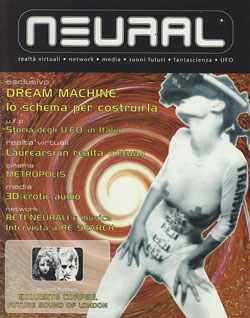
The Irish academic and co-editor of the journal Neural1 Rachel O’Dwyer published in 2023 (Verso editions) a book titled Tokens, the Future of Money in the Age of Platforms, dealing with the ways that online subcultures and internet art can transform the idea of money; and what forms of control and exclusions these new ideas bring. According to O’Dwyer:
… Tokens are not just value. They are more communication than exchange. We move away from Marx and Simmel2 who believed that money reduces every exchange to the level of transaction and every object to the level of its price. Tokens emphasize the non-material3 side of economic life, identity, social aspects; and the work that platforms do is to monetize social relationships… Already in Roman times, tokens were used to allow access to festivals and gatherings. If money moves, the token filters… Tokens emphasize power relationships. They bring people together – and separate them… The challenge here is that tokens are actually promises, as in the case of OnlyFans. Their value lies in the belief that these promises will be fulfilled.
Trademarks, coupons, IOUs (even the humble beans in friendly poker games) were/are indeed representations; representations of money in its known, established, physical form. But even banknotes were representations, certainly until the mid-1970s, as long as the “gold standard” was in effect, either directly or indirectly: any banknote of any “value” could theoretically be exchanged at the issuing state’s central bank (of the banknote) for its equivalent in gold. The word/concept “equivalent” has strategic significance here: for there to be trust in the banknote and the numbers it displays, it had to be “tied” to a corresponding (small) quantity of gold. Consequently, the banknote was a representation of that small quantity. Of course, because gold cannot be used in transactions, it was sufficient to have (state) assurance that banknotes are guaranteed representations of gold, that they have an equivalent in something of unquestionable “asset value.”
However, from all these kinds of representations, only recognized money was of unlimited duration and general use. All the rest—the chips, the coupons, the checks, the beans—were conventional representations strictly limited in time, space, and specific use. The “banknotes” of the Monopoly game had “value” within the game, but not outside it. Even if someone collected all the beans from the table after a few poker games, at most they would make a bean stew, if the representation didn’t end in time.
The same restrictions do not apply to tokens. O’Dwyer says:
…These tokens are not exactly the same type as money whose value and universality is guaranteed by the state, but they are used in all cases where regular money is used: for payments, storing value, keeping accounts, speculation, and the rest. For platforms, these essentially coupons that resemble money are:
- a way to create assets from things that were previously outside the market (such as personal influence, forms of art, electronic games, carbon footprints)∙
- a way to appropriate and control new value flows related to identity, consumer data and social trust;
- a way to determine and plan the general conditions of each one’s financial inclusion, either in parallel or independently of the state;
- and an unregulated tactic to bypass the legal conditions that determine the rules for issuing money and employment. They (the tokens) are a way for platforms to act as employers and payment managers while officially being neither….
Amazon, for example, partially pays its workers on the Mechanical Turk platform4 around the world with a gift card that can only be used through the Amazon store. And a source of income for streamers on Amazon’s Twitch site (for gaming and e-sports) is bits, which can be redeemed for regular money. But very subtly, Amazon declared that bits have no commercial or monetary value, because otherwise it would have restrictions and obligations.
Three to four key points we should keep in mind going forward:
a) Through tokens, that is, through a “representation of value / asset,” “some” are attempting to monetize (and thus shape new markets…) situations, behaviors, and social relationships that were previously outside the scope of monetization and the market. Here, Marx’s prediction about the creation of new markets, early on in the Communist Manifesto, proves correct once again. Quite clearly…
b) Those who attempt the above—token issuers—can be anyone! However, the most convincing ones (i.e., those with access to a large potential customer base) are located in cyberspace and are the (owners of the) platforms. We are very close here to corporate shares, especially in times when shares were like “pieces of paper,” similar to lottery tickets: if you held 1,000 or 10,000 of these “little papers,” you were (you thought you were) somewhat of a co-owner of the company. Small-scale, yes, but still—a shareholder! Moreover, if the company was profitable, at the end of each fiscal year it would distribute “something per share”: the so-called dividend—i.e., a portion based on a percentage of profits.
These “little papers” were tradable. You could sell them (at their stock exchange price) or buy others… Once stock exchanges went digital, the “little papers” disappeared: digital representations of them emerged. A digital representation of the paper representation… (That’s why no one should talk about “intangible”: the digital world is absolutely material, and indeed at all scales. From electrons to data centers!)
c) A strategic characteristic of tokens is their digital materiality. They can be further utilized by their “issuers” for monitoring and categorizing “users” and their behaviors. With digitization and “card payments,” banks can monitor individual consumer habits, precisely located in space and time. Tokens offer these capabilities to other sectors of capitalism as well. There are now even “flowing” tokens—tokens that can be modified and have usage restrictions applied after their issuance.
d) In quite a few cases, the issuance of tokens, or otherwise known as tokenization, has the direct goal (from the issuer’s side) of accumulating real money or/and real values. It is essential for such purposes that tokens (let’s remember: representations!!) can be bought and sold, receiving or paying not with other tokens but with regular money. Something similar must already be happening with the infamous “pollution rights”…
The internet of forests (!)
… Once you tokenize it, you can trade it. Once you can trade, you can create pools. Once you create pools, you can create derivatives. This is restructuring in a way that hasn’t existed until now… The reason you see Larry Fink5 pushing for tokenization is … there aren’t many alternatives for businesses to scale. This is the solution for large companies, whether it’s Morgan Stanley or BlackRock or other asset managers, to grow their businesses. So I consider it inevitable…
Peter Knez, president of O.N.E. Amazon (for many years director of BlackRock’s global investments office, now director of the Venom Foundation with activities in “developing” blockchain technology and creating tokens)
A satellite surveillance company with ties to U.S. intelligence services; former Trump administration officials; major names in the “management and trading” of the enormous U.S. public debt; one of the largest American companies in the world for “providing infrastructure investment advice,” also with serious “contacts” with U.S. services (AECOM)6; and the company behind the stablecoin Tether, concluded at the beginning of the year that they can “save” the Amazon rainforest, in the most modern and ideal way there can be for “salvation” according to the specifications of the 4th (capitalist) industrial revolution: by turning it into an asset!!!
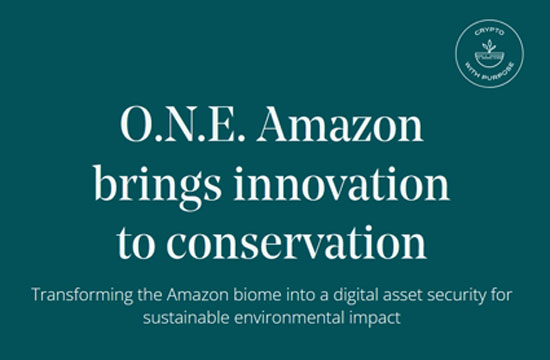
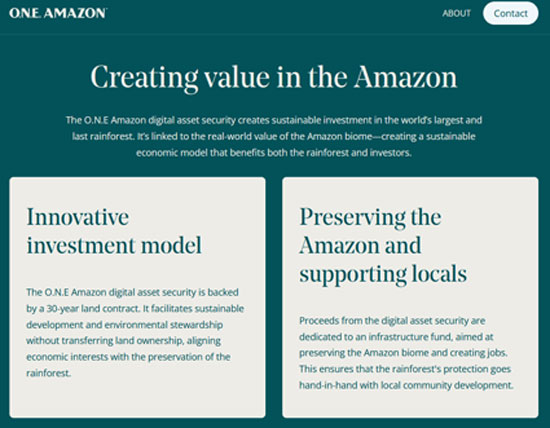
The mind will immediately go to massive bulldozers and extensive deforestation of the forest… It might also go to the purchase of huge tracts of land in it… Wrong! These are primitive, characteristic of the 20th century, not the 21st. The “savior” group has serious environmental concerns, is interested in preserving (through creative management…) the Amazon rainforest, and naturally worries about carbon dioxide emissions (in the wholesale trade of which it invests heavily). The joint venture (or, perhaps, group of companies) O.N.E. Amazon is essentially an investment scheme that plans to transform the Amazon rainforest into a digital insurance asset, which will be “cut” into thousands, millions of shares, tokenized and sold to investors around the world as a pioneering form of digital debt. The President of O.N.E. Amazon is Peter Knez.
To unravel what seems impressive (or shocking), let’s give it the simplest possible form: we will take care of the forest; and we will sell this care as an asset, in “tokens”. This simplification understandably raises questions: what does (corporate) “care of the Amazon forest” mean? Will crews be paid to clear fallen branches? Of course not! “Care” means: we will fill the forest with all kinds of sensors, terrestrial, aerial, riverine. We will continuously collect data about anything concerning the “life of the forest.” We will process them with complex algorithms. We will simulate the “productivity” of the forest regarding oxygen emissions and carbon dioxide absorption; consequently, we will continuously calculate the “economic contribution” of the ecosystem to “addressing the climate crisis.”
These look sweet, but they are somewhat passive. They become active (from an investment perspective) as follows: whoever has bought enough “Amazon forest care” tokens will be able to offset carbon emissions from other companies; or will be able to create a “green” portfolio company, list it on a stock exchange, and profit from there; or will be able to present themselves as a “protector of the planet’s largest green lung” to hide other activities of theirs…
This is the most “favorable” version of the investment utilization of a process that will be considered “care for the good of the forest and humanity,” while essentially it is an over-concentration of data for such a complex ecosystem. The reality is not so “favorable.” A critical article from early 2023 emphasized, with data from O.N.E. Amazon’s own presentation, what this means before tokenization, as its foundation, under the name Internet of Forests:
…Electronic data storage; database development; data analysis and processing; research on agroforestry and agroecological systems; research activities, including the use of monitoring equipment, instruments and methods; advice and consultancy services for conducting quality control tests and measurements; measurement and verification of carbon dioxide emissions and other greenhouse gases; photogrammetry; aerial photogrammetry; topographic surveys; geological surveys; provision of information and advice on carbon offsetting; development of technical works in agroforestry and agroecological systems…
A vast and complex natural ecosystem that is initially digitally colonized for the purpose of exploiting/utilizing/monetizing its representations falls prey to any other form of “utilization.” One of these is biopiracy—we don’t need to explain what that is. Another is the military/warfare utilization of the technology of “total digital/data mapping” of a forest, which will be developed for the sake of “care.” A third is the use of data for geoengineering designs and actions, which emerges as one of the modern weapons (a “partner” company in Amazon’s O.N.E. is the Canadian CarbonEngineering, presented as a geoengineering company).
A fourth is the discovery of various raw materials: which large token holder/investor would resist the temptation of discovering a large deposit within a forest of some “rare earth”? Another one, by no means insignificant, is the systematic and detailed monitoring of the daily life of populations historically associated with each specific ecosystem; in the case of the Amazon, these are indigenous tribes.
Here, from below, was where the fairy tale of Amazon’s corporate “care” for the Amazon rainforest began to unravel. In September 2022, Amazon’s subsidiary O.N.E. signed an agreement with the indigenous organization FICSH, which represents a federation of Shuar Indians living in the Amazon, in Ecuador. The agreement provided for the installation of a dense network of ground sensors in the Shuar territory, as well as satellite monitoring – in exchange for a modest sum as “compensation.” At that time, in September, the Shuar representatives had not fully understood what the agreement entailed. When they studied it more carefully, they realized the implications and, in early February 2023, denounced the agreement. They discovered that they would have no access to the data collected by O.N.E. Amazon, and no control over what it would do with them (i.e., how it would sell them). The agreement also stipulated that the indigenous people had no right to terminate the agreement – it was, simply, colonialist.
The insatiable appetite for conquests (material, immaterial) on the part of various categories of bosses would surprise no one. However, doing this with the starting point being the digital mapping / representation of the spaces / times to be conquered is a novelty of 21st century capitalism – even though (crude) cartography always played its role in colonialism, already from the 15th century.
Now, in the 21st century, the starting point “works” by extracting-money as such: the significance of tokens and tokenization certainly lies in this too. Which is not simply a “pre-sale” of future profits but is rather a pre-emptive establishment of rights to exploit / capitalize / profit from anything that can be digitized, starting from data and proceeding from the digital to the “analog” world (: capitalism).
Biomass
The Amazon rainforest is “biomass”… Anything living is “biomass”… And our species (the human…) is “biomass”, if someone sees it from a specific perspective: that of the 4th industrial revolution.
In September 2023, in the relentless machine under the general title financialization of nature, we wrote among other things:
… By one way or another, forests are now considered an “economic resource.” Not for those who have beehives or for the resin collectors. Generally speaking. And when something becomes a “general economic resource,” it falls under large-scale, high-intensity capitalist management. This also applies to wildfires, regardless of their causes! “Economic resource” necessarily means “management,” “profitability” – and ultimately “ownership.” Yes: whoever thinks that forests, burned or not, can become profitable per stremma – a small plot here and a concrete base for a wind turbine there, is looking backwards…
… First topic: financialization of nature. Which means: monetization of nature.
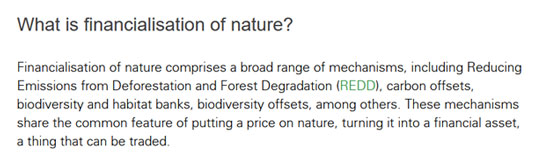
What does this mean? We translate:
The financialization of nature includes a wide range of mechanisms, including REDD+ (Reducing Emissions from Deforestation and Forest Degradation), carbon offsets, biodiversity and habitat banks, biodiversity offsets, among others. These mechanisms share the common characteristic of pricing nature, turning it into a financial asset, into something that can become a commodity…
Below, the same definition completes:
… The process of financialization of nature … makes it possible to own, buy and sell an entire forest or an individual tree, or even a function of the forest, such as for example its ability to retain water or absorb carbon dioxide…
Although there may be some “suspicion” of what and how the monetization of nature is already taking place, the specific methods each time refer more to “economic studies” and accounting offices rather than to anything natural. The following table, concerning the “assessment of the economic value” of forests in the US, can give a first clearer idea:
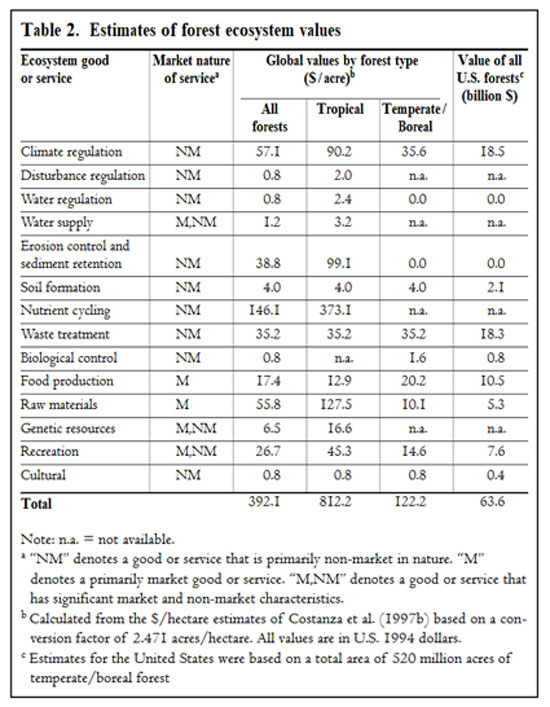
In the left column are listed the individual characteristics (or capabilities) of a forest and in the right column their translation into billions of dollars. Climate regulation, regulation of water resources, water supply, soil formation, biological control, food production, raw materials, genetic raw materials are some of these characteristics (or capabilities) that translate into billions of dollars.
Pay attention to the second column from the left: NM means primarily (primarily) non-market in nature. The emphasis is on “primarily”: the meaning is, obviously, that by their nature they are not commodities, but…
The digital colonization/financialization of forests through tokens should not be considered an isolated condition, a process on the margins of the evolving capitalist restructuring, on the margins, that is, of the (technological) over-exploitation of all life on the planet. The executives of the American “investment” bank BNY Mellon happily indicate the universality of this process’s ambitions:
… Asset tokenization involves the digital representation of real, physical assets in accounting books, or the issuance of traditional (categories of) assets in tokenized form. Within the context of blockchain technology, tokenization is the process of converting anything of value into a digital token that can be used in a blockchain application, and a token represents a share of ownership in the underlying asset. This process can work on tangible assets such as gold, real estate, debt, bonds and works of art; or in certain forms of intangible assets, such as property rights or content licensing. What is exciting is that tokenization allows the conversion of ownerships into digital equivalents so that traditionally physical indivisible assets can be fractioned in symbolic forms…
And Larry Fink, CEO of the monstrous “investment” (that is: collective…) fund Blackrock, recently declared happily:
…I have been arguing for some time now that fiscal deficits are significant. The future for governments trying to finance their deficits through their own balance sheets is becoming increasingly difficult. We are discussing with many governments more transactions between the public and private sectors. We see more and more companies selling asset packages. Sometimes 100%, sometimes 50% so that a partnership is created in infrastructure development… When we talk about the entire range of infrastructure, we are talking about trillions of dollars…
I believe that the next step forward will be the tokenization of all assets… Every investor will have their unique digital identity number… We will save many expenses…
This, in simple terms, means that in order to “cover” part of their deficits, governments will tokenize various infrastructures, private entities will buy these tokens (without it appearing that they have acquired full ownership) so as to hold a kind of usufruct of these infrastructures… etc. etc. It could involve the electricity grid, the water supply network, the “exploitation” of beaches or seabeds… etc. etc… Argentina, under its current far-right president, already appears as a “laboratory” for these schemes….
Representations become a means, a weapon of sovereignty!
(The “digital identity” is an organic part of this process, which practically will mean that no one, ever and anywhere, will be able to escape from their debts and fines and their consequences. On the other hand, preparations for the tokenization of forests are also developing in our parts…)
Ziggy Stardust
- Neural was first published in 1993 by the Italians Alessandro Ludovico and Ivan Lusco, based in Bari, with themes ranging from new electronic music and hacking to science fiction, networking, and UFOs. Until 2003 it was in Italian (along with the site created in 1997). It later became bilingual. ↩︎
- German neo-Kantian philosopher, 1858 – 1918. ↩︎
- As we will see later, there is no greater error than the notion of “immateriality” regarding anything in this world! ↩︎
- It is a digital marketplace for skills, between companies and individuals looking for work. ↩︎
- Founder and CEO of BlackRock… ↩︎
- There is a subsidiary of it in our parts. Roughly, it could be considered a real estate company… ↩︎