
The Soviet Union had publicized the fact that Japan’s microbial warfare unit in World War II, Unit 731, had used American prisoners of war as experimental subjects. But the United States concealed the story in favor of an agreement with Japan’s biological warfare criminals.
Of all the reactions from the West to the current Kremlin claims about an American biological warfare program targeting Russia, none has reached the level of hysterical ridicule like the sarcastic and dismissive criticism of Russia’s claim that the US is developing a biological weapon specifically targeting ethnic Russians.
A report by Duma TV on March 22, 2022, cited Deputy Chairman of the State Duma Health Committee Sergey Leonov, who accused the West of funding “the most terrible and despicable research… the creation of genetically selective viral strains that infect this or that people, this or that ethnic group.” Leonov referred to research conducted against Slavs in general, not only Russians.
But an alleged threat of an ethnic biological weapon was raised by Russia long before even the Russia-Ukraine war, at least since May 2007, when the head of Russia’s Federal Security Service (FSB) Nikolai Patrushev told Putin that biological samples from clinical trials sent to medical centers in the West were being used in a “program to develop genetic biological weapons against the Russian population”.
According to the American Cold War researcher (or propagandist, if you prefer) Milton Leitenberg, the FSB identified a number of “medical centers” accused of such research, including the Harvard School of Public Health, the American International Health Alliance, the Department of Environment and Natural Resources of the US Department of Justice, the Karolinska Institute in Stockholm, Sweden, the Swedish International Development Agency, and the Indian Genome Institute.
Leitenberg gathered dozens of pages of alleged evidence of Russian “disinformation” regarding Western research on biological warfare. For Leitenberg, a key figure in denying the use of biological weapons by the US during the Korean War, Russia’s “false claims [against the West] could serve as cover for a Russian offensive biological weapons program, which was never dismantled and for which Russia does not account.” Even so, however, Leitenberg admits: “There is no directly available evidence to support this concern…“
The Russian article from May 2007 mentioned above described what it called “very fantastic details about the development of a ‘biological weapon‘ that is allegedly ‘ethnically oriented‘ – that is, capable of harming the health of members of the Russian people, including sterility and death.” As a result of these fears, Russia banned the shipment of biological samples outside the country in 2007, a policy that was heavily criticized.
Genetic engineering of biological weapons?
“War propaganda”, supported Douglas Selvage at the Wilson Center. Selvage was speaking about Russian claims in 2022, which were repeated by alleged Twitter bots and troll factories, “that the US, Ukraine, or both countries are developing biological weapons in secret laboratories on Ukrainian soil to use them against Russians or Russian-speaking Ukrainians”.
“Another disinformation narrative,” emphasized Roman Osadchuk of the pro-NATO Atlantic Council regarding the Russian allegations. An article in The Intercept cited Russian biologist Eugene Lewitin, who dismissed the Russian claims about an ethnic biological weapon as “a completely unsupported idea.” The “existence of a special ‘Slavic DNA’ that could be used to target ethnic Russians with a biological weapon… is nonsense that echoes German Nazi propaganda.”
However, the genetic engineering of biological weapons and the risk of targeting specific ethnic-national groups is something that certain responsible scientists have been concerned about for decades. As recently as 2019, the Centre for the Study of Existential Risk at the University of Cambridge warned: “a biological weapon could be engineered to target a specific ethnic group based on its genomic profile.”
Although there are serious scientific reasons to believe that such a national or ethnic biological weapon would be difficult to create, according to a 2004 article by Michael J. Ainscough, which was republished in 2019 by the US Air Force’s Center for Counterproliferation of Weapons of Mass Destruction (Next Generation Bioweapons: Genetic Engineering and BW), “biological ethnic cleansing is a theoretical possibility.”
The relevant paragraph in Ainscough’s essay reads as follows:
There have been reports of biological agents targeting specific ethnic groups. Although “biological ethnic cleansing” is a theoretical possibility, most experts are skeptical about this scenario. Analysis of the human genome sequence to date has not revealed polymorphisms that could be used for the absolute determination of racial groups. Several studies have shown that genetic variability in human populations is low compared to other species and that the greatest variability exists within and not between ethnic groups.
In a recent unpublished study, it is speculated that new gene-editing technologies, such as CRISPR, could be used to create biological agents with targeting specificities so precise that they could be considered “ethnic” in terms of their target. The same author wondered, however, whether for purely biological reasons, such a weapon “could be an insurmountable challenge.”
The subject of this article is not whether such a weapon is feasible, has been created, or could be created. The point is that the idea is not far-fetched and that dismissing it as mere Russian propaganda buries the significant role that research into such a biological weapon of ethnic cleansing played in the U.S. biological warfare program. It was so important that evidence of such research during World War II by the Imperial Japanese Army was concealed by the United States, in order to incorporate the secret data from that research into their own biological warfare program. While it is not clear that the U.S. at the time was interested in a “national” microbial bomb, their Japanese counterparts certainly were.
Unit 731 in Mukden
At the end of the 1940s, the United States obtained extensive research data from experiments conducted by the Japanese research and biological warfare unit, Unit 731, regarding experiments carried out on prisoners of various nationalities, including American prisoners held at the large Mukden POW camp. The person most responsible for organizing and operating the Japanese biological warfare program was Colonel Shiro Ishii. (You can access online a copy of Ishii’s interrogation by the United States in June 1947. Ishii was only partially forthcoming about the full extent of Japan’s biological warfare program and operations).
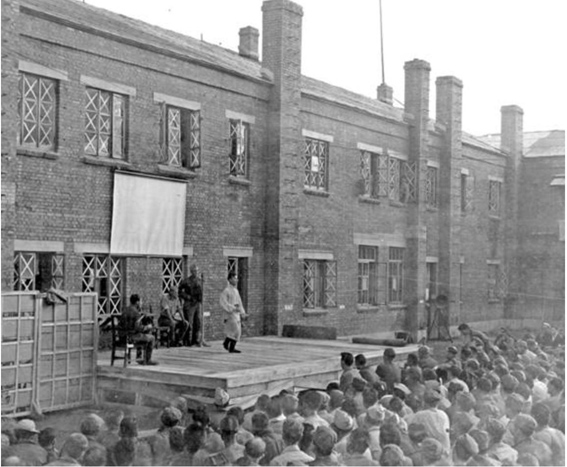
Information about Japan’s biological weapons against personnel came from criminal, unethical experiments on humans, many of whom were dissected while still alive. The information from all this was kept secret within American “intelligence channels,” and the Japanese scientists and military doctors who participated, including Ishii, all received immunity for war crimes. This happened despite the fact that operational tests of microbial weapons were known to have killed hundreds of thousands of Chinese civilians.
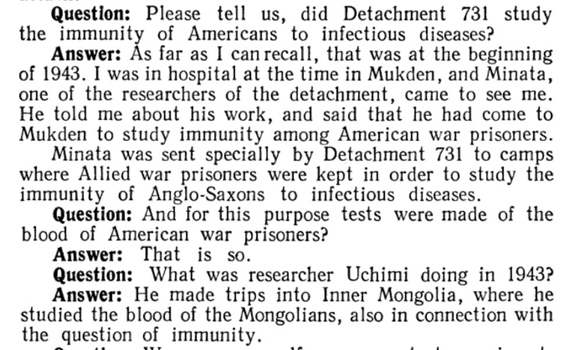
In December 1949, after the multinational war crimes trial of Japanese war criminals, led by the United States, refused to prosecute the war criminals for biological weapons, the Soviet Union conducted its own trial of prisoners from Unit 731 and the Kwantung Army who were associated with war crimes involving biological weapons. During the trial, which took place in Khabarovsk, Russia, the testimony of Colonel Tomio Karasawa, head of the biological production department of Unit 731, confirmed that his department had studied “the immunity of Anglo-Saxons to infectious diseases.”
From the trial records:
Karasawa: From what I can remember, this happened in early 1943. I was at the hospital at that time in Mukden, and Minata, one of the researchers from Unit 731, came to see me. He told me about his work and said he had come to Mukden to study immunity among American prisoners of war.
Minata was specifically dispatched from Unit 731 to camps where Allied prisoners of war were held, in order to study the immunity of the Anglo-Saxons to infectious diseases.Question: And for this purpose, blood tests were conducted on prisoners of the American war;
Answer: This is true.
The long-buried truth about Japanese biological weapons experiments on American prisoners of war began to leak out in the 1980s and 1990s, prompted by the urging of the aging prisoners of war themselves and certain congressmen. A Los Angeles Times article in March 1995, “Truth Emerging on Ailing POWs, Japan Germ Unit”, described how the US had been notified by the Soviets about evidence from interrogations of captured members of Unit 731 who had been arrested at the end of World War II:
A further declassified memorandum, dated March 1948, warned: An independent investigation conducted by the Soviets in the Mukden region may have uncovered evidence that American prisoners of war were used as experimental subjects in experiments related to biological warfare and lost their lives as a result of these experiments.
“There is a high probability,” the unsigned document noted, “that Soviet prosecutors … will present evidence of experiments conducted on human beings by Ishii’s biological warfare unit, experiments which do not differ significantly from those for which this government is now prosecuting German scientists and doctors at Nuremberg.”
The evidence of biological warfare was used in the trials of Japanese war criminals in Tokyo after World War II. Fifty years later, the revelations mentioned in the Times article and the congressional hearings never led anywhere. U.S. government officials continue – I believe even today – to deny that American prisoners of war were victims of Ishii and his group. This was certainly the case when the National Archives published the online book “Researching Japanese War Crimes” in 2006. The historians of the national archives assured their readers that more than sixty years after the end of World War II, “the question of whether Allied prisoners of war at the Hoten camp in Mukden, Manchuria, were experimental subjects remains unresolved.”
Even so, the documents show that the Americans were not the only group that the Japanese army was investigating for potential ethnic sensitivity to biological diseases, which could then be used as weapons. According to the transcripts of the Khabarovsk trial (which were published on the internet), a researcher from Unit 731 named Uchimi was sent to Inner Mongolia in 1943, “where he studied the blood of the Mongols, also in relation to the issue of immunity”.
Colonel Karasawa developed his testimony in Khabarovsk in a sworn deposition submitted to the International Military Tribunal for the Far East (IMTFE), although it never saw the light of publicity in the courtroom. The sworn deposition is not available on the internet, but historian Linda Goetz Holmes reproduced part of the text in her book “Guests of the Emperor: The Secret History of Japan’s Mukden POW Camp” (Naval Institute Press, 2010):
“A study was conducted at the unit to determine the immune serum reaction of a vaccine according to races. To achieve this purpose, Minato, a technical expert, examined the blood of American prisoners of war who were in Mukden around the summer of 1943… Regarding this, Minato told me that as a result of the blood tests, which began simultaneously with the experimental research to enhance the power of bacteria, no distinction had been found in the serum immunity between the races.”
As Holmes put it, Japan’s biological warfare research program wanted to “ascertain whether Caucasian Americans reacted to bacterial infections in the same way as Asians.”
Mysterious injections
Blood tests were not the only experiments conducted by the Japanese at the Mukden POW camp. Many years later, American prisoners described being given mysterious injections, after which many died. Some recalled waking up to see Japanese researchers waving feathers under their noses.
Fleas were a favored medium for spreading disease organisms or spores. A brief report dated September 30, 1944, on Japanese biological warfare, sent by the U.S. Joint Intelligence Service to the Military Intelligence Division of the War Department, stated that “the Japanese were dropping fleas from aircraft and that there was increased fear of attack with biological weapons.” By the time of the Korean War, the U.S. had developed its own biological bomb using fleas.
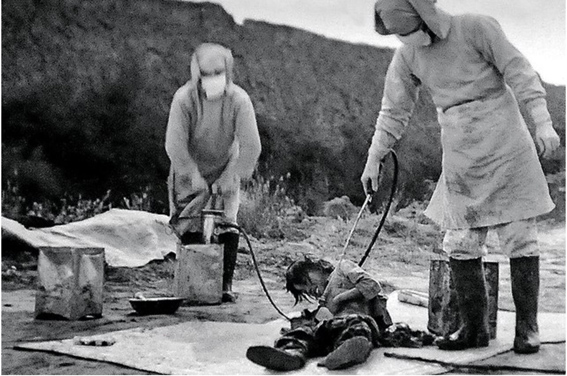
A prisoner at Mukden, Private Herman Castillo, recalls that he was kept in a cage measuring 150 by 75 centimeters, with a height of 30 centimeters. According to Holmes, Castillo told Japanese investigators from the television network Nippon TV in 1995 that Japanese medical staff sprayed something into his mouth, moved a bird’s feather in front of his nose, injected powder into his mouth, and inserted a glass rod into his rectum. For two weeks he was held in the cage without any exit and suffered from fever, chills, vomiting, and dysentery.
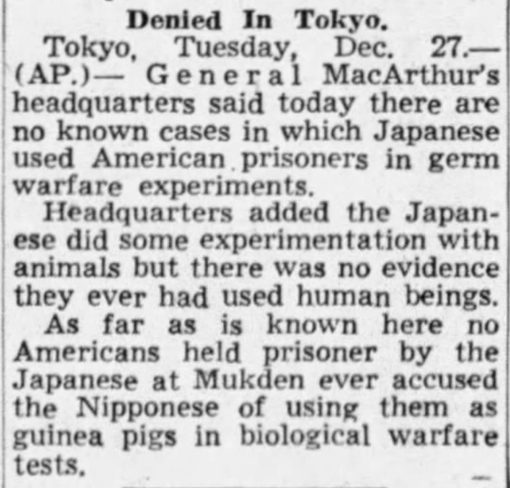
For decades, the United States denied that the Japanese had conducted experiments on American prisoners of war. The hearings on this matter in 1986 before a subcommittee of the U.S. House of Representatives concluded that the allegation lacked sufficient evidence. But it was a cover-up.
Linda Goetz Holmes’ book “Guests of the Emperor” definitively settles the dispute regarding experiments on American war prisoners, however it received almost no mention in the global press. Ironically, it was not published by any left-wing or conspiratorial media outlet, but by the book publishing arm of the U.S. Naval Institute.
Based on prisoner testimonies, diaries from the Mukden camp, documents from Unit 731, trial transcripts from the IMTFE trial in Khabarovsk and Tokyo, as well as materials from the U.S. National Archives, Holmes believed that her work provided “some definitive answers, at last, to the dispute and confusion surrounding the question of whether any prisoners at Mukden were used as experimental subjects by Japanese doctors who visited the camp in several instances”.
It is certainly strange that the Russians never seem to mention the fact that they tried to warn the Americans about how their captives were killed in biological warfare experiments by the Japanese, nor do they ever mention the Khabarovsk trial. Perhaps they are reluctant to say anything that would glorify the Soviet regime, which Putin’s mentors and sponsors helped overthrow. Or perhaps they don’t want to touch any topic that could raise questions about the Soviets’ own biological weapons program or any subsequent possible Russian research.
Critics have accused Russia of making irresponsible claims regarding the bio-warfare origins of AIDS and Covid-19. I have not evaluated the claims that Russians may or may not have written about SARS or Covid, so I will not comment on them here. I have learned that what is published is very often so prejudiced or poorly characterized that, especially when it comes to claims about the “enemies” of the United States, I must evaluate them with extreme care.
In any case, I raised these issues in this article to show that regardless of what the Russians say or don’t say, the U.S. government and the mainstream media are equally guilty of covering up, or at best downplaying, the crimes of the U.S. biological warfare program and one episode in history— their alliance with Unit 731—about which many people today know little, if anything. It is at least ironic, given the U.S. ridicule of Russia’s claims about an ethnic bomb, to consider that part of Japan’s research involved the development of “ethnic” or racial biological weapons, and that this research was conducted on captured American prisoners. The fact that the U.S. government continues essentially to deny that this occurred may be a political issue due to the alliance with Japan, but from historical and moral standpoints, such denial amounts to historical malpractice, as well as a shameful betrayal of the war veterans themselves.
With regard to the US propaganda objectives in addressing Russian allegations about biological weapons, it is important to consider that at least some of these allegations are not nonsense at all. The specter of a bio-weapon targeting ethnic, racial, or national groups, although perhaps somewhat remote, is not outside the realm of possibility, and some Western scientists have raised alarms about this prospect. Given that much of the research on biological weapons is classified, we really cannot say what has or has not been done in relation to this specific type of biological weapon.
The truth, as it is commonly said, is the first casualty of war. This appears to apply both in the case of allegations of biological weapons and in anything else.
Original title: Devil’s Bargain: U.S. Covered-up Japan’s Ethnic-Racial Bioweapons Experiments on U.S. POWs Author: Jeffrey S. Kaye, December 12, 2024
Source: kayej.substack.com/p/devils-bargain-us-covered-up-japans
Translation: Harry Tuttle