
After years of confrontations and interstate disagreements, the majority of member states of the “assembly” of the UN Convention on Biological Diversity (Convention on Biodiversity / COB) adopted [last November] a landmark decision regarding something called “DSI.” DSI stands for Digital Sequence Information. It refers to digital records of biological codes such as DNA, RNA or protein amino acids. These biological codes are routinely collected, stored and processed digitally, and have become the raw “raw material” on which the global biotechnology industry is based, whose stock market “value” is today estimated at 1.5 trillion dollars. It concerns the genetic material of plants, animals, viruses, bacteria, any kind of living organisms plus whatever is collected from human samples for medical use. The ever-increasing volume of “DSI”, which is not simply “genetic information” in general and vaguely, but rather the genetic / digital “relief” of all life on the planet, now rivals in size the volume of texts and images on the internet. And it can exceed it.
Whether you expect it or not, this genetic/digital “universal” is proprietary.
You may not care what this decadent “organ” called the UN does or doesn’t do, but since power, sovereignty, and control relations are shaped from above downward (the opposite would be called social revolution!), it’s worth (at least…) knowing how an international convention that started (let’s say) well-intentioned in 1992, namely the Convention on Biological Diversity (as a result of the Earth Summit in Rio the same year) with the noble goal of preventive readiness against genetic modification of plants and animals and biopiracy, ended up in 2024 being almost the opposite. How this happened – and why.
The Convention on Biological Diversity was finalized as a text in Nairobi in May 1992 and opened for signatures at the UN Conference on Environment and Development (UNCED) in Rio de Janeiro on June 5, 1992. It entered into force on December 29, 1993.
… Biosafety1 is one of the key issues addressed by the Convention. This concept refers to the need to protect human health and the environment from the potential adverse effects of modern biotechnology. At the same time, modern biotechnology is recognized as having great potential for promoting human well-being, particularly regarding critical needs for food, agriculture, and healthcare. The Convention clearly acknowledges both sides of modern biotechnology. On one hand, it supports access to and transfer of technologies, including biotechnology, related to the conservation and sustainable use of biological diversity. On the other hand, it aims to ensure the development of appropriate procedures to improve biotechnology safety within the overall objective of the Convention to reduce all potential risks to biological diversity, also taking into account risks to human health. Article 8 addresses measures that Parties should take at the national level, while Article 19 sets out the basis for developing an international legally binding instrument regarding biosafety.
At its second meeting in November 1995, the Conference of the Parties to the Convention established an ad hoc working group on biodiversity, with the objective of creating a draft protocol on biosafety, particularly focusing on transboundary movements of any genetically modified organism resulting from modern biotechnology that could cause adverse effects on the conservation and sustainable use of biological diversity. After several years of negotiations, the Protocol, known as the Cartagena Protocol on Biosafety, was finalized and adopted in Montreal on January 29, 2000, at an extraordinary meeting of the Conference of the Parties.The conclusion of the Cartagena Protocol was applauded as a significant step forward, providing an international regulatory framework for reconciling the needs of trade protection and environmental protection, while respecting a rapidly developing global industry, the biotechnology industry. Thus, the Protocol creates an environment that facilitates environmentally sound applications of biotechnology, making it possible to achieve maximum benefit from the opportunities offered by biotechnology, while minimizing potential risks to the environment and human health2.
The half-full or half-empty glass: depending on one’s orientations and views, this “peak journey” from 1992 to 2000 for reconciling the interests of a “rapidly developing global industry” with the protection of “natural biodiversity and human health” could be considered successful; or, simply, deceptive. To illustrate with another example, it would be as if “humanity” (more accurately: the political powers over it) were concerned about the weaponization of fireworks (a Chinese invention for recreational use: pyrotechnics) somewhere back in the 14th century, and successively made “treaties” for controlling its use, exclusively for “good purposes”…
The real fact is that between 1992 and 2000, the Western masters of this “rapidly developing global industry” had the opportunity to begin discreetly dragging any institutional and state-expressed concerns either for the “fate of biodiversity” in an environment of free mutations, or for the “fate of human health” in a capitalist world of savage exploitation and profit-seeking.
Thus, the Cartagena Protocol was followed by two more, as biotechnology companies “produced” not only mutation techniques but also an increasingly expanded agenda of aggressive action, more and more “fields” either for accumulation or capitalist exploitation on their part: the Nagoya Protocol in 2014, which attempted to address biopiracy (on behalf of companies at the expense of the organic, plant, and animal resources of various populations); and the Supplementary Nagoya – Kuala Lumpur Protocol of 2018 concerning the remediation of damages already caused by the achievements of the “rapidly developing…” Each of these protocols/international agreements was noticeably weaker than the previous one, despite the fact that the stakeholders—from the social base (farmers, indigenous populations in various parts of the planet)—were becoming more numerous and, above all, more forcefully categorical in their objections/refusals. What does “weaker” mean? It means wishful thinking.
Not from some purely ecological but rather from an anti-capitalist/anti-state perspective, the reason why this was happening is not mysterious. It is called power correlations – in this case between industry with its stable (and greedy and “unethical” if you want to call them that) orientations toward profitability and alternating state political facades (as representatives of the “good”…) along with all sorts of “specialists” with all their human shortcomings or, sometimes, with their inability in the face of private blackmail and threats.
The easily understandable in these power correlations is the who-has-the-money. Money for the success of noble (or not so much…) goals. Suffering from various capitalist difficulties (from the tendency towards so-called “corruption” to the consequences of successive crises, most recently the financial crisis of 2008–2009) and certainly because this was/is the directive of neoliberalism, political administrators of more and more states began to look with increasing affection towards private financiers for funding. These, for their part, showed even greater love and devotion to humanity’s problems, crafting boastful “goal” agendas for almost everything. Moreover, apart from biodiversity, another “goal” of high ideological investment became climate. Great responsibility was placed on the shoulders of the industries of the 4th industrial revolution (with their “fast-growing…”) to protect everything, and they were ready to carry it… Aren’t these two connected with, let’s say, green growth;
From this perspective, the issue was not the “how” but the “when” industrial/capitalist interests would definitively appropriate and for their own benefit this long-drawn, “well-intentioned” path to climate action at the OHE scale since 1992 and beyond. At the end of the day, those who specialize in piracy over living organisms (and their genetic stock) would have no trouble pirating a process that was, from the outset, “a half-full glass / a half-empty glass.”
Cali Station
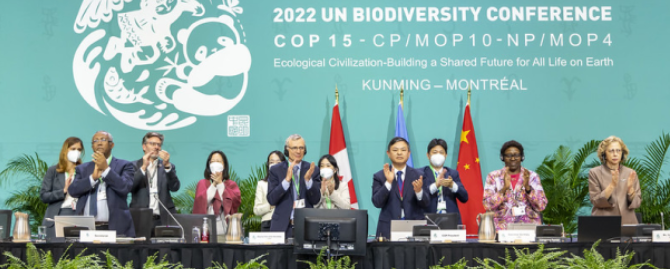
The 16th Conference of the Parties to the Convention on Biological Diversity, along with many others, from NGOs to corporate representatives and lobbyists (total: 16,000 individuals…), lasted two weeks and took place last November (2024) in Cali, Colombia. Jim Thomas participated as a representative of the older, well-meaning, and sincere intent to control biotechnology industries, especially as a member of the Convention’s technical group of expert advisors on synthetic biology and its risks. Because – and this means “fast-developing…” – the technologies that have emerged from the frenzied effort to fully subsume anything living under capital have made very large leaps in the past 30 years. As a result, the old, good, and noble intentions are now running behind, worn out and sweating, trying to understand and hit the brakes – while biotechnologies and their bosses now freely define the playing field of what is what and why. Thomas witnessed this piracy being completed, and described it as elegantly, ecologically, and nobly as possible in an interview he gave in early December. A brief excerpt:
Question: So Jim, for those of us who are not experienced observers of these processes, give us first a description of the basic elements of the agenda that the Convention on Biological Diversity followed throughout its long history, and what it was that changed this time at the 2024 Assembly.
Answer: What just concluded in Cali, Colombia, was the 16th Conference of the Parties to the Convention on Biological Diversity, sometimes referred to by its initials, CBD.
And it was the first of 3 Conferences that took place: The Conference on Desertification (UN Convention to Combat Desertification), the Climate Conference (the UN Framework Convention on Climate Change) and the Conference on Biological Diversity, which deals with a wide range of environmental issues.
And it is true that for 25 years the Convention on Biological Diversity dealt with protection, especially against genetically modified foods and genetically modified crops… So the issues around genetic engineering, which is now called synthetic biology… have been at the heart of the Convention for 25 years. However, this is changing.Part of the reason it’s changing is that we’re seeing a new agenda at the Convention on Biological Diversity assembly, which looks very similar to what’s happening with climate. Companies and financial institutions see new opportunities here. They want to turn biodiversity into new financial markets. They believe they can create biodiversity markets and biodiversity credits. Just like they have carbon markets and carbon credits.
To achieve this, they bring in new technologies, new surveillance technologies, new genetic engineering technologies. And thus, in a way, the Convention on Biological Diversity is now being transformed into a market for quite advanced digital and genetic engineering technologies as a way of managing environmental problems and the collapse of biodiversity.
What was happening in Cali was as if there were simultaneously, in the same place and with the same participants, two Conventions. On the one hand, we had the long-standing agenda of trying to protect the environment and the rights of small farmers and indigenous peoples, whose resources industry appropriates for its own benefit. And on the other hand were both the Big Finance industry and all the Big Tech companies trying to create new markets for artificial intelligence, synthetic biology, and digital surveillance… It’s striking to see which companies are leading the so-called genetic (synthetic) biology. We are at the stage where artificial intelligence is designing genetic engineering. So major companies of the kind like Microsoft, Google, NVIDIA, Alibaba and Salesforce appear. These are now setting up platforms that will design proteins, viruses, DNA, that will design organisms. And then come the collaborations with chemical companies, with pharmaceuticals, with food companies. Which have a long history of betting on trading technologies before any control exists.
… One of the things that has changed, for example, and this was very clearly shown at this 16th Conference, is that now industry is pushing hard to transform the Convention’s agenda into a kind of industry promotion. Instead of regulating and monitoring negative consequences, let’s say, of synthetic biology (which is extreme genetic engineering), the pressure now is for it to be accepted. To solve biodiversity problems. And (they say) that if this happens, there will be more money, which however will be directed toward these dangerous and quite profit-driven technologies, following the logic of technical fixes.
… Until now, one of the brakes that existed against new genetically modified organisms affecting biodiversity was that their emergence was slow. It took a long time to create a new genetically modified organism and release it into the environment.This changed with synthetic biology and its combination with artificial intelligence. Now it is much easier and faster to create new genetic codes that seem to function somehow. And to transfer them into living organisms, whether they are bacteria, viruses, plants or animals. So we will see many more synthetic organisms being released.
We also see a major focus on creating new proteins. New proteins, whether for food, medicines, or other materials that are completely unknown. There is concern here that even if regulatory authorities try, they will be overwhelmed by the volume, by the multitude of all these constructions, and thus ultimately they will be produced and traded without any control.
This attack did not suddenly begin in 2024 in Cali. Two years prior, in September 2022, in Montreal, at another noble gathering called the “Nature Session,” several new, well-funded “green” NGOs, philanthropists, and others with large portfolios appeared dynamically and participated, bringing “innovative” ideas: for the financialization of biodiversity, for creating bonds (that is: debt) for “protecting nature” through its commodification, and for showcasing new digital and genetic technologies which they termed “innovative solutions.”
It may not be necessary, but we will remind that in 2022 “innovative genetic engineering” had “saved” the planet from the certain extermination of the human species… from an insignificant virus… The “salvation” had a simple recipe: mass misinformation, mass purchase of specialists’ consciousness (assuming they have consciousness), mass terrorism. But the “success” lay in another element of psychological warfare: the concealment of the terrifying, death-causing consequences of the mass use of mRNA platforms. Consequently, since the “innovative vaccine,” for which (i.e., transferred from public budgets to private corporate accounts) many billions had been spent, had “succeeded,” the merger of biotechnology and digitization could save everything.
These heralds of the 4th industrial revolution were already loudly or quietly spreading the message that there is no greater “biodiversity” than that which had begun to accumulate in the form of digitized genetic sequences on the servers of companies like Amyris or Ginkgo3; that synthetic biology can “resurrect” any natural species threatened with extinction (but can also cause many to disappear by replacing them with “improved” versions…); that the smartest way to protect nature is through new large, very large enclosures, thus creating an unexpectedly new form of “climate-friendly” land grabbing; that (extremely energy-consuming) “artificial intelligence” is “pro-nature”; and that, ultimately, willing philanthropists of the Bezos, Gates, etc. kind can serve the “spread of innovative solutions” (and, as always, the salvation of the planet…)
Two years later, in Cali, this bloc was even stronger, even more determined. In our and your simple morality, you’d send such types to hell to get rid of them. But this would be considered “sidewalk morality” of sprayed and enemies of science. In large forums (and the meetings of member states of the Convention on Biological Diversity are such) there is abundant propriety: you must discuss, exchange arguments, persuade or be persuaded… Tragic, especially when you know that the high priests of the bio-info-military complex wield superweapons: from their vetoes to systematic lobbying, and from bribes to demagogy.
Let us add that in this bloc participated / participate states with strong biotechnological and agro-industrial interests: Canada, Australia, New Zealand, Japan, Argentina, Brazil, Great Britain – the USA simply do not participate in the Convention. How many threats and blackmails for economic, financial and trade penalties, for exclusions due to “human rights” for non-compliance of weaker member states can arise from such “heavyweights” of global capitalism?
Background: financial system
So far, the technological subsumption of life (in all its forms) under capital has been outlined, as it evolves toward its “institutional summit” (under the Western-dominated segment of the) planet: WHO, etc. There are other aspects of this process, such as the half-baked, half-lame Treaty on Pandemics that the WHO—bought out by the bio-info-military complex—is trying to push through. (After the withdrawal of the USA and the rumored withdrawal of Italy from the WHO, this treaty will go down in history as yet another ambitious campaign for universal control.) The technological subsumption of life under capital is highly significant and certainly the most tangible aspect in everyday life. We learned this well through the terror campaign and the assault of mRNA genetic engineering.
But it’s not the only one. There is another side, more or less “invisible,” which would be worth paying attention to, even if it seems (while it is the opposite) like “fine print.” It concerns the financial subordination of life as such to capital. Or, to put it differently, the conversion of life as such into debt.
In a 2016 article titled Rethinking Value in the Bio-economy: Finance, Assetization, and the Management of Value, Canadian academic Kean Birch begins as follows:
Current discussions in science and technology studies emphasize that the bioeconomy (or the articulation of capitalism and biotechnology) is based on the concepts of commodity production, commodification, and materiality, indicating that it is possible to extract value from parts of the body, molecular and cellular tissues, biological processes, and so forth.
… More than one-third – 29 companies – of the publicly traded biotechnology sector have collapsed since 2008, and 10 are on the brink of collapse, according to research by Paul Cuddon. Another 38 are “doing well,” and 6 have been acquired by other companies (The Guardian, August 29, 2011)
As the above excerpt shows, part of the impact of the 2007–2008 global economic crisis was the (partial) collapse of the biotech industry sector, not only in the United Kingdom but globally. All forms of funding in the biotech industry were affected by this crisis. From venture capital to initial public offerings upon their stock market introduction… By 2014 … the global capitalization of the biotechnology market had soared to over 1 trillion dollars. Despite the rise in capitalization, however, in 2014 this sector did not produce proportionally more products and services, nor proportionally higher revenues than 4 or 5 years earlier.
What Birch touches upon here (and which has substantial international bibliography) is that the genetic engineering industry aims to produce goods; however, at the same time, and partly as compensation for potential difficulties in this (e.g., if there are still some troublesome safety and effectiveness checks…), it is a field of financial profitability: flows of large amounts of money, whose holders are looking for “opportunities,” through stock exchanges, derivatives, etc.
This is the point that Jim Thomas hastily made earlier. We remind you: …Companies and financial institutions see new opportunities here. They want to turn biodiversity into new financial markets. They believe they can create biodiversity markets and biodiversity credits. Exactly as they have carbon markets and carbon credits…
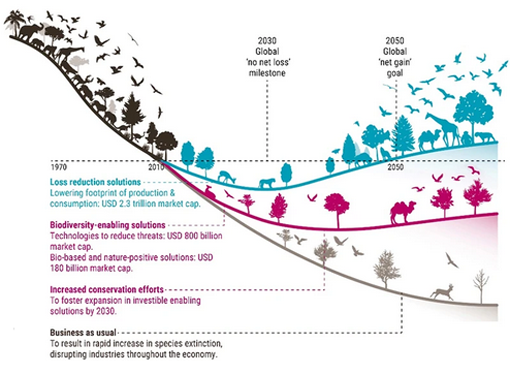
Not only markets and credits for “biodiversity.” But more broadly, stock markets and credits for “forms of life.” Where “forms of life” include biological activities (such as, for example, the absorption of atmospheric carbon dioxide by plants, as well as the behavior of various proteins…) or even complete organisms (e.g., viruses, microbes, plants, animals).
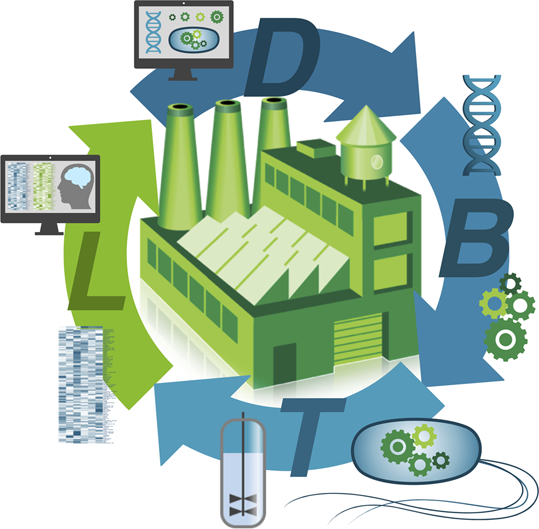
The process through which stock-market products, “tokens” or anything similar can be made from “life forms” begins with ownership over them and proceeds to their leasing. Leasing of patents, primarily. From this perspective, synthetic biology as such is the technological and financial “tipping point” of life’s monetization. Firstly, because it definitively circumvents legal and ethical restrictions on patenting natural life forms (for example: natural DNA sequences) through the dizzying production of artificial (sequences) – here the deployment of “artificial intelligence” is an accelerator catalyst:
… «The bioreactors» brags a manager, «create economies of scale in biological production for the first time». Thanks to this capital-intensive automation program, Ginkgo claims it has the ability to create 50,000 different genetically modified cells in one day…4
And secondly, because the “storage” of life components (DNA sequences with hypothetical α or β function, proteins, etc. in digital form) becomes an “asset” and “potential” of companies, regardless of the extent to which these will ultimately be converted into commodities.
The atomistic mindset may struggle to understand what this means. What does ownership and leasing of biological factors mean, for example? The answer is known and given, provided someone deals with what is already happening with cultivable versions of genetically modified seeds: the company is the real owner of the crop and indirectly but clearly of any production, from which it “collects rent” – that is, land rents. If anything happens and the production is insufficient or destroyed (e.g., by weather phenomena, or by poor quality of the genetically modified seed), the farmer is indebted to the company; from which, moreover, he will get the biological material for the next round of cultivation.
When, therefore, the big biotech, big tech, and big finance appear together at the center of the capitalist “institutional” scene, it is not because they offer high-quality cocaine at the World Economic Forum or similar events. But because ownership-of-life can be not only literal but also yet another generator of the dogma “money breeds money.” Indicatively, in the words of Birch:
… Even if biotech companies develop products that are marketed, such as drugs, their profit does not consist (mainly) in the production of these drugs – the production of which is relatively cheap once their synthesis is established – but mainly in the ownership and control of assets called “intellectual property,” on which these drugs are based. The (stock market) value of the company arises mainly from the valuation of such assets.
An asset is a “resource” that generates “future benefits” – that is, it is both capital (productive) and property (something tradable in itself). Consequently, intellectual property-type assets constitute simultaneously a resource for the potential production of goods and an income stream, representing knowledge monopolies that collect monopoly rent.
It thus emerges that while the technological subsumption of life under capital aims at modifying it, at making it “predictable and controllable” in every aspect, the financial subsumption of life under capital aims at keeping it permanently rented. At continuously generating revenues, “for the term of life,” for its “intellectual” owner.
This is called the creation and exploitation of new markets (a quintessentially capitalist process!) and debt economy (which perhaps refers to feudal forms). We certainly know that at times, when a structural crisis of valorization in capitalism is unfolding, such a “coexistence” emerges. Rentiers (from the word rent), from the perspective of formal, “orthodox” capitalism, are considered parasites; however, they appear as “saviors of profitability” whenever productive investments are “not profitable” or “do not yield returns.”
We also know that the holders of the “monetary” billions and trillions that have been created financially (through “money printing” by central banks and/or stock market gambling) over the past two or three decades—numbers with many zeros that far exceed global GDP (the production of goods per se)—inflationary money, are frantically searching for material values to match these amounts, in order to preserve them as a “general measure of transactions.” They are frantically searching for material values to use as equivalents.
It seems that life as such makes them. Especially to the extent that it can be constructed in the form of synthetic/artificial DNA, RNA, proteins…
Ziggy Stardust
- As you can see, even this term “was seized” ultimately from the bioinformatics-military complex—and became military… ↩︎
- From the official website of the Cartagena Protocol: https://bch.cbd.int/protocol ↩︎
- More at cyborg 31, The organism is the product (synthetic biology and the creation of genetic tailoring). ↩︎
- O.p. ↩︎