
In the 1990s, the Human Genome Project—concerned with the “decoding of human DNA”—promised to provide humanity with its “instruction manual”: a document that would forever clarify how the human organism develops and functions. However, once the race to map the sequences of bases was over, the human genome appeared to be chaotic, incomprehensible, and disorderly. Over 98% of the mapped DNA seemed to have no recognizable function: an ocean of nonsense, quickly dismissed by molecular biologists as “junk DNA.” At that time, it was largely considered to be the result of accumulated evolutionary waste, an endless genetic landfill containing obsolete fragments from forgotten ancestors, remnants of past viral infections, strange and ancient mutations that gradually piled up over centuries. This perception—presenting the genome as overly complex, tangled, and full of useless software-like elements—would give rise to modern ambitions for genetic enlightenment: to clean it of junk and reduce it to an organized and orderly set that would be easier to interpret, control, and manipulate.
If molecular biologists initially dreamed of “reading the book of life,” modern initiatives such as the Genome Project Write have inspired a shift “from passive reading of the genome to active writing of it.” In this context, the field of synthetic biology has tasked itself with the rationalization of biology through the design of techno-scientific life forms that are easier to measure, evaluate, predict, and target. According to Drew Endy—member of the bioengineering faculty at Stanford University and author of “Foundations of Biological Engineering”—”evolution does not select things that are easy for scientists to understand and interact with, which is what we always want. So we aim to build standardized biological systems that we can understand and use as engineers; we want to rebuild the living world so that it is standardized.” He assured that synthetic biology offers techno-scientific “liberation” from the “tyranny of evolution” that causes “random and purposeless mutations.” Evolutionary history should be guided according to rational principles, overcoming the unpredictable outcomes of random genetic mutations filtered by natural selection.
Similarly, Thomas Knight – senior researcher at MIT and founder of the synthetic biology company Ginkgo Bioworks – points out that in order to rationalize genomes it is necessary to “reduce useless genes; eliminate overlaps; standardize promoters” and to “reprogram proteins so that they use a reduced portion of the coding space.” The ultimate goal is to construct “simple organisms” that are “modular, understandable, and malleable,” and characterized by a “rational structure.” In short, synthetic biologists promise to impose the organic rationality that characterizes the Enlightenment’s imposition onto biology. According to Max Horkheimer, modern technoscience originally aimed to reconstruct the world according to the principles of efficiency, predictability, computability, and control, thereby reducing nature to “mere matter, simple material for domination, with no other meaning apart from that of domination itself.” This modern order culminates in contemporary synthetic biology, a research endeavor aiming to rationalize the physiology of living beings, transforming them into functional components of bio-production systems.
By reconstructing the genome of a specific bacterium, synthetic biologists aim to make its metabolic processes “better” from a functional perspective. For one group of researchers, “rationalizing” a particular bacterium means making its genome more legible, more understandable, more predictable. For a pharmaceutical company, it could mean making its metabolic processes more efficient, maximizing the production of a desired molecule and reducing the excretion of useless byproducts. Genome editing, in other words, allows the integration of functionalism and its embodiment into living flesh. After being used for a while as production tools, living beings are now designed as such. If random natural mutations appear to many synthetic biologists as the unreasonable whims of evolution’s tyranny, the targeted mutations they propose appear as the enlightened embodiment of economic logic.
An example of the role that instrumental rationality has played in shaping the forms of life created by synthetic biology is Syn3.0. In 2010, synthetic biologists at the J. Craig Venter Institute announced the creation of the first “self-replicating synthetic bacterial cell.” In a publication in Science, the researchers demonstrated the steps to synthesize the genome of the bacterium Mycoplasma mycoides from basic chemical substances and transplant it into a recipient cell. They named the resulting bacterium Synthia, and celebrated it as “proof of principle that genomes can be designed on a computer, chemically constructed in the laboratory, and transplanted […] to produce a new self-replicating cell controlled by a synthetic genome.” Venter hopes that this particular experiment will advance genomic synthesis rather than genomic cut-and-paste. “If you want to make a few changes, CRISPR is a great tool,” he said in a recent interview with Nature, “but if you really want to create something new and try to design life from scratch, CRISPR won’t take you there.”
The next step taken by Venter’s team was to synthesize a “minimal cell” containing only the genes necessary for the simplest form of life. In 2016, the institute announced that it had completed the work and publicly presented JCVI-Syn3.0, a new version of Mycoplasma mycoides equipped with a synthetic genome stripped of all “useless” DNA sequences. According to Venter, this “minimal bacterial cell” will soon provide “a system where we know and understand all of its components, so that when we add something extra to it, we will do so in a logical, designed way.” Essentially, the goal is to use Syn3.0 as a standardized platform on which to build highly specialized life forms, whose metabolism will focus on the industrial production of a desired product. For example, Synthetic Genomics Inc.—founded by Craig Venter in 2005—received $600 million from ExxonMobil and additional investments from British Petroleum (BP) to design bacteria “that will function as cellular factories, producing high-energy oils that can be easily processed into renewable diesel and aviation fuels.” In other words, the fossil fuel capital is promoting the creation of bacteria whose organisms will have been “rationalized” to serve the bizarre irrationality of a system based on oil.
The first studies of synthetic biology were celebrated by many prominent molecular biologists as the beginning of an era in which, as George Church writes, “we can convert inorganic material into organic. We can also read and interpret genomes—as well as modify them. Moreover, we can create genetic diversity, adding to the remarkable set already created by nature.” At the heart of this new field is, undoubtedly, the MIT Synthetic Biology Working Group, an academic center whose mission, in its own words, is “to make life better, piece by piece.” In this context, “better” means more predictable, more manageable, and more controllable. “Synthetic biology,” writes Drew Endy, one of the early pioneers of the Working Group, “taught me that: design and build living organisms that behave as you expect” and “create new genetic programs that obey you.” Paraphrasing James Scott’s views on scientific forestry, we could say that synthetic biology represents an experiment in the functional simplification of organic life, aiming to transform cells into “commodity machines,” “dissecting an expectedly complex and difficult-to-understand set of relationships and processes in order to isolate a single element with instrumental value.”
Perhaps the most impactful and ambitious part of this journey involves efforts to develop the so-called “Registry of Standard Biological Parts”: an open library of functional genetic elements – also called “BioBricks” – that can be easily combined to produce complex systems. The content of the “BioBrick Assembly Standard” ensures compatibility between these units and specifies how they can be combined into more complex assemblies. The stated goal is “to simplify and standardize the process of creation” by turning genome construction into a simple and clear industrial assembly process. By playing with BioBricks, synthetic biologists attempt to create new synthetic forms of life. This is presented as an initial step “towards the dreamt future: synthetic biology without DNA modification”; a future in which biotechnology labs will no longer need to genetically modify natural organisms “since they will be able to design them completely from scratch”.
Two companies are at the forefront of the new horizons opened up by synthetic biology: Amyris and Ginkgo Bioworks. The first has declared as its goal to “make unlimited whatever is finite in the world.” It was founded in 2003 with a grant from the Gates Foundation, and initially focused on creating a synthetic metabolic pathway for the production of artemisinin, a drug for malaria. Amyris scientists redesigned cells of a fungus by introducing synthetic DNA segments from the amorpha-4,11-diene synthase enzyme, which exists in artemisia annua and catalyzes the production of artemisinin. They then made another mutation in the modified fungus to focus its metabolic activity on producing the desired molecule, increasing its production by 500 times. The new technology offers a biotechnological alternative to the traditional process of artemisinin production, which involved processing the artemisia plant. By the early 2010s, artemisinin was mainly produced by small agricultural operations in Vietnam, China, and East Africa. When synthetic and semi-synthetic artemisinin began to circulate, the Royal Tropical Institute of the Netherlands predicted that “pharmaceutical companies will gain control and power over the production process; artemisinin producers will lose their income; and the local production, export, and (possibly) industrial manufacture of artemisinin in regions where malaria occurs will relocate to the core production sites of Western pharmaceutical industries.”
In the following years, the company developed similar synthetic processes and several more profitable molecules… It also managed to automate the production of new bacterial strains. “The creation of a new form of life,” according to the head of Amyris’s techno-scientific department, “has been simplified as follows: a scientist writes a DNA sequence on their laptop and hits ‘send’. Next to the laboratory, robotic arms begin mixing various components to produce the desired cells […] You can now create a cell in the same way you can create an app for your iPhone”… Automation has dramatically accelerated bio-production. Amyris proudly claims that it creates new organisms, mainly genetically modified bacteria and fungi, at a dizzying rate of 1,500 per day. These are stored at the company’s facilities: it is one of the world’s largest collections of techno-organic organisms, with over 3,000,000 living “parts.”
Amyris is not the only company that has benefited from recent developments in synthetic biology. Ginkgo Bioworks – whose advertising slogan is “The organism is the product” – started in 2008 by Thomas Knight, from an MIT synthetic biology program, along with 4 graduates. In 2017, the company’s value was estimated at over 1 billion dollars. In a recent interview, Jason Kelly – the current CEO of the company – compares Ginkgo “to an online app store, with the difference that the apps are programmed cells.” The company creates synthetic bacteria to be utilized as living production tools by other companies. The promise is: place an order with Ginkgo Bioworks and its laboratories will “spit out” an organism that does whatever you want. Want a cheap substitute for a natural product like vanilla or rose scent? Ginkgo will design a microbe that secretes it. “We are a kind of cell programmers,” Kelly says in another interview, “our job is to make the cell do whatever our customers want.” In exchange, Ginkgo usually charges a standard fee for delivering the requested organism, plus a percentage of the profit resulting from the use of these proprietary molecular machines. Over two dozen industries are currently collaborating with Ginkgo – including Moderna, Roche, and Bayer/Monsanto – in developing microbes used in the production of fragrances, drugs, and food. Through synthetic biology, these businesses aim to modify their production processes using armies of genetically modified bacteria as programmed living production tools.
The heart of the business is a 9,300 square meter facility in Boston, which a journalist from Science News described as a “biological assembly line” where “synthetic biologists aim to transform biology the same way Henry Ford revolutionized car manufacturing. Instead of placing standardized parts or carburetors onto a car moving along a conveyor belt, scientists insert brand-new biological components into the body of a bacterium.” Since its creation, Ginkgo has spent nearly half a billion dollars on gene analyzers, mass spectrometers, computers, and robots in an effort to automate the production of synthetic bacteria. “Inside the 3rd building of Bioworks,” writes Amy Feldman after visiting Ginkgo’s facilities in 2019, “a robot with pipettes moves pieces of DNA that are in some liquid onto a disk with 8 rows and 12 columns at a speed beyond human capabilities. When the cells grow in plastic containers, another robot photographs them and uses their image to separate irregular colonies from the gelatinous substance surrounding them. The facility is quiet, with relatively few people. To a large extent, it is the machines that do the work.” “The foundries,” boasts a manager, “create economies of scale in biological production for the first time.” Thanks to this capital-intensive automation program, Ginkgo claims it has the capability to create 50,000 different genetically modified cells in a day.
[…]
According to a recent overview, over 600 companies—with headquarters mainly in the USA, Japan, and Europe—operate in the synthetic biology market, with an annual growth rate ranging from 5% to 10%. These companies, regardless of their stock market fluctuations, are pioneers in manipulating biological matter. They design living organisms that do not fit into the categories of traditional taxonomy and create problems even in distinguishing between life and non-life. They are recombination centers where genes are systematically cut up, redesigned, and assembled into new genomic combinations. They are centers of specialized labor and centers of capitalist accumulation, automating traditional scientific activity and transforming it into an industrial strategy. Ultimately, they are centers where the principles of Fordism and Taylorism are incorporated into social relations and into countless living organisms.
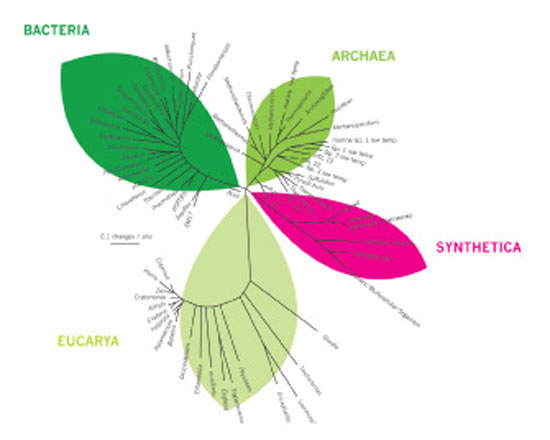
As Sophia Roosth notes, the synthetic organisms that ensure the profitability of companies worldwide “do not fit with the trees of life determined by descent and genealogy.” Their artificial genomes create confusion in the classical distinction of life forms. Some discuss the possibility of adding a new tree of life. The cover of a recent special issue of the journal Nucleic Acids Research features an image created by Alexandra Ginsberg titled “The Synthetic Kingdom.”
This project intends to spark discussions about the ways in which genetic engineering and synthetic biology are transforming the living world. In this approach, genetically modified organisms and synthetic entities constitute a Fourth Kingdom, whose emergence has nothing to do with classical Darwinian evolution. Industrial design and industrial reproduction, in other words, have taken the place of random mutations and natural selection.
In this development, who decides which synthetic lives are created to live, which designed organisms are going to flourish, which are revived and which are abandoned and die? Who holds sovereignty in the synthetic kingdom? While many synthetic biologists promise to create a better world through their biological designs, we must remain cautious as there is no universal “better design.” Design is always determined by values, it is ultimately a political process; and biological design is no different in this respect. Marxist ideological critique has shown how social relationships manifest in literature, films, songs, architecture. From this perspective, it is not surprising that today – when synthetic biologists and genetic engineers imagine how they will redesign bacteria and create new forms of life – they do all this in ways that reflect the social environment in which they work, think and live.
Ideology is to a large extent embedded in the living flesh of millions of molecular factories, all designed to function as the metabolic pathway for capitalist accumulation. The critical assessment of synthetic biology and genomic engineering reveals how social relations of power and market forces shape the “synthetic kingdom.”
Excerpt from the 4th chapter of the book Mutant Ecologies, Manufacturing Life in the Age of Genomic Capital, by Erica Borg and Amedeo Policante, ed. Pluto press, 2022. Chapter title: CRISPR assembly lines and the acceleration of the molecular factory. More from the same book in the tetradio for worker use no 8
Translation, adaptation: Ziggy Stardust