The following article is a translation of a text by American professor Benjamin Peters. Together with Slava Gerovich (also based in the U.S., but of Russian origin), he is one of the two historians who have most expertly studied (at least in the West) the developments of cybernetics in the Soviet Union. This text examines some snapshots of the evolution of Soviet networking systems, after the emergence of ARPANET in the U.S. The purpose of this retrospective is, of course, not a sterile historicism that randomly lists events for the delight of (Soviet) history buffs. Even through such a brief tour, certain crucial questions emerge regarding the social dimensions of any technology (in this case, networking systems), and some pioneering, faint answers are outlined. A key question: why can a given technology take root and spread within a specific social formation (the Internet in the U.S.), but wither in another (in the Soviet Union)?
Peters attempts here to provide a first answer, perhaps not absolutely satisfactory or complete, focusing primarily on the bureaucratic entanglements of the Soviet system. On the other hand, he ignores the role that networking technologies played in reshaping work practices in the West toward more flexible directions, precisely at the time when worker refusals were reaching a peak. A more significant contribution of the text may be that it highlights the “ephemeral” and “transitory” (in the sense of historically contingent) nature of various technological complexes that we take for granted. The fact that the internet became associated in the West with freedom—initially of ideas and subsequently of goods—does not mean that it will always retain this form. Cryptocurrencies, on the other hand, only emerged in the West over the past decade, even though the idea existed in embryonic form in Soviet scientific minds decades earlier.
The interesting thing is that there they were not proposed with the same motivations that were proposed in the West (of a non-centrally controlled payment medium), but with exactly the opposite ones. The even more interesting thing is that their conclusion in the West tends, perhaps in a dialectically distorted way, towards something identically “concentrated.” The most pressing and difficult question that arises, however, from such historical resurgences is the following: are there specific systems of thought, specific perceptions that contain some manipulative or oppressive potential, such as here the governmental one that was mobilized from time to time to justify both decentralized and centralized decision-making systems? Or can any perception take one form or the other, depending on who expresses it and within what historical-social context it is expressed? The answer (if it exists) to such a question cannot be given here, by such a “mere” historical text. At least, however, the question is posed. Something that is already a lot, given the data of the Western subordinates of the 21st century.
Separatrix
On the morning of October 1, 1970, Viktor Glushkov, a computer engineer, arrived at the Kremlin to meet with the Politburo. Wide awake, with piercing eyes behind his black glasses, he was the kind of person who, if you gave him a problem, would find a solution not only for it, but for all similar problems. And the Soviet Union had a serious problem at that time. A year earlier, the U.S. had launched ARPANET, the first distributed computer network based on packet-switching logic, which would eventually serve as the precursor to the internet as we know it today. Such a distributed network had been designed with the goal of maintaining communication channels between scientists and the government even in the event of a nuclear attack. At the height of the technological competition between the two superpowers, this network was intended to give the U.S. an advantage. The Soviet Union had to find an answer.
Głoskow’s intention was to inaugurate an era of electronic socialism. The name he gave to this ambitious program: “Pan-National Automated System.” Its purpose was to technologically optimize and upgrade the entire planned economy system. Economic decisions would still be made through state planning and not via free market, but the system’s operation would be accelerated through the use of computational models capable of predicting equilibrium points before they became reality. What Głoskow wanted were smarter and faster decisions; perhaps even an electronic currency. What he needed was the Politburo’s wallet.
However, as soon as he entered the cavernous office where the meeting was to take place that morning, he noticed two empty chairs. His two strongest supporters were missing. He found himself facing a table full of ambitious, greasy ministers, many of whom eyed the Politburo funds on his behalf.
Between 1959 and 1989, there were quite a few Soviet scientists and government officials who attempted to build a national computer network for social purposes. Still bearing the open wounds of World War II, the Soviet Union continued to invest in massive modernization programs that had managed to transform a scattered nation of illiterate peasants under the tsar into a global nuclear power in just two generations.
A sense of new possibilities swept the country after Khrushchev’s decision to denounce Stalin’s personality cult in 1956. In this climate, a number of socialist programs were proposed that aimed to network the national economy. Among these was the globally pioneering proposal to create a national network for use by citizens. The father of this idea was military researcher Anatoly Ivanovich Kitov.
Young, diminutive, and with a particular flair for mathematics, Kitov had risen through the ranks of the Red Army during World War II. Shortly thereafter, in 1952, he read Norbert Wiener’s major work, Cybernetics (1948), in a secret military library. The title of the book was a neologism derived from the Greek word for the helmsman of a ship (the steersman) and referred to the new science of autonomous information systems. With the help of two veteran scientists, Kitov translated cybernetics into Russian as a method of self-governing control and communication systems using computers. It was believed that the vocabulary of cybernetics, with its flexible and airy concepts, would provide the Soviet state with a high-tech toolkit for rational Marxist governance, acting as an antidote to the logic of violence and personality cult that characterized the Stalinist era. Perhaps even more—it might ensure that such a despotic, dictatorial figure would never appear again; at least, that was the technocrats’ dream.
In 1959, while serving as director of a secret military computing research center, Kitov decided to channel “unlimited quantities of reliable computing power” toward improving the design of the national economy. This was the most persistent coordination and information management problem that plagued the Soviet socialist program. For example, in 1962 it was discovered that a human computational error during the 1959 census had caused a population estimate deviation of 4 million. Kitov recorded his thoughts in the so-called “Red Book letter” and sent it to Khrushchev. Among his proposals was to allow political organizations to use the military’s computing facilities for economic planning purposes during evening hours, when most military personnel were asleep. He believed that in this way, those responsible for economic planning could exploit the military’s computing surplus in order to make real-time adjustments to the plan—even at night, if necessary. The name he gave to this military–political national computing network was the “Economic Automated Management System.”
As it turns out, Kitov’s military superiors intercepted the Red Book letter before it reached Khrushchev. What outraged them was the implication that the Red Army would be required to share its resources with the civilian officials in charge of economic planning, whom Kitov had described as falling short of the demands of the era. A secret military tribunal was convened to examine his transgressions, which were deemed serious enough for him to be expelled from the Communist Party for a year and permanently discharged from the army. Thus, the first attempt at creating a national public computer network came to an end.
However, the idea remained alive. In the early 1960s, another scientist took up the task of continuing in Kitov’s footsteps. In fact, the two of them became so closely connected that their children eventually married each other. His name was Viktor Mikhailovich Glushkov.
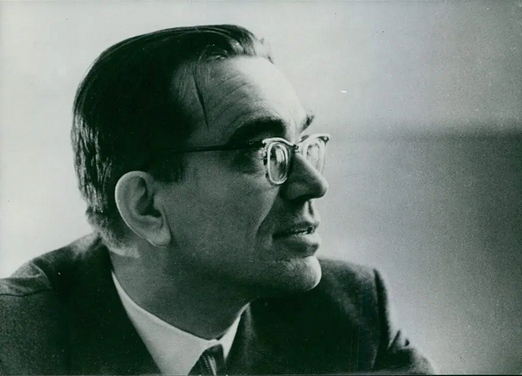
The full title of Glushkov’s proposal is indicative of his epic ambitions: National Automated System for Collection and Processing of Information for the Recording, Planning, and Management of the National Economy. When it was first proposed in 1962, the All-State Automated System (or OGAS, from its Russian initials) was intended to be built upon the existing (as well as new) infrastructure of telephone cables, as a real-time, remote-access national computing network. In its most ambitious versions, it was designed to cover most of the Eurasian continental mass, functioning as a nervous system with nodes in every factory and enterprise of the planned economy. The network’s architecture was hierarchical, structured according to a three-level pyramid logic, reflecting the structure of the state and the economy: a central computing center in Moscow would connect to approximately 200 centers installed in major cities, which in turn would have under them 20,000 terminals distributed at strategic points of national economic production.
The network’s architecture thus followed a decentralized logic, just as was the broader logic of Glushkov’s. In practice, this meant that while Moscow would be able to determine who would receive which authorizations, any authorized user could communicate with any other user within the pyramid without needing to request explicit permission from mother nodes. Glushkov understood very well what the advantages would be of exploiting local knowledge within a network, as he had devoted a large part of his career to similar mathematical problems during his commute between his home and the capital (the train between Kiev and Moscow he jokingly called his “second home”).
For many state officials and economic planners, the OGAS project seemed, especially by the end of the 1960s, to be the best answer to an old impasse: all Soviets agreed that communism was the future, but no one, after Marx and Engels, knew what the optimal path toward it was. For Glushkov, computer networks might provide the opportunity to give the country a push in the direction of what author Francis Spufford called “red plenty.” Through them, the sluggish, soft, and clotted blood of the centrally planned economy, with its ceilings, plans, and massive manuals of industrial standards, would be transformed into the nervous impulses of the nation, operating at the impressive speeds of electric current. Not a little, not a lot, the project would mark the entry into the era of “electronic socialism.”
To pursue such ambitions, they needed intelligent people with a strong sense of commitment and the ability to set aside outdated perceptions. In the 1960s, such people could be found in Kiev, just a few blocks from where the Strugatsky brothers wrote science fiction novels at night and worked during the day as physicists. Around Kiev was located the Institute of Cybernetics, which Glushkov directed for 20 years, starting from 1962. He gathered at his institute a plethora of ambitious young people; the average age of his researchers was 25 years. Glushkov, together with his youthful staff, devoted themselves to developing OGAS as well as other cybernetic programs put at the service of the Soviet state. One such program was also an electronic transaction system aimed at transferring hard currency into the virtual world, into an electronic ledger book; all this in the early 1960s. Glushkov, known for his ability to ironically and condescendingly counter the party’s pure ideologists by quoting from memory entire paragraphs from Marx, described his innovation as fulfilling the Marxist prophecy of a socialist future without money. Unfortunately for him, the idea of a Soviet digital currency raised concerns in certain circles and was not approved in 1962. Fortunately, however, his grandiose plan for an economic network survived.
The dream of these government supporters was something like an intelligent neural network, a kind of nervous system for the Soviet economy. This government-inspired analogy between a computer network and the brain left its mark on other innovations in computing that emerged in Kiev. For example, in place of the von Neumann architecture, which imposes limitations on the volume of data that can be transferred from memory to a computer’s processor, Glushkov’s team proposed a kind of “macro-pipeline” processing inspired by the simultaneous firing of multiple synapses in the human brain. Beyond various central processor construction programs, he had also theoretically engaged with automata theory, “paperless offices,” as well as natural language programming that would enable computer users to communicate with them at a semantic level rather than merely syntactic, as programmers do today. Glushkov’s and his students’ most ambitious attempt concerned processing the capability to achieve “informational immortality,” a concept we could also describe as “mind uploading,” following the example of Arthur C. Clarke and Isaac Asimov. Decades later, lying on his deathbed, Glushkov would comfort his grieving wife with a thought along similar wavelengths: “Don’t worry. Someday the light from Earth will pass through constellations, and in each of these constellations we will be reborn anew. And thus we will be together forever throughout all eternity!”
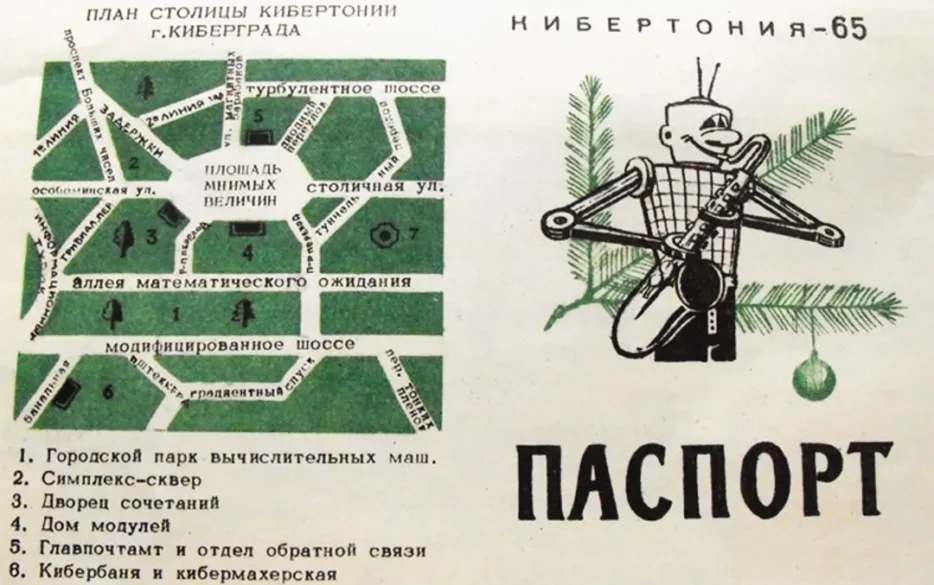
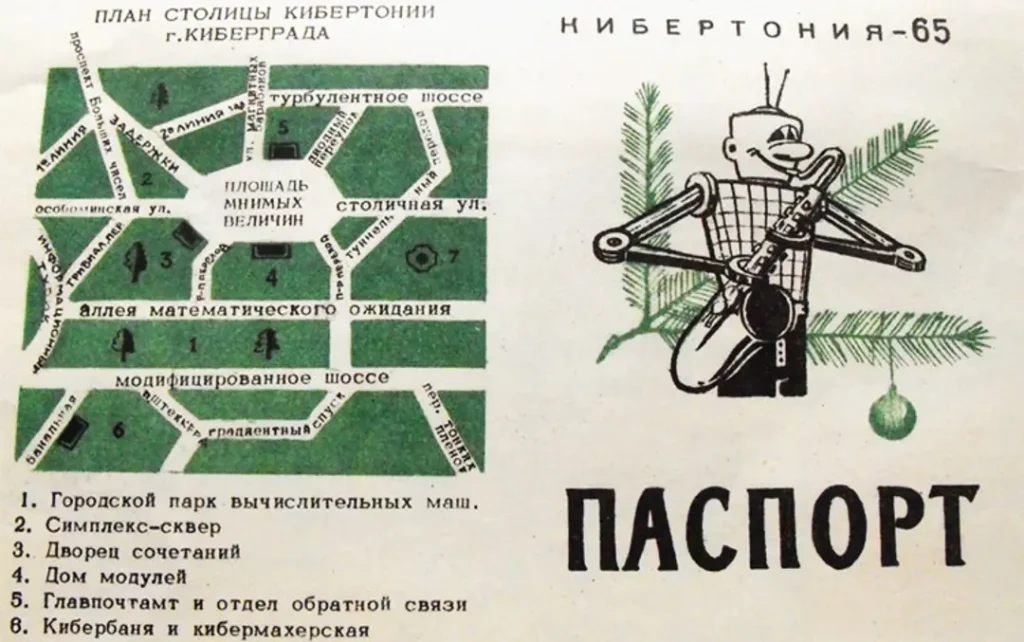
After their working hours were over, all these cyberneticians took part in a group dedicated to light comic sketches and benevolent farces, which often seemed to scorn and ignore the regime. Although it was simply a way to blow off steam, they saw themselves as a virtual country, independent of Moscow. At the New Year’s Eve party of 1960, they were baptized with the name “Cybertonia” and began to organize regular meetings, dances, banquets and conferences in Kiev and Lviv, going so far as to publish playful articles with titles such as “On the Desire to Remain Invisible, At Least in the Beginning”. Instead of invitations, fake passports, wedding invitations, newsletters, perforated cards or even a Constitution of Cybertonia circulated, full of wordplay and implications. Parodying Soviet governmental structures, they had placed a council of robots at the head of Cybertonia, and as the supreme leader of the council they had placed their mascot, a robot playing jazz on a saxophone; a sample of the cultural influence that American jazz had on them.
Gloskowski did not remain unaffected. In his memoirs, he gave the title “Against the Principles,” even though he himself held the official title of vice-president of the Ukrainian Academy of Sciences. The counterculture, understood in Fred Turner’s way, as that force which can be measured and compared with other forces, has always been akin to cyberculture.
All of these, however, required money; a lot of money, especially for Glushkov’s OGAS. Something that meant they had to convince the Politburo to give it to them. For this reason, therefore, Glushkov found himself in Moscow on October 1, 1970, hoping to manage to continue the work of Cybernetics and bring the internet to the beleaguered Soviet state.
The most significant obstacle on Glushkov’s path was Vasily Garbuzov, the Minister of Finance. Garbuzov had no appetite for fast, dazzling, and optimized computer networks that would take control of the state’s economy. All he wanted were simple computers that would blink lights and play music in chicken coops to boost egg production, as he had seen during a recent visit to Minsk. This stance, of course, was not the result of any common, pragmatic logic. He wanted the funds for his own ministry. There are even rumors that, before that meeting on October 1st, he had privately approached Prime Minister Alexei Kosygin (who generally viewed attempts at economic reforms positively), threatening that if the Central Statistical Office retained control of OGAS, then he and his ministry would torpedo any new reform efforts, just as he had done five years earlier with Kosygin’s then timid attempts at liberal changes.
To keep the Soviet internet alive, Glushkov needed allies powerful enough to stand up to Garbuzov. However, none of them attended that meeting. The two positions that remained vacant that day were those of the prime minister and Leonid Brezhnev, the technocrat general secretary. They were the most powerful men in the Soviet state and potential supporters of OGAS. As it turned out, they chose to be absent rather than risk the possibility of a mutiny.
Garboouzov finally managed to convince Politbiro that OGAS, with its ambitious plan to model and optimally manage the information flows of the planned economy, was not feasible at that time. The committee, although initially inclined to approve the program, ultimately decided that Garboouzov was the safer choice, and so the still highly classified OGAS was left in a state of limbo for another decade.
The forces that led to the deadlock of OGAS were of the same nature as those that eventually brought the Soviet Union to its knees: all those forms of institutional disobedience that were expressed in various informal ways. Ministers who undermined other ministers, bureaucrats stuck in their chairs, anxious factory directors, confused workers, or even self-styled reformers by name; all of them opposed OGAS because it conflicted with their institutional interests. Without state funding and oversight, the national network that was supposed to bring electronic socialism ultimately fragmented in the 1970s and 1980s into a mosaic of dozens (and eventually hundreds) of isolated local control systems, with no communication channels between them. The reason the Soviet state failed to network the country was not its rigidity or hierarchical structure, but its actual instability and the ill will of its members.
There is an irony at this point. It was in the U.S. that the first large-scale computer networks appeared, thanks to well-coordinated state funding and a collaborative research culture, at the same time that corresponding (and largely independent) efforts in the Soviet Union collapsed due to anarchic competition and institutional disputes among Soviet leaders. The first computer network was built by capitalists who behaved like cooperative socialists, and not by socialists who behaved like competing capitalists.
Looking back at the fate of the Soviet internet, we can discern some warning signs for the future of the modern internet. The so-called modern “internet” (understood as a single, global network of networks for promoting information freedom, democracy and commerce) is in serious decline. Consider how many companies and states are trying to create isolated bubbles for the experiences they offer. The ubiquitous applications function more as walled gardens than as a gateway to the public commons. Various inward-looking black holes, such as Facebook or the Chinese firewall, have begun to devour anything that refers outside them (such as the Aeon page). State leaders, such as those of France, India and Russia, are pressing for the ICANN (Internet Corporation for Assigned Names and Numbers) to be placed under international control so that they can apply their own local legislation within their own territories.1 In any case, for decades there have been hundreds of networks operated independently by various companies and states that do not belong to what we call the internet. It is certain that in the future there will not be one network but many discrete internet ecosystems.
In other words, the future will resemble the past. The 20th century is full of various national networks competing for global recognition. The Cold War drama surrounding Soviet attempts at networking (what historian Slava Gerovitch has aptly called “Soviet InterNyet”) completes the history of computer networks with what we might call the -1.0 version of the internet. The notion that there exists only one global network of networks, viewed from the perspective of all the networks that came before and those that followed, seems to be the exception rather than the rule. Given that the Cold War irony at the heart of this history (cooperating capitalists overcoming competing socialists) did not turn out to the advantage of the Soviets in the past, perhaps we should be less certain about how much better the internet will fare in the future.
Once, the anthropologist and philosopher Bruno Latour commented that the technological is the social that has become durable. By this he meant that social values are embedded within technologies. For example, Google’s PageRank algorithm is considered “democratic” as, among other factors, it takes into account links to a page. Just as politicians with the votes they receive, so pages with the most links are ranked higher. The internet appears today as a vehicle of freedom, democracy and commerce partly because it was embedded in the social imaginary precisely at the moment when Western values seemed to dominate the world after the end of the Cold War. The history of the Soviet internet reverses Latour’s aphorism: the social is the technological that has become ephemeral.
In other words, as our social values shift, so too will what we consider self-evident regarding technology. At one time, the Soviets embedded values (such as a form of governmental collectivism, state hierarchies, and planned economy) into their networks that seem foreign to us. In the same way, the values that today’s internet users ascribe to it will seem misplaced in the future. Network technologies will continue to exist and evolve, regardless of our current social perceptions, which we now consider self-evident and unquestionable, and which will be cast into the dustbin of history.
The story of Glushkov should also serve as a warning to all kinds of investors and evangelists of technological progress that changing the world requires more than just being a genius who can foresee the future or having political acumen. The environment and institutions within which one operates often constitute the critical factor. The Soviet experience shows this clearly. Likewise, a mental environment that is constantly in a state of digital frenzy and engages in all kinds of privacy violations for selfish purposes demonstrates the same. The institutional networks within which computer networks and their associated culture live and develop are of crucial importance and can take multiple forms.
At the same time that champions of networks insist on preempting a bright future, various institutional forces of a private nature, if left unchecked, will continue to rely on surveillance networks and to encroach upon our private lives. Perhaps precisely this is the stake of privacy: whether various unscrupulous organizations will be allowed to acquire sweeping power so that they can oversee our private lives, and not merely whether this or that private right is threatened by such abusive behaviors. The Soviet example comes to remind us that both the internal surveillance programs of the American NSA and Microsoft’s Cloud are parts of a broader long-term evolution throughout the 20th century that wants general secretaries to exploit information of private and public nature for their own institutional benefit.
In other words, there is no reason to take comfort in the thought that the global internet was initially born thanks to some collaborating capitalists and not thanks to competing socialists. The history of the Soviet internet serves as a reminder that there is no guarantee for all of us, the users of today’s internet, that the private interests that besiege it will show better conduct than those forces whose unwillingness to cooperate brought down not only Soviet electronic socialism, but threatens to do the same to our own networked age.
translation – rendering:
Separatrix