explosion of illusions > “Can we now describe what education will be like in a few years?... Is it utopian to describe a virtual reality?” experts observe. “Our bewilderment in the face of developments in education is explained by the fact that knowledge acquisition in the coming years will mainly occur through virtual reality…” According to recent research data (National Training Laboratory, USA), knowledge acquired through a lecture or speech will be retained at only 5%, through reading at 10%, while through virtual reality—with a dramatic increase—it reaches 75%. Just as we now consider it obvious for a company to have a website, in the Metaverse, that page will be replaced by a three-dimensional representation. In this way, just as someone can enter a store and shop or a stadium to watch a game, students in a classroom, with the help of their teacher, will be able to visit a museum or an archaeological site and explore its exhibits. From this example, it becomes clear how much the teaching of History and Geography can change, or what possibilities exist for experiential learning even in subjects such as Literature, Mathematics, or Physics…”
This is what the mainstream newspaper Kathimerini wrote, among other things, in a full-page feature titled “Virtual Reality in Education” on December 9, 2022. (It is clear that the term cyborg is buried: with this content, it persists only on paper, hence within that marginal 10% “knowledge acquisition through reading.”)
However, no matter how obvious and trivial the concept of “virtual reality” may seem, it is a contradiction in terms, with a dangerously deceptive goal. Until just two decades ago—or perhaps even less—the word “virtual” meant false, not real. For example: “virtual dismissal,” “virtual execution”... Only thanks to the evolution of digital representation technologies (such as holograms or special glasses) did “virtuality” become an adjective of reality, to the point of eroding and replacing it. In the world where “virtual reality” has been imposed, only the virtual will be real—representations. And these representations will have owners, controllers (and behaviorists who shape them).
Before this restructuring is completed—and for it to be feasible, as one might have said years ago about the (technical) becoming of simulation—it is necessary for other things to happen, things that have already happened or are still happening, preparing the ground. The acceptance of the existence of reality used to be official—and even liberating. If different opinions, different thoughts on the same subject, are worth exchanging, checking, developing arguments and counterarguments, and—most importantly—being judged, it is only because all parties tacitly but firmly agree that there is Truth, that there is Reality; and consequently, that its investigation is worth the creative effort of thinking.
This official, initially abstract but deeply significant mutual acknowledgment that “ultimately, there is one reality” has sunk ever deeper into the abyss in recent decades of “mature postmodernism.” There is no reality, says the current “truth” (?); there are only realities—opposing, contradictory, yet self-contained and equally valid... There is no truth, no lie; there is only the one who directs the “exchange” of opinions. That is, power—and more specifically, capitalist power.
This situation is called “tribalism” by sociologists. Originally from “tribe,” it now refers, under contemporary metropolitan conditions, to the privatization of reality within larger or smaller social, political, and ideological (usually fluid...) groups. In tribalism, there are no different opinions that must be tested against each other until one reveals the truth about issue A or B. Instead, there are now different realities, in power relations with one another, competing over which will prevail by destroying the others. It is only logical that the strongest and victorious “reality” can be virtual—as long as it has sufficient power (of money or violence).
The incoming mass “virtual reality,” whether still called “education” or exerting its educational force everywhere, is an education in virtuality. An education in illusions.
Ask yourself: who benefits (and therefore promotes) this kind of education? Obviously, the merchants of illusions. For them, the “experience” (of illusions...) is a central tool of power—now more than ever. How else?
Ziggy Stardust
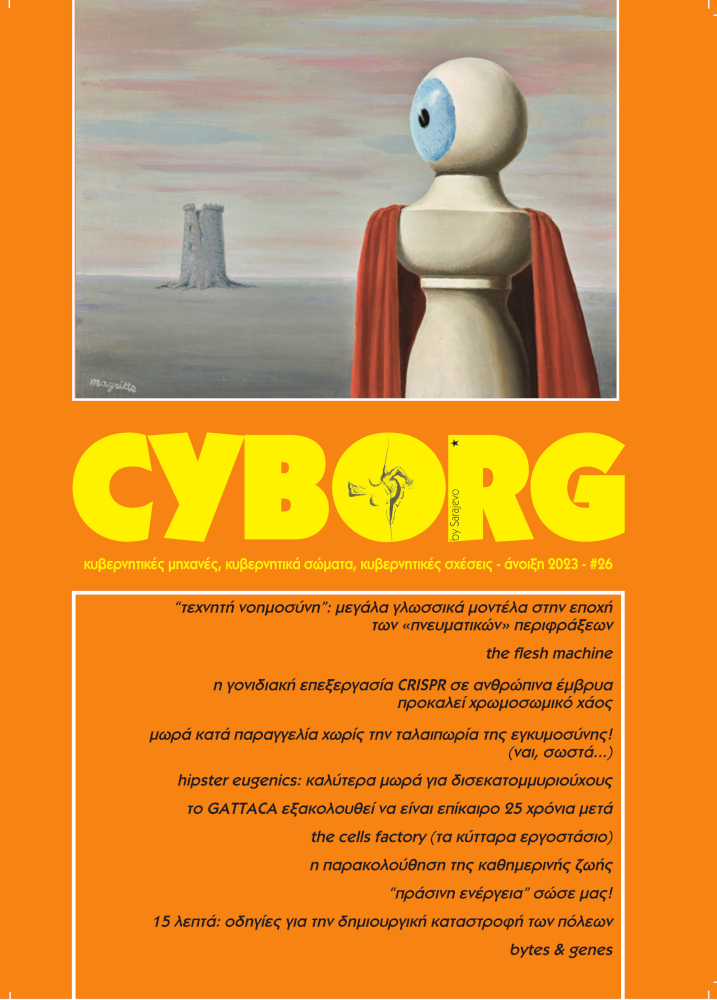
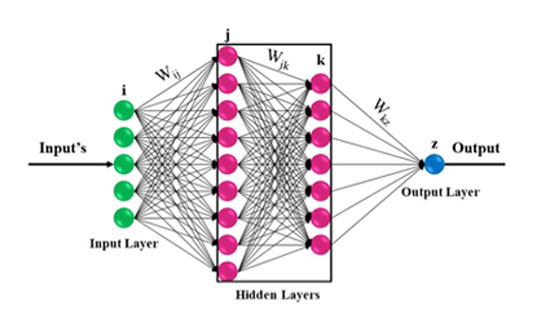
“artificial intelligence”: large language models in the age of “intellectual” enclosures

the flesh machine

CRISPR gene editing in human embryos causes chromosomal chaos

babies on demand without the hassle of pregnancy! (yes, that’s right…)
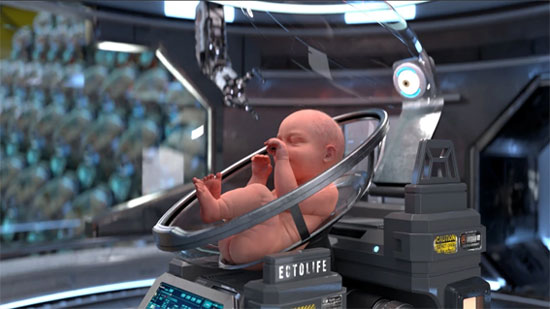
hipster eugenics: better babies for billionaires

GATTACA remains relevant 25 years later
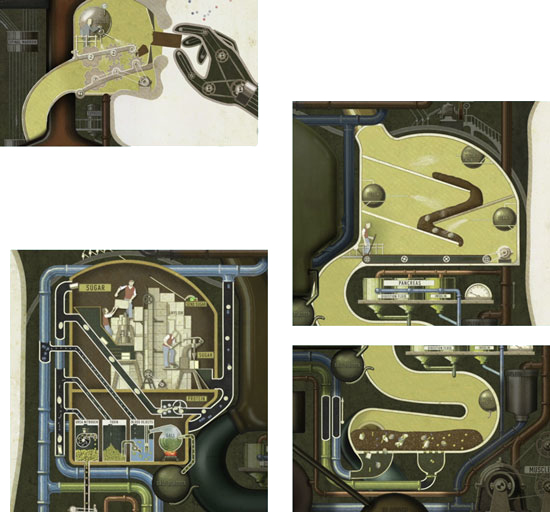
the cells factory

the monitoring of daily life

“green energy” save us!