
The following article was published on October 13, 2023, in the Chinese Social Sciences review, signed by Zhang Shuqin (associate professor at the School of Sociology and Psychology at the Central University of Finance and Economics) and Song Qingyu (postdoctoral candidate at the School of Public Administration at Hosei University).
The two authors acknowledge certain consequences of generalized datopification (in Chinese society); however, they consider them a positive development. The only thing they regard as potentially negative is the prospect that people will stop relating to one another in the (old…) natural way.
It is interesting for cyborgs (we assume also for those who read these pages) that what these two Chinese academics consider “potentially negative,” something we will call generalized dualanthropy (with the prospect of becoming misanthropy…), is (for them) an “evil” among many “goods”… at least so far…
We found it interesting to translate it (from English) and publish it, precisely because it expresses the opposite of our own approach…
(The spelling is from the original).
In recent years, the concept of digital society has become the fundamental backdrop for researchers to conduct their studies and also radically transforms the interpersonal dynamics between individuals. The focus of research has shifted from the question of whether digital technologies will be used to determining which technologies are most suitable for specific scenarios. People now largely rely on e-commerce platforms for their daily economic activities, and their interactions with government often take place through governmental applications. As a result, the majority of interpersonal relationships are created and maintained through messaging apps and social networking platforms. The increasing volume of social interactions facilitated by technology has led to a social dynamic that can be encoded by computer systems.
Encoding of social relations
The encoding of social relationships involves the digital recreation or representation of specific elements of social interactions. This process transforms the contextual dynamics of social relationships into a phenomenon of technological-social integration. While these platforms continue to incorporate the fundamental principles of human social dynamics, such as creating connections by clicking “follow” or cultivating a broad network of friends like a “social butterfly,” they also encode the fundamental logic behind these actions. For example, to see another person’s activities, you must click “follow,” and participation in real-time communication requires confirmation of a friend request from the recipient. Additionally, adherence to the rules of the social platform is crucial for gaining visibility generated by the platform.
To understand the problematic aspects of the “coding” of social relations, it is important to take into account two basic characteristics.
To begin with, the regulation of technology and the restructuring of social relations have become the norm. The 51st Statistical Report on the Development of the Internet in China, published by the China Internet Network Information Center, reveals that Chinese internet users spend an average of 26.7 hours per week on online activities, equivalent to nearly 4 hours per day. When taking into account the standard 8 hours for work and 8 hours for sleep, it becomes evident that a significant portion of people’s free time is spent on the internet. This highlights the deep integration of technology and the digital expansion of social relations. Therefore, discussions regarding future forms of social relations should gradually shift from debating the presence or absence of digital technology to examining the specific types of digital technology involved. This will allow for a deeper analysis of the methods and directions that digital technology follows in encoding social relations.
Secondly, the recognition of encoded social relations by social entities is a prerequisite for analysis. Whether a social relation has been encoded is not based on whether it can be converted into code on a digital platform, but rather on whether the encoded relation actually functions among multiple entities. For example, some local authorities attempt to implement digital governance in rural areas by creating a “digital twin” of daily practices through digital technology. However, if the village residents have no intention of using this technology in their daily lives, the digital governance system is useless.
The varying degree to which individuals accept the encoding of social relationships can also lead to deviations in interpreting research on the same types of interactive social relationships. Among the “digital natives,” direct messaging applications and social media platforms are considered an inseparable part of genuine social interactions, leading to the evolution of a complex online social etiquette. However, those who grew up before the digital era generally agree that online social activities are merely a form of virtual relationship. They tend to prefer maintaining social relationships through face-to-face interactions, emphasizing offline social etiquette over online social norms. Therefore, all encoded social relationships must be discussed within the specific context in which they occur.
Three mechanisms
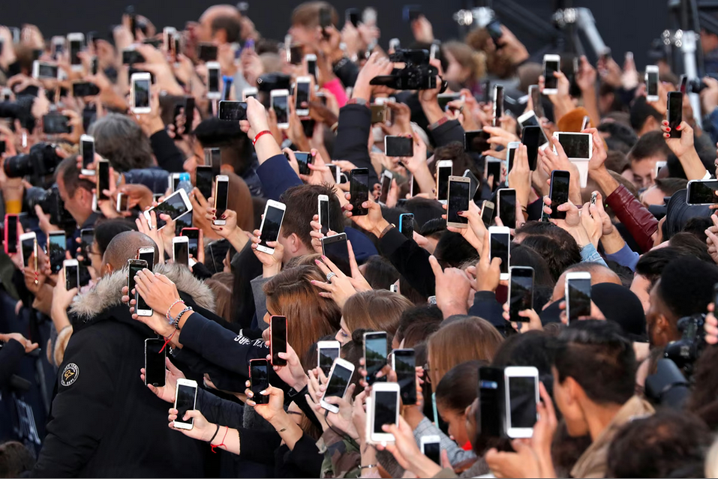
One of the consequences of coding social relations is the transformation of social relations into patterns of action that can be understood by digital technology. This raises the question of how technology extends its sphere of influence into relationships. This extension occurs through three mechanisms.
First of all, the structure used by digitization allows for easier comparison between different types of social relationships. Compared to offline social interactions, which do not leave clear traces, relationships formed on digital platforms exhibit more visible and standardized characteristics. For example, we can compare the influence of public figures by measuring their number of followers, click-through rates, retweets, and so forth. By examining the number of interactions and their frequency on direct messaging platforms, the duration of conversations, whether a contact is “pinned” at the top of someone’s chat list, and other indicators, we can measure interpersonal distance. Although each of these indicators may have certain reliability and validity issues, the structured data formed through encoding consistently provides various new indicators that support each other to some extent. This structural tendency not only measures social dynamics but also signals a social and cultural consensus, which can be used as a significant indicator for measuring social relationships and predicting how subsequent social interaction activities might evolve.
Secondly, digitization enables the rapid transmission of social interactions. On digital platforms, all social interactions and relationships can be transformed into data streams that can be transmitted, stored, analyzed, processed, and matched in an instant. Digital social relationships are no longer confined to a fixed geographical location or time, thus enabling a broader spectrum of interpersonal relationships. Specialized social interests, which were initially limited to the narrow space of local face-to-face interaction, have now formed large-scale online subcultures through the form of data. In recent years, as young people have become more diverse, dating software and websites for creating acquaintanceships have gradually become one of the main ways for young people to develop romantic relationships. This also shows that multiple value orientations require the support of algorithms to encode social relationships.
Finally, encoding embeds social relationships within a broader spectrum of scenarios. When social relationships are abstracted into specific codes, it means that relationships can be placed within wider social contexts that are also encoded. Using the promotion of public service activities as an example, when social relationships unfold primarily through instant messaging applications, the platform itself can encourage users to share information with others in their online social network. The platform can also create engaging online public service activities to keep users occupied in charitable efforts. A key prerequisite for the success of these actions is that relationships must be transferred to the digital world and, once they are in the digital world, they can easily be moved to other versions.
Virtual “social relationships”
With the development of digital technology, an increasing number of forms of relationships can be encoded, leading to another social consequence – the gradual disconnection of physical humans from social processes. In certain contexts, individuals no longer need to interact with real people to experience a “social connection.” With the advancement of artificial intelligence technology, the degree of authenticity in virtual “social relationships” has been further improved, accelerating the replacement of physical humans with artificial intelligence chatbots. This can be examined based on the following three aspects.
First of all, virtual relationships demonstrate higher levels of social affinity than the average person. The degree of socialization between individuals varies, and people can only achieve limited socialization through natural processes. With the development of Artificial Intelligence technology, the degree of socialization or social affinity offered by chat-bots trained on real interactive data on the internet can gradually surpass the social scope of real humans. When people become aware of the social risks of Artificial Intelligence, such as discrimination, adjustments are made to the programming, which will further improve the sociality of Artificial Intelligence’s digital tools. Therefore, in the near future, the existence of a virtual relationship may be more comfortable than interacting with a real person.
Secondly, virtual “social relationships” have greater potential for “socialization.” Compared to interpersonal interactions where interacting parties may forget important information, virtual “social relationships” have the ability to record more micro-level information during social interactions, such as consumer preferences, user habits, etc. By analyzing user trace data, optimizations and adjustments can be made towards the direction of social relationship interactions. Eliza, a chatbot from the 1960s, was already able to select appropriate conversation content based on prompts set by its programmers, making real people feel they were talking to an empathetic listener. In June 2022, Google’s LaMDA chat program also had the capability to extract information from a speaker’s linguistic patterns to form an interactive “conversation,” convincing engineers that the program had a soul. Regarding the processing of information from interactants, virtual “social relationships” can completely surpass real interpersonal interactions.
Third, virtual “social relationships” are more likely to create technological risks that exceed the imagination of current social perceptions. Based on the aforementioned capabilities, virtual “social relationships” can provide 24-hour uninterrupted interaction, highly personalized experiences, and rich social representations. They can also carry out a series of actions centered on the interactors. This flexibility, diversity, and power accelerate the process of shifting people’s emotional dependence from their natural human nature to virtual entities. However, how this virtual “social relationship” will profoundly affect the social forms that have revolved around natural individuals for thousands of years, and what social risks and structural changes it entails, is a question to which the current knowledge system of social sciences has not yet provided an accurate answer.
It is true that digital technology is not yet capable of creating digital humans with human warmth and logic. However, the continuous 30-year process of encoding social relationships has enabled digital technology to empower a significant portion of the population to consciously or unconsciously perceive interactions with virtual entities as real social relationships. Humans and machines have moved towards a state of “interdependence.” Questions regarding how to properly address non-real social relationships and to predict the social risks and structural changes arising from these social interactions will constitute important topics for future research.
translation Z.S.
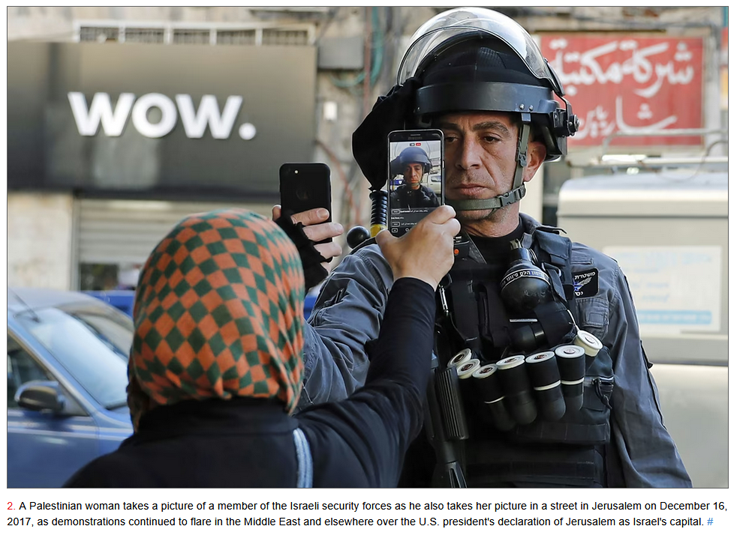
A Palestinian photographs an Israeli soldier who is also photographing her on a street in Jerusalem/al-Quds on December 16, 2016, during demonstrations against the decision of U.S. President Trump to declare the city “the capital of Israel,” violating all UN resolutions.