
It is easy to imagine a version of the human species that would not know any of the “luxuries” (or burdens) of high technology, from the humblest cars to smart phones. There are, moreover, still people alive who have memories from such “primitive” times. Less easy but certainly feasible is to imagine a life without high (or not so high) art, without theaters, opera and cinemas, perhaps even – even without music. At the limits of the imaginably feasible is also the case of “human societies” without linguistic ability. What in any case one cannot conceive is the case of humans without the most elementary of behaviors: that of gathering (which concerns all living beings, of course) and processing food. Perhaps not by chance, the first tools that the paleo-anthropological record offers us had exactly this purpose: to facilitate the capture and processing of food. The rise of technique is thus closely connected with the “humblest” of instincts, that of hunger.
Despite the importance of the techniques and technologies surrounding food and nutrition, few of the subjects of advanced capitalist formations have even the faintest idea of what these technologies actually entail. Even the producers themselves (farmers and livestock breeders, broadly speaking, including factory-scale units), within the entire production process that begins in a field and ends up on a plate, constitute merely a link, without overall oversight of the entire chain, which may include anything from chemical preservation techniques to transportation/processing technologies and high-tech financial bets on the price of rice. The division of labor and social roles has indeed progressed to such a depth that for a significant portion of the population, even cooking tends to occupy a completely marginal position in their daily lives, something like a chore that should, as much as possible, be delegated to others—the petty bourgeois always secretly dreams of having servants; if he cannot literally have such, like a proper grand bourgeois, he can at least console himself with the fact that he has delivery bringing him food and coffee to his door every day for 8 euros.
The ignorance surrounding food is further amplified by the fact that it appears on our table unproblematically, as if the times of scarcity have passed(?) at least for a large part of the western world. No matter how much there is an abundance of information about food products, from their caloric content to their biochemical composition (is my dietitian suggesting carbohydrates or proteins today?), this kind of knowledge pertains to dietary products that essentially view food as a kind of input to the “body machine.” Food, as the most fundamental use-value, continues to remain somewhat of a taboo. Unless someone comes from an agricultural or livestock family, the term that might come to mind when discussing food production is the famous “green revolution.” Until even the early 20th century, the basic technologies involved in agricultural and livestock production, in terms of composition and capacity to produce work, did not differ remarkably from those that were dominant even in medieval times.1 The emergence of the internal combustion engine (e.g., but not only, in tractors) and chemical substances (fertilizers and pesticides) during the second industrial revolution provided a strong enough push to qualitatively reshape (initially) agricultural production and to reduce the rural population to less than half of the total population.
The so-called Green Revolution, which chronologically took place in the decades following World War II, aimed to intensify the use of these technologies. The development of new, more productive varieties of rice and wheat (staple foods heavily consumed by poor populations) was another key direction. However, the revolution was not purely technological. A critical axis was also the reorganization of production management according to industrial, factory-like models, to the despair of cattle and poultry, perhaps also corn and tomatoes. At the same time, a supporting infrastructure had to be established, both in terms of funding and research. Among the various related institutes founded, perhaps the best known is the so-called CGIAR (Consultative Group on International Agricultural Research), which was created in 1971 with support from the United Nations, the World Bank, and philanthropic foundations such as the Rockefeller Foundation. Strictly speaking, CGIAR does not consist of a single institute, but in reality functions somewhat like a coordinating body for various local institutions. In any case, this combination of techniques, technologies, economic practices, and institutional initiatives is said to have resulted in an explosion of global agricultural productivity, pushing back the threat of famine for millions of people. In any event, the motivation behind establishing CGIAR was the broader post-war concern that rapid global population growth would bring the specter of food scarcity back to the foreground.2
It is therefore assumed that the Green Revolution was an undisputed success of hyper-technological capitalism. What seems odd at first glance, however, is that half a century later the very same concerns are recycled once again by experts and philanthropists alike. If, according to their estimates, the Earth’s population reaches close to 10 billion by 2050, then population growth must be accompanied by a corresponding increase in food production. In fact, the increase in food should not simply match the population growth, but is estimated to need to reach 70% in order to prevent famine phenomena. Beyond the population factor, another alarming fact is that 33% of arable land has now become unproductive. What is the reason for this impressive land degradation? Soil degradation due to erosion, intensive use of chemicals, and deforestation—practices that were applied precisely following the model of the Green Revolution. The experts’ proposal to achieve the 70% target, given also the soil degradation, should not surprise anyone. Even more innovative technologies for even more intensive production! The answer to the population (real or imaginary) challenges and the failures (within the success) of the Green Revolution is yet another revolution. In other words, almost a “permanent Green Revolution” is required so that we won’t go hungry.
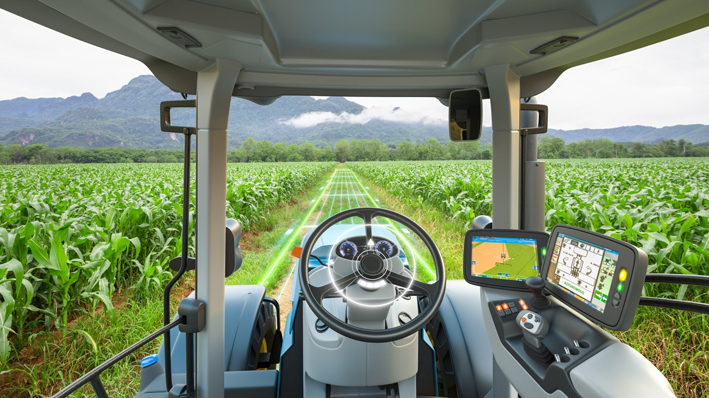
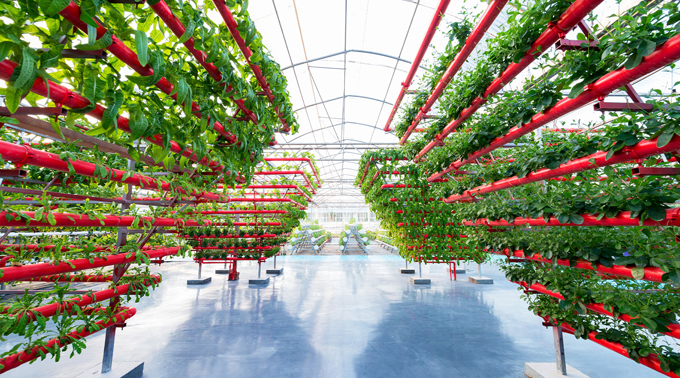
In this round, of course, the recipe does not simply call for more chemistry and more machinery. Other sectors have taken the lead: computer science and biotechnology, as would be expected.3 A widely used term in relevant circles is the so-called “precision agriculture,” obviously by analogy to precision medicine. The broader logic behind precision agriculture aims at collecting and analyzing large amounts of data from fields in order to identify with greater accuracy the ideal timing and dosage for every intervention. Satellites and drones collect images of the fields, automated tractors equipped with GPS to plow or spray autonomously and with high precision, soil sensors to measure moisture levels, pH, and whatever else might prove useful. All these (ideally) will collect data, the data will feed artificial intelligence models, and the farmer will be able to have accurate oversight of their field and its needs or even predictions regarding the harvest yield. A key objective is what we would call reducing waste (e.g., reducing water and chemical usage) in order to optimize the field’s productivity. However, that’s not the only goal. Labor shortages in agriculture repeatedly emerge as an issue in the relevant literature. Automation is proposed as one possible solution to the dilemmas faced by agro-employers.
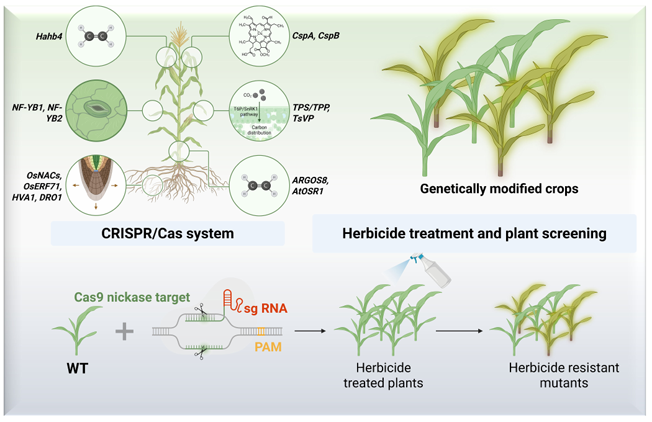
If the transformation of agriculture into a (and) digital ecosystem constitutes one arm of the new green revolution, the other is armed with new biotechnologies. Specifically, genetic engineering enthusiasts are eager to overcome any remaining legal obstacles in order to pave the way for applying genetic modification techniques to crop varieties (with CRISPR leading the charge). In this case, increasing production is at the core, achieved through developing higher-yield varieties. This can be accomplished in at least two ways. Either by achieving higher absolute nutritional surplus: increasing yields in absolute terms. Or through attaining higher relative nutritional surplus: increasing the nutritional—caloric content of a given harvest. The convergence of biotechnology and informatics is therefore at the starting line, ready to surge into fields, pastures, and grazing lands.4
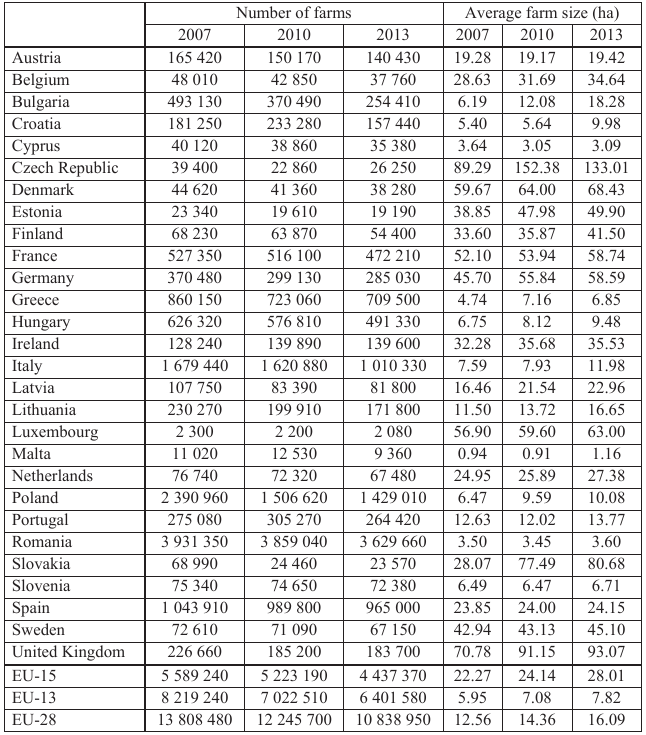
No matter how good grand visions may be (especially for those selling them), some paradoxes, however, are often difficult to ignore. It is estimated, for example, that based on current agricultural and livestock production techniques, there are approximately 2,700 calories available per person on Earth daily—a level that is more than sufficient to meet the needs of the entire global population, even if everyone were adults (excluding, of course, Western overconsumers who enjoy consuming double the calories and then go on to hunt down fat shamers).5 If today’s production level is sufficient to feed the global population and yet hundreds of millions still face acute hunger (not including the milder forms of undernourishment), how exactly will yet another green revolution solve the problem? It should have been obvious for decades that undernourishment is not a matter of absolute numbers or an absolute scarcity of food. It should also be evident that no technological “progress” or intervention on its own has the ability to magically resolve such issues. On the contrary, it may even exacerbate them. Two other figures that are somewhat—more or less—taken for granted, even by green revolutionaries, concern the share of small farmers in land ownership and total agricultural output. Both of these percentages exceed 80%. In other words, over 80% of farms are owned by small farmers, and over 80% of global food production comes from small farms! If new bio-informational technologies can primarily be adopted by large agribusiness employers, then why wouldn’t their introduction ultimately lead to the collapse of agricultural production if this 80% is pushed toward extinction?
How is it possible, however, for small farms that cover around 80% of arable land to contribute a similar percentage to the total food productivity? Shouldn’t the remaining, concentrated 20%, with high mechanization and continuous pharmaceutical interventions, provide a higher percentage of food? Wouldn’t it be more logical, for example, for this 20% of land to provide 40% of the food? Perhaps these 80% figures are numbers conjured up by some conspiracy theorists who are trying to find out who introduced gluten into foods in order to stupefy the population? These numbers, therefore, are not only accurate, but the phenomenon has also been given a specific name: it is called the “productivity paradox.” The mass production technologies of the Green Revolution do indeed yield greater harvests. Under two conditions. First, that what is measured as yield specifically concerns the variety which is the main target of production – therefore not the overall productivity of a farm. Second, that measurements and comparisons are made on relatively short-term scales.
A “small” problem with this type of agricultural production, which aims at giant monocultures, is that it leads to soil exhaustion, both in terms of its nutrients and its water reserves. On the other hand, the elimination of all other species from the field (that is, the dramatic reduction of its so-called biodiversity) makes it more vulnerable to diseases, perhaps in a similar way that raising only one species in livestock units makes them vulnerable to pathogens, if a pathogen encounters no resistance from the genetic material of that species. Obviously, such a condition creates a vicious cycle, with crops needing more pesticides than usual to survive, which in turn result in faster soil depletion. Sick and fragile plants are thus produced, which need constant “medical” care to remain standing (this reminds us of something…).
A second issue concerns the nature of large-scale cultivation itself. While small-scale farming primarily aims at food production, largely for the farmers’ own subsistence, the goal of large-scale farming is the production of… profit. What kind of “product” and how it will be produced comes second. If a variety of corn used for biofuel production, which is not suitable for consumption, has a higher price than common potatoes, then economic “rationality” forces the agro-entrepreneur to uproot his potatoes and start cultivating this corn variety. In other words, a large portion of extensive farmland may not even aim at food production. Even in cases where cultivation involves edible products, the rigid logic of concentrated units may prefer reduced productivity. The reason is again the expected profit margins. If 10 stremmata of olive groves are divided among 10 farmers, each producing 100 kilograms of olive oil, total productivity will reach one ton. If the 10 stremmata are concentrated under one owner, it is not at all necessary to achieve the same productivity levels. Mechanization may, for example, initially reduce the new owner’s need for farm workers from 10 to 7. However, labor costs may still be at such a level that, from a profit perspective, it is more advantageous for the owner to employ 4 workers. With 4 workers and his modern machinery, the new owner can achieve maximum profit by producing 700 kilograms instead of one ton. In any case, and beyond the details, it is not uncommon (within the framework of economic, capitalist logic) for a business to increase its profits by reducing the products or services it provides. Agricultural production, especially in large-scale cultivation, tends to be organized according to exactly this business logic.

Is there perhaps a chance that the new green revolution will save small farmers, as its advocates proclaim? Not at all, even if one sticks to what the advocates themselves say and not to various naysayers who have no intention of blessing whatever is “green.” An autonomous tractor currently costs around $300,000 to $500,000. The cost of digitizing a farm through soil sensor implantation can reach as high as $2,000 per 10 stremmata (approximately 1 hectare). Since 10 stremmata constitute a minimal area by today’s standards, digitizing a “typical” farm of hundreds of stremmata would require tens of thousands of dollars. Moreover, for those considering reducing their farming area by adopting vertical, hydroponic, or aeroponic farming techniques, they should know that the energy cost of such installations is 3 to 5 times greater than that of “traditional” farming. These are, of course, capital investments of such magnitude that they are beyond the means of the 80% of small farmers.
What we believe to be even more interesting lies elsewhere: in the bonds (even more intense) of dependence that will be created between farmers, on one hand, and providers of relevant technologies, on the other. A simple example follows. The various robotic harvesters proposed to be introduced, essentially replacing workers, although tireless, have specific operational specifications. For them to function smoothly, the plants must also comply with these specifications, e.g., the fruits must have a specific color easily recognized by the harvester’s machine vision. However, to ensure this, it may be necessary to genetically modify the variety of the particular plant so that it produces fruits with that specific color only. And everyone already knows well what dependence on genetically modified seeds owned by agro-biotech industries means.
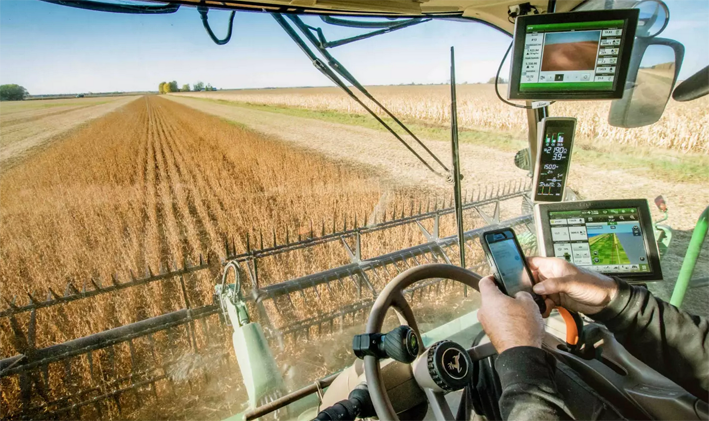
As for the purely digital aspect now, one would not naturally expect the data collected by sensors to remain in the hands of the farmer. Firstly, companies that provide such services and products prohibit their customers from opening and tampering with them in order to serve them better. They must view them as black boxes. Moreover, agro-industries such as Pioneer and Monsanto additionally require, as a condition for those who want to purchase their artificial intelligence services, to already be customers of their seeds, leading them into an even tighter embrace with them. Secondly, it is understood that farm data is transferred to central data centers owned by the companies providing artificial intelligence services and data processing. At the same time, these specific companies often require farmers – their customers – to sign liability disclaimer agreements; they themselves will bear no responsibility in case of hardware failure or poor harvest or in any other case where something goes wrong. The result is that farmers feel, as many of them already complain, that their field no longer belongs to them, that they have been transformed into employees of the companies. They do not use tools as they see fit to facilitate their work, but instead they themselves are converted into mere monitors and complements to their “tools.”
It is not, of course, inaccurate that this somewhat vague and confused feeling of discomfort among those who work with the land, both small and large, exists. However, to make the causes and sources of this feeling somewhat clearer and more specific, it would be helpful to place it within a broader and more macroscopic view of the evolution of agricultural livelihoods. Traditionally, working the land was structured on the basis of relatively small, autonomous social groups, often bound together by family ties. This era has naturally long since passed (always speaking about farmers in more capitalist-advanced formations), even though some faint remnants of such a family-based labor relationship still remain. As has already been mentioned, agricultural production tends to be organized according to the model of any other business enterprise. This entails at least two things: on the one hand, the ever-increasing mechanization of the productive process; on the other hand, dependence on financial borrowing mechanisms.
This commercialization of (never before) “farming” is not without consequences. On the contrary, it turns it into a crossroads of an entire array of pressure vectors. A first consequence has to do with the introduction of economies of scale logic into agricultural production.6 Dependence on machinery and capital (to express it somewhat simplistically) often results in the rise of so-called variable costs (the expenses that vary as production volume increases) as a percentage of total expenses. Additional labor hours must(?) be paid as overtime, additional kilowatt-hours cost more as consumption increases, loan interest rates that must be repaid inflate. The end result is that the profit margin per unit of product also decreases. This deadlock can be broken in various ways. One is simply for the agro-producer to refuse to increase production, especially if the marginal cost (cost of one unit of product) exceeds the expected profit (we have already referred to this). Another way out is the “flight to heaven,” that is, the adoption of economies of scale so that production increases in absolute numbers and thus, multiplied by a relatively small profit margin, leaves a satisfactory absolute profit. A third option is the shift to other, more profitable varieties, even if they have no nutritional value (and we have referred to this). Finally, there is always the possibility for capital to completely withdraw from agricultural production to move to greener pastures (metaphorically speaking) of profitability. In this way, agricultural production becomes a seismograph of broader economic developments and upheavals. The same applies to those who make a living from it.
At the same time, the links in the chain connecting food production to its final consumption have multiplied. If at some point the farmer constituted the zero point of this chain, the first link in it, now it has shifted closer to the middle of it. Before him, and as a prerequisite for his existence, come the companies that provide him with (highly specialized) mechanical equipment, those that provide him with fertilizers, pesticides and seeds, and of course credit institutions as sources of borrowing. After him in the chain follow processing, manufacturing and storage companies, transportation and handling companies, and of course all kinds of wholesalers and retailers, from local markets and greengrocers to supermarkets. Such a condition has the potential to function as an economic burden for farmers, given the particularities of agricultural production. For the majority of today’s western subjects, who are accustomed to working with neatly organized Excel sheets, moving on streets that always have some name, and simply opening the refrigerator whenever they get hungry, it may seem inconceivable, but it is reality. Agricultural production is characterized by a high degree of randomness. It is never certain that X units of product will be produced within one day.
When now an inherently unpredictable branch of agriculture is exposed to market logic, the market cannot naturally tolerate such whims. If control over agricultural production itself is not always possible, it is nevertheless possible to control the farmers, workers, and economic cycles around it, e.g., through cost-shifting, assigning to the production link the role of absorber and buffer. At the same time, despite the “progress” of mechanization, the production link still bears more intensely the “stamp” of labor. It remains labor-intensive. Labor intensity varies, peaking typically during harvest periods, but always high. When adjacent links in the chain (especially certain crucial ones, such as seed companies) organize themselves into high-technology units with organic capital composition and thus with smaller margins for surplus value extraction, then the way for them to maintain or even increase their profits is by setting up a reverse, quasi-vampiric flow of profits from the production link to themselves.7 The result, naturally, is the creation of yet another pressure piston directed at production, through increasingly brutal methods of surplus value extraction.8 9 In other words, the production link becomes something like a punching bag upon which the rest, clinging to it like leeches, can unleash their frustrations, uncertainties, and profit expectations.
If the aforementioned approach holds true even in broad terms, then the other side of the precision agriculture coin reads “tailoring agriculture.” The advent of biotechnologies and artificial intelligence technologies in the fields has more specific objectives. Following the mechanization of agriculture, the declared goal of the current digitization efforts is to reduce their degree of “ambiguity,” to make them more predictable and manageable. Not only the fields themselves, of course, but also those who work with and in them. If for this purpose it becomes necessary for crops to become aeroponic to摆脱 the now bothersome soil and to be standardized within closed, climate-controlled environments, so much the better. Nature, not only in its wildest forms, but now also in its more domesticated (i.e., cultivated) aspects, will become a museum piece and an opportunity for school trips so children can see how the leftovers of the 20th century used to produce their calories.
Customization without supervision, however, is not conceivable. If the direct subordination of (small and large) farmers to the dictates of an employer and a production line is not feasible – partly due to existing, objective geographical constraints – it is still possible to achieve a decentralized “unification” through their gradual deskilling. The recipe is time-tested. The new element this time is that the walls of the “agricultural factory” appear invisible, because they are digital. Much as they don’t see them, farmers sense these walls closing in; perhaps soon to cast themselves out.
Separatrix
- More specifically for Greece, this “medieval” (the term is used without any derogatory intent) period extended throughout the first half of the 20th century. ↩︎
- Of course, it is understood that branches of the Gates foundations (see Gates Ag One) have set their sights on CGIAR, providing funding generously. For now, the relationship appears to be primarily financial. ↩︎
- For example, see the recent Chen X (2025) The role of modern agricultural technologies in improving agricultural productivity and land use efficiency. Front. Plant Sci. 16:1675657 ↩︎
- We are eagerly awaiting the moment when automatic tractors will storm the military airport of Eleusis for pesticide spraying, dousing the parked C-130s with chemicals, declared by the pandemic Greek spirit as olive trees. ↩︎
- One issue here is that not all of these calories have high nutritional value. A lot of waste is also produced, so that many people can drown their sorrows in it. ↩︎
- See the relevant analyses of the Dutch sociologist Jan Douwe van der Ploeg, e.g., his article The Food Crisis, Industrialized Farming and the Imperial Regime (2010). ↩︎
- We have repeatedly referred to this mechanism through the pages of Cyborg. See the analyses of Caffentzis, especially “Why Machines Cannot Create Value,” published by the 21st Century Spy Club. ↩︎
- In Greece, which is traditionally considered a labor-intensive economy, such methods are well-established throughout the country. ↩︎
- Some analyses go as far as to speak about so-called food empires, that is, entire networks that are set up around agricultural production in order to exploit it. They consider that a large part of the profit that is extracted in the agricultural sector is due to unorthodox (from a rational, capitalist point of view) methods. Instead of organizing production rationally, they position themselves peripherally to it and extract profits through rents, patents, data collection and exploitation, and other such parasitic practices. See again van der Ploeg. ↩︎